
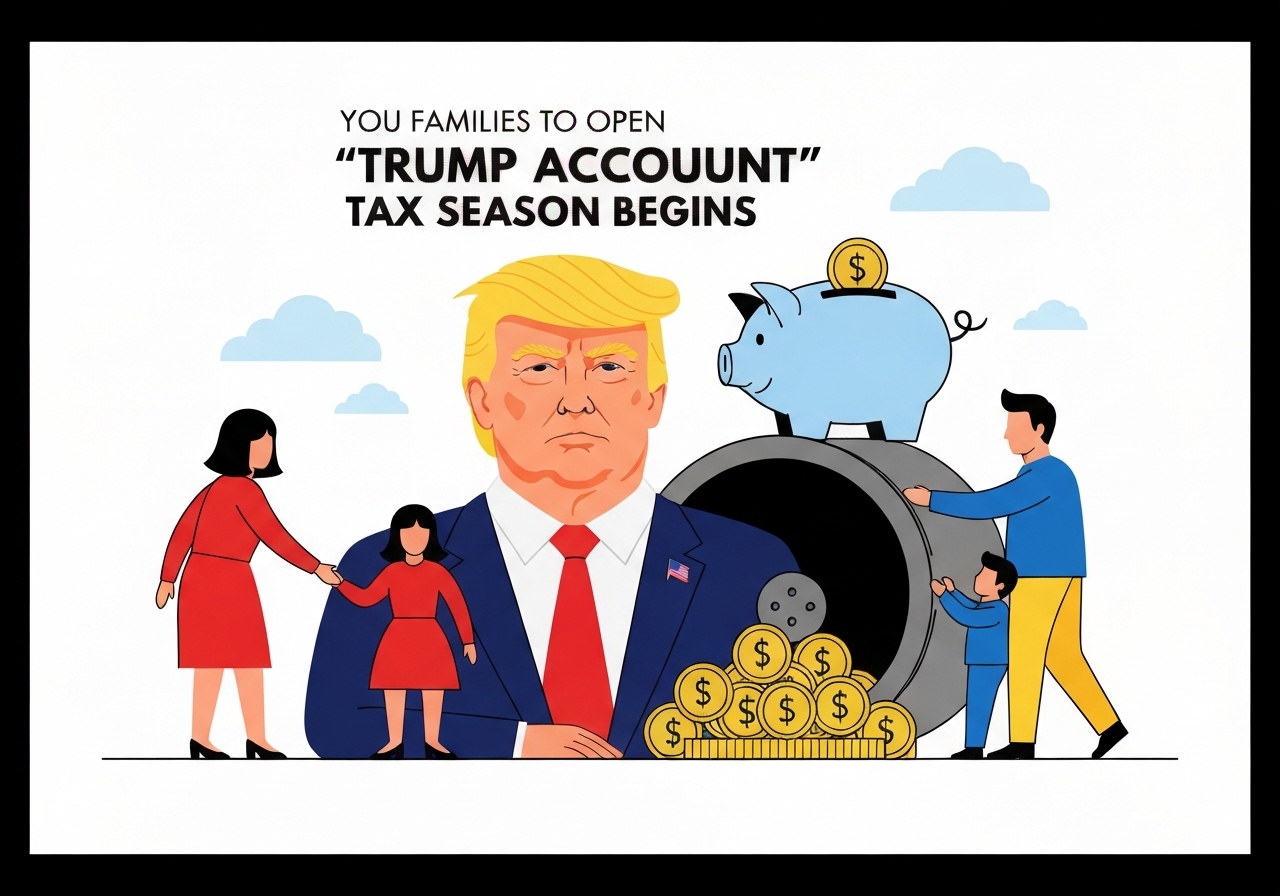
Lead: President Donald Trump will join Treasury Secretary Scott Bessent, business leaders and investors at a Washington, D.C., summit this week to encourage parents to open so-called “Trump Accounts” as 2025 tax filing season gets under way. Under legislation signed by Mr. Trump, the federal government will deposit $1,000 for every child born between 2025 and 2028; the administration says contributions from employers and companies will be announced alongside the push. The accounts are set to accept deposits beginning July 4, 2026, and the White House projects that a $1,000 seed could grow substantially by a child’s 18th birthday.
Key takeaways
- The federal program deposits $1,000 for each baby born between 2025 and 2028, with contributions starting July 4, 2026.
- Families filing 2025 returns must elect a Trump Account on IRS Form 4547 to receive the federal seed deposit.
- Families may contribute up to $5,000 per year; employers may contribute up to $2,500 per employee per year.
- The administration projects a $1,000 2026 seed invested in a market-tracking fund would be about $5,800 by age 18.
- A family contributing the $5,000 annual maximum is projected to see an account of roughly $303,800 at age 18 under the administration’s assumptions.
- Major companies — including Charles Schwab, Robinhood, SoFi, Uber, Charter Communications and BNY — have pledged initial matches or support, with additional commitments expected.
- Dell and his wife announced a $6.25 billion program to seed savings with $250 deposits for eligible children in lower‑median ZIP codes, covering up to 25 million kids.
Background
The ‘Trump Account’ initiative stems from tax and spending legislation enacted by the administration aimed at encouraging early savings and wealth accumulation for children born in a four‑year window. The policy builds on a growing policy trend in the U.S. toward automatic or seeded children’s savings accounts designed to expand asset ownership and reduce intergenerational inequality. Proponents say a universal seed plus voluntary top‑ups can jump‑start long‑term savings and help with future costs such as higher education or homebuying.
The rollout arrives amid broader economic anxiety: a New York Times/Siena poll published this month found 65% of registered voters think a middle‑class lifestyle is “out of reach for most people,” and 58% disapprove of Mr. Trump’s handling of the economy. The political timing — a high‑profile summit in Washington and a presidential visit to Iowa the day before the push — signals the administration’s intent to highlight this program as part of its broader affordability agenda ahead of the 2026 midyear milestones.
Main event
The summit in Washington convenes Treasury Secretary Scott Bessent, Republican Sen. Ted Cruz, investor Kevin O’Leary, corporate chiefs including Dell’s Michael Dell and SoFi’s Anthony Noto, and several entertainers and public figures. A Treasury official told ABC News that additional corporate matches and contributions will be announced throughout the day, and the president will urge parents to make the election when filing their 2025 tax returns. The event is billed as a daylong push to enroll families and secure private‑sector backing.
To activate a Trump Account and receive the federal seed, families must elect the account on IRS Form 4547 as part of their 2025 tax filing. Once open, the accounts must be invested in a fund that tracks the broader stock market, according to administration guidance; withdrawals are prohibited until the beneficiary turns 18. Employers can make contributions up to $2,500 annually per employee and families can add up to $5,000 per year themselves.
Several major employers have publicly pledged matching or complementary programs. The administration highlighted commitments from Charles Schwab, Robinhood, SoFi, Uber, Charter Communications and BNY as examples; Treasury indicated more corporate partners could be announced. Separately, Michael Dell and his wife, Susan, said late last year they will commit $6.25 billion to seed accounts with $250 deposits for eligible children living in ZIP codes where median income is below $150,000, covering up to 25 million kids.
Analysis & implications
Financially, seeded children’s accounts can increase long‑term asset accumulation for lower‑ and middle‑income families by leveraging compound returns over 18 years. The administration’s projections—a $1,000 seed becoming roughly $5,800 by age 18 and a maximum‑contribution scenario reaching about $303,800—assume historical average market returns and steady contributions; actual outcomes will vary with market performance. That sensitivity to market fluctuations means families relying on projections should understand both upside potential and downside risk.
Politically, the program gives the administration a tangible benefit to showcase ahead of the summer milestone and may help shift debates about affordability toward asset‑building solutions rather than short‑term cash assistance. Employer matches and large philanthropic commitments broaden the base of support and reduce upfront fiscal pressure on the federal budget, but they also raise questions about equitable access if employer participation concentrates benefits among certain workers.
Distributional concerns are central. Critics may point out that families without access to employer matches or financial literacy supports could fall behind, while wealthier households who can contribute the $5,000 annual maximum will see far larger absolute gains. Implementation choices — enrollment procedures, default investment options, outreach to underserved communities and rules for ZIP‑code eligibility in private pledges — will shape whether the program narrows or widens existing gaps in child wealth.
Comparison & data
| Program | Initial contribution | Projected value at 18 (admin. estimate) |
|---|---|---|
| Federal seed (one‑time) | $1,000 | $5,800 |
| Family contributes $5,000/yr | $5,000 annual | $303,800 |
| Dell family program (per child) | $250 | Not projected (seed deposit) |
The table summarizes the administration’s headline projections and announced private commitments. These figures are sensitive to the assumed rate of return: smaller changes in average annual returns compound substantially over 18 years. Policymakers and families should note the projections are illustrative, not guaranteed outcomes.
Reactions & quotes
“Additional pledges will be announced throughout the day, including company matches and contributions,”
Treasury Department official, as reported by ABC News (U.S. media)
“The initiative is designed to seed savings for children born between 2025 and 2028 and to encourage long‑term asset accumulation,”
Administration statement (official briefing)
“Dell and his wife said their $6.25 billion donation will deposit $250 for eligible children,”
Dell family announcement (private philanthropy)
These statements reflect organizer and participant messaging at the summit and related announcements. They do not encompass independent evaluations of the program’s long‑term effects.
Unconfirmed
- The precise list and dollar amounts of additional corporate matches to be announced remain unconfirmed until companies make formal disclosures.
- Attendance by some named entertainers and public figures was described as expected by an official; final guest lists and statements may change.
- Long‑term investment returns used in administration projections are estimates based on historical averages and are not guaranteed.
Bottom line
The Trump Account push combines a modest universal seed with voluntary family and employer contributions and private philanthropy to promote early savings. If broadly adopted and paired with outreach to under‑served communities, the program could boost long‑term asset accumulation for many children; however, outcomes will depend heavily on market returns, employer participation and implementation details.
For families considering participation, the immediate action is administrative: make the election on IRS Form 4547 when filing 2025 returns to receive the federal seed. Policymakers and advocates should focus now on ensuring broad access, transparent disclosures about investment assumptions and supports for families less likely to benefit from employer matches or financial education.
Sources
- ABC News (U.S. news media reporting on administration event and Treasury official comments)
- U.S. Department of the Treasury (official agency site; policy details and official statements)