
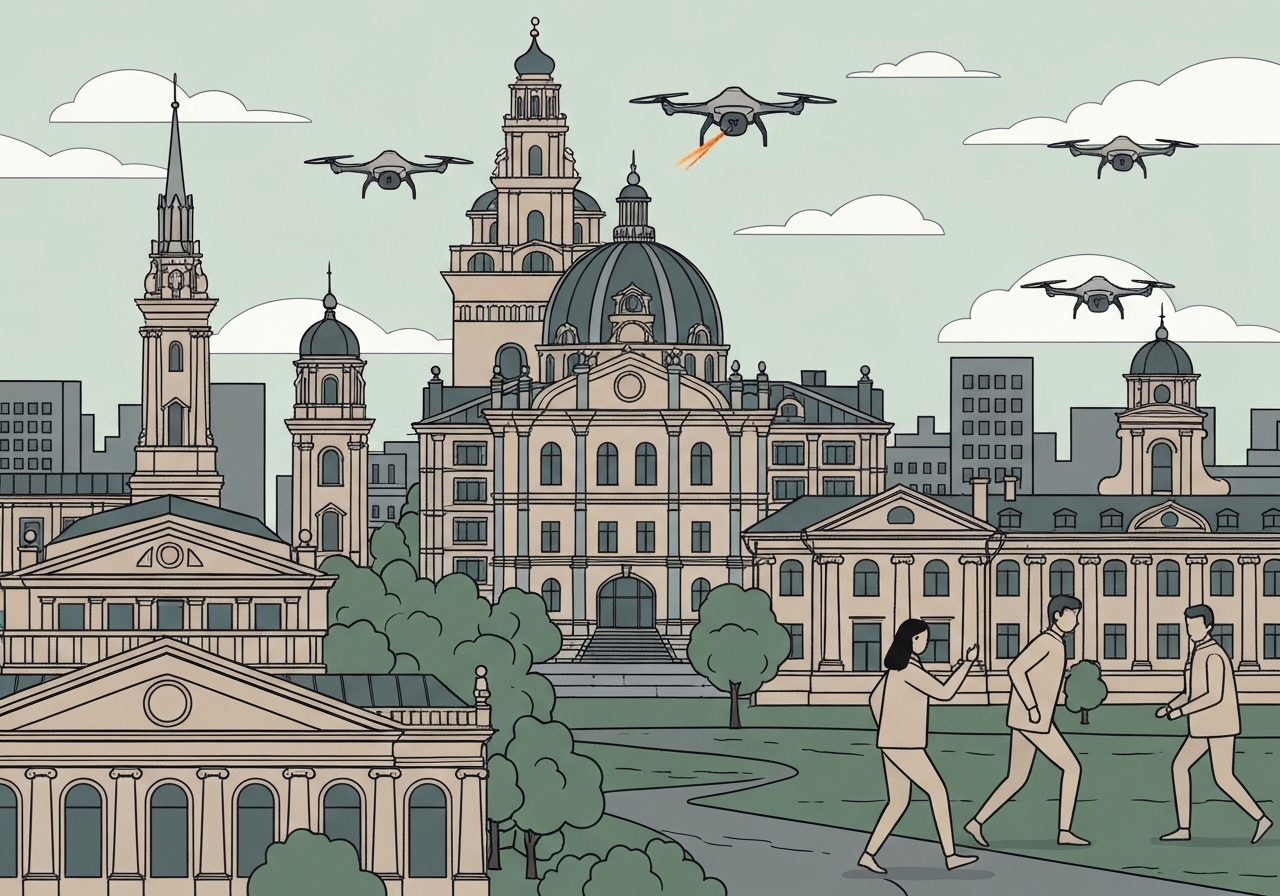
In Kherson, southern Ukraine, daily life has been reshaped by the constant threat of small Russian quadcopter drones that can reach the city from positions across the Dnipro River. On Jan. 28, 2026, residents still in the city describe a routine of checking crowdsourced chat groups and fitting anti-drone netting into the worn fabric of everyday movement. Parents like Tanya Leshchenko, 36, who bundled her 5-year-old daughter into a purple winter coat before they stepped outdoors, say the sky now dictates whether people leave their homes. The risk is not theoretical: inexpensive, widely available drones have made open streets hazardous and driven many civic activities underground.
Key Takeaways
- The city of Kherson lies within range of cheap Russian quadcopter drones launched from territory Russia controls across the Dnipro River; attacks are recurring as of Jan. 28, 2026.
- Crowdsourced chat groups provide real-time warnings; one alert last fall read simply, “I hear a drone!” and many residents rely on these signals before stepping outside.
- Much of Kherson’s prewar population has fled; those who remain report restricting movement, schooling and commerce to sheltered spaces.
- The city is experimenting with layered defenses, including anti-drone netting deployed over thoroughfares spanning dozens of miles to catch drones before they reach targets.
- Parents and carers report heightened anxiety and altered routines: pickup and transit now include checking online warnings and choosing routes based on perceived exposure.
- Local infrastructure and everyday commerce operate under unpredictable interruption, with public transport and outdoor markets frequently disrupted by aerial alarm reports.
Background
Kherson, a regional city on the Dnipro River, came under Russian occupation early in the full-scale invasion and has since been within artillery and aerial reach of forces positioned on the river’s opposite bank. The rise in low-cost quadcopter attacks mirrors a broader trend in the conflict: readily available commercial drones repurposed for strikes, surveillance and psychological pressure. These small aerial systems are inexpensive to procure and launch, enabling persistent harassment even without large-scale conventional capabilities.
The psychological and civic effects in Kherson follow patterns seen elsewhere in Ukraine and in other conflicts where drones lower the barrier to attack. Public life — schooling, markets, street transit — has been pushed into basements, covered corridors and online groups that share alerts and coordinate safe movement. Municipal authorities and volunteers have prioritized ad hoc countermeasures, from physical netting over major roads to localized air-raid protocols adapted to an airborne, mobile threat.
Main Event
On a recent afternoon of routine pickup at a day care, Ms. Leshchenko and other parents gathered inside a hallway before checking a local chat for drone warnings. The group exchange, crowdsourced and instantaneous, has become an informal early-warning network in the absence of consistently reliable official systems. When the sky was reportedly clear, parents moved toward the bus stop; elsewhere in the city, an alert can halt movement and send people back indoors.
Officials and volunteers in Kherson have rolled out a patchwork of defenses. Crews install anti-drone netting over main thoroughfares—coverage described in local reporting as spanning dozens of miles—intended to disrupt or capture incoming quadcopters before they reach vulnerable targets. Maintenance of these nets and their removal for seasonal leaf clearing were observed by local workers, underscoring the logistical burden of sustained civil-defense measures.
The strategic geometry of the Dnipro River matters: Russian forces positioned on the far bank can launch small drones that cross to urban areas without exposing larger platforms. That geographic convenience makes Kherson particularly vulnerable, since launch points are relatively close and repeatable. Residents and local responders say the pattern of buzzing alerts — intermittent but ever-present — has changed how errands, schooling and work are scheduled.
At the same time, the city’s reduced population means that many public services are operating at limited capacity. Evacuations since the onset of hostilities have left buildings half-empty and essential workers stretched. The remaining communities have developed informal norms—alarm chats, shared routes, and time windows judged safer—for moving through exposed spaces.
Analysis & Implications
The weaponization of cheap consumer drones shifts both the tactical and humanitarian calculus of modern urban warfare. Tactically, quadcopters enable persistent, low-cost pressure on civilian areas without requiring large, vulnerable assets. For defenders, the options are constrained: kinetic intercepts, electronic jamming and physical barriers all carry trade-offs in cost, coverage and collateral effects.
Humanitarian implications are acute. Recurrent aerial threats that are hard to predict degrade normal life and amplify displacement. In Kherson, a steady fear of the open sky discourages outdoor commerce, limits schooling and burdens mental health. Those who remain face a continuum of risk that changes the cost-benefit balance of staying versus leaving, and that can fracture local economies over time.
On a strategic level, the diffusion of drone technology means other cities near contested front lines could face similar pressures. If inexpensive drones continue to be used for harassment or directed strikes, urban centers across conflict zones could see a multiplication of low-intensity but high-impact threats that degrade civic resilience over months and years. That may prompt broader investments in counter-drone systems, but also a rise in improvisational civilian defenses that are never a full substitute for protective governance.
Comparison & Data
| Threat / Measure | Characteristic |
|---|---|
| Drone type | Low-cost commercial quadcopters repurposed for strikes |
| Launch posture | From positions across the Dnipro River under Russian control |
| Local defenses | Dozens of miles of anti-drone netting, local alert chats, ad hoc jamming/response |
The table summarizes readily observable elements reported from Kherson: the widespread use of commercial quadcopters, the geographical advantage afforded by hold on the opposite Dnipro bank, and locally deployed countermeasures such as extensive netting. These measures illustrate both the ingenuity and the limitations of civilian and municipal responses when formal air defenses are limited or prioritized elsewhere.
Reactions & Quotes
Residents and local participants have expressed alarm and adapted behaviors; two representative, directly observed reactions follow.
You cannot outrun a drone. It’s scary.
Tanya Leshchenko, Kherson resident (age 36)
Ms. Leshchenko’s remark came as she described checking a chat group and preparing her 5-year-old daughter for the short walk to a bus stop. The remark encapsulates a common sentiment among remaining residents about the unpredictability and speed of small aerial threats.
I hear a drone!
Local crowdsourced alert (chat group)
Simple, rapid messages like this one are circulated by volunteers and neighbors to warn those outside or in exposed areas. These alerts function as an informal, community-run early-warning layer that many residents now treat as indispensable.
Unconfirmed
- The exact daily rate of drone incursions and the total number of drones used in strikes against Kherson are not independently verified in available reporting.
- The measured effectiveness rate of anti-drone netting across the city (percentage of drones intercepted) remains unreported and thus unconfirmed.
- Comprehensive casualty or damage figures directly attributable to quadcopter strikes in Kherson since 2024 are not fully compiled in public sources cited here.
Bottom Line
Kherson’s experience illustrates how inexpensive aerial systems can transform everyday life in contested urban areas: persistent drone threats impose a constant, low-level risk that forces behavioral change, undermines local economies, and burdens civil defense resources. Community-run alert systems and improvised physical measures demonstrate local resilience, but they also highlight gaps in formal protection that leave civilians dependent on ad hoc solutions.
Looking ahead, similar tactics could appear wherever front lines sit close to population centers and where drones are easily obtainable. Policymakers and urban planners should account for the multi-year persistence of such threats, prioritize civilian protection measures that minimize disruption, and document outcomes to inform more effective, scalable counter-drone strategies.
Sources
- The New York Times — news outlet reporting and on-the-ground interviews (primary reporting referenced)