
Lead
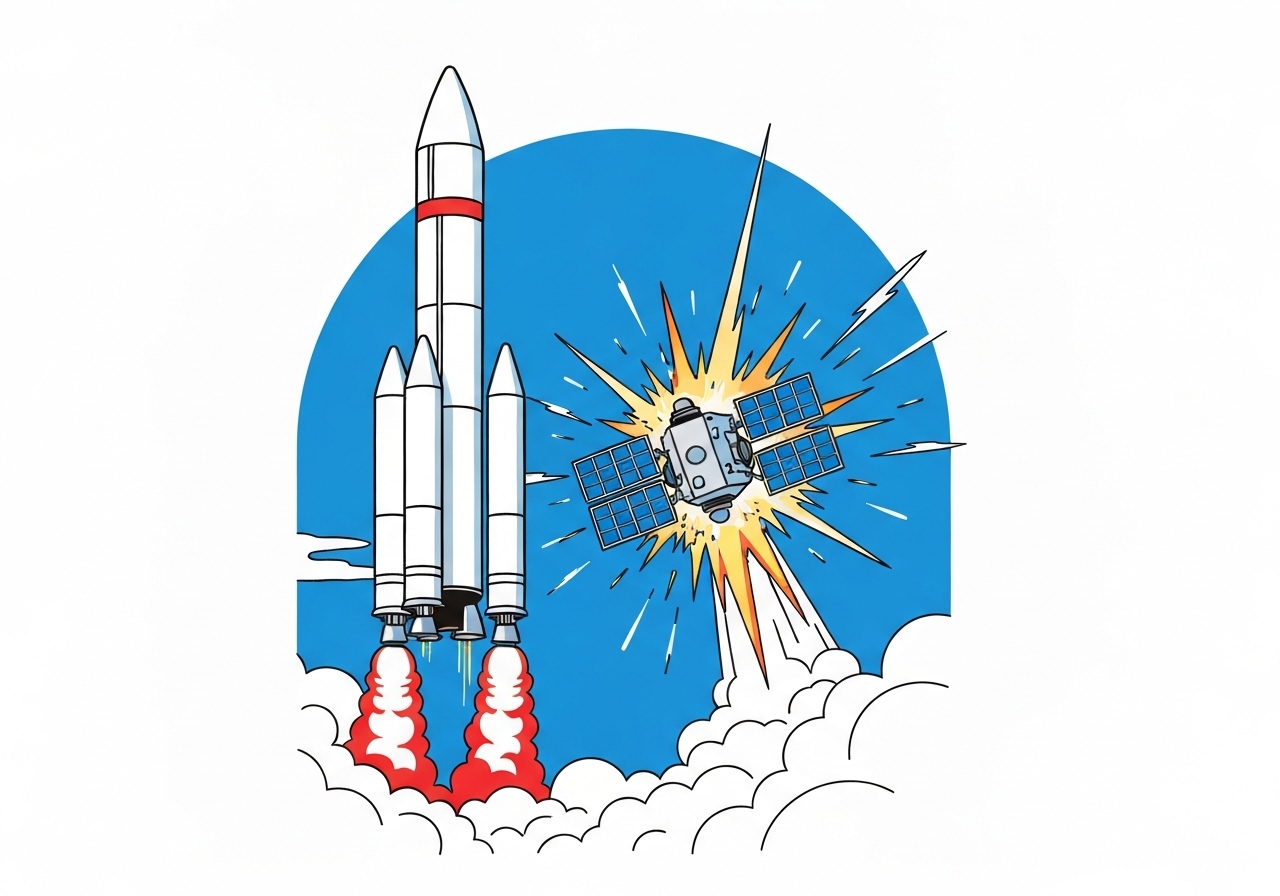
On December 22, 2025, an H3 rocket launched from Tanegashima Island carrying the roughly 5-ton Michibiki 5 navigation satellite failed to deliver its payload to the planned orbit. About four minutes into the flight, the vehicle jettisoned its two-piece payload fairing and onboard cameras recorded a shower of debris around the spacecraft. Telemetry showed sudden accelerations near the satellite’s attachment point and visual evidence of the satellite beginning to lean and tumble. JAXA and the overseeing ministry have released a technical presentation and launched an investigation into the anomaly.
Key Takeaways
- The launch occurred December 22, 2025, from Tanegashima Space Center; it was the eighth flight of Japan’s H3 rocket.
- Payload: Michibiki 5, a navigation satellite weighing about 5 metric tons intended for an orbit above 20,000 miles.
- The anomaly coincided with fairing separation nearly four minutes after liftoff; onboard video shows debris and the satellite beginning to tumble.
- Flight sensors recorded abrupt accelerations around the mechanical interface between the spacecraft and the rocket’s upper structure.
- JAXA posted a technical briefing including a fault tree, sensor graphs and imagery to a government website and briefed the supervising ministry.
- Because the satellite tumbled and did not reach its planned orbit, operators currently treat the mission as a failure pending further analysis.
- The incident provides rare, detailed public data from a launch provider on a malfunction, aiding independent technical review.
Background
The H3 is Japan’s next-generation medium-to-heavy launcher developed to restore and expand domestic access to space. Designed to be more cost-effective and flexible than its predecessors, H3 entered operational testing in recent years and the December 22 flight was its eighth overall. Michibiki 5 is part of Japan’s Quasi-Zenith Satellite System (QZSS), a regional augmentation network that supports navigation and timing services across Japan and parts of Asia; each Michibiki unit typically weighs several tonnes and is intended for high-altitude, long-duration service.
Fairing separation is a routine but critical event that exposes a payload to the space environment while removing aerodynamic protection. Multiple redundant mechanisms, pyrotechnics or pneumatic systems and separation sequencers are designed to ensure clean jettisoning; failures at this stage can expose a spacecraft to debris, shock, or unintended loads. Japan’s civil space agency, JAXA, and industry partners have overseen design, testing and incremental flight-proving of H3 components, while the national ministry responsible for space activities reviewed the post-flight technical briefing.
Main Event
The vehicle lifted off normally and climbed on a nominal trajectory until nearly four minutes into flight, when the two-piece clamshell payload fairing was command-released. Video from the rocket’s cameras immediately following that nominal event showed fragments in proximity to the satellite and the spacecraft starting to lean and rotate. Ground and onboard telemetry registered unexpected accelerations concentrated near the structural interface that attaches the satellite to the rocket’s upper stage.
The presentation JAXA provided to the ministry included a fault-tree analysis and plots of in-flight measurements, noting the timing and magnitude of transient signals around the separation sequence. Engineers observed that the mechanical attachment experienced accelerations inconsistent with the predicted separation loads, and imagery suggested secondary debris or loose hardware near the payload during the critical seconds after jettison.
Mission control did not achieve the commanded orbital insertion for Michibiki 5. Telemetry indicates the spacecraft did not stabilize into its planned orbit above 20,000 miles; initial assessments treat the satellite as lost or severely compromised, pending further telemetry reanalysis and ground-based tracking. JAXA has said it will continue forensic review of sensor logs, imagery and manufacturing records to isolate root causes.
Analysis & Implications
Technically, a safe fairing separation requires precise sequencing, clean mechanical separation and absence of loose debris. The evidence JAXA published — sensor spikes near the attachment and camera footage of debris — points toward either an unexpected hardware release, structural failure in the separation system, or secondary fragmentation from an upstream component. Each hypothesis implies different corrective paths: redesign of separation fittings, review of fairing actuators and retention systems, or stricter contamination control and inspection in assembly.
Operationally, the loss of Michibiki 5 affects redundancy and capacity in the QZSS constellation. While the network includes multiple satellites, losing a scheduled node delays improvements to positioning and augmentation services and could force adjustments to user services or accelerated launches of replacement spacecraft. Insurance and procurement schedules for both the satellite and launcher may be invoked, with financial and contractual consequences for manufacturers and operators.
Strategically, a high-profile anomaly on a flagship national launcher can slow program momentum and prompt wider scrutiny of industrial supply chains, testing regimes and certification standards. Japan’s openness in publishing detailed flight data may accelerate independent technical scrutiny and catalyze corrective measures, but it may also raise questions among international customers about launch reliability until root causes are resolved and mitigations demonstrated on subsequent flights.
Comparison & Data
| Item | Value |
|---|---|
| Flight | H3 — 8th flight (Dec 22, 2025) |
| Payload | Michibiki 5, ≈5,000 kg |
| Fairing separation | ~4 minutes after liftoff (visual confirmed) |
| Intended orbit | >20,000 miles altitude (high-altitude navigation orbit) |
The table summarizes core numbers released by JAXA. While H3 is intended to be competitive in the medium-to-heavy class, detailed failure data will determine whether the issue is systemic or isolated to hardware, software sequencing, or assembly practices.
Reactions & Quotes
JAXA’s presentation showed sensor traces and imagery under review; agency representatives described the material as central to identifying the sequence of events at fairing separation.
JAXA (official presentation)
The supervising ministry was briefed by agency engineers and has requested a thorough investigation and public reporting of findings to maintain transparency and public trust.
Supervising government ministry (official briefing)
Independent analysts note that unusually, JAXA released substantial technical detail early in the investigation — an approach that helps the engineering community but does not yet replace hands-on forensic work.
Independent space analyst (industry expert)
Unconfirmed
- Whether the initial debris observed originated from the fairing, attachment hardware, or an upstream component remains unconfirmed.
- It is not yet conclusively determined if the accelerations recorded caused structural failure at the attachment or were symptoms of a prior mechanical release.
- Any single causal factor (hardware defect, procedural error, manufacturing contamination) has not been publicly confirmed and is under investigation.
Bottom Line
The December 22 anomaly halted a major national navigation satellite deployment and exposed a rare failure mode tied to fairing separation and payload attachment. JAXA’s unusually detailed public briefing provides the technical community with immediate data but does not yet identify a definitive root cause. Stakeholders should expect a multi-month forensic process involving hardware inspection, manufacturing tracebacks and software/sequence reviews.
For Japanese navigation services and international customers, the near-term impact depends on constellation redundancy and insurance outcomes; for the H3 program, the incident will likely lead to grounded flights or tighter oversight until corrective actions are validated. Observers should watch for JAXA’s final investigation report and next H3 test flights to gauge whether fixes are effective and whether the launcher can restore confidence for scheduled payloads.
Sources
- Ars Technica — news report summarizing JAXA materials (media)
- JAXA — Japan Aerospace Exploration Agency (official agency)
- Ministry of Education, Culture, Sports, Science and Technology (MEXT) (official government oversight)