
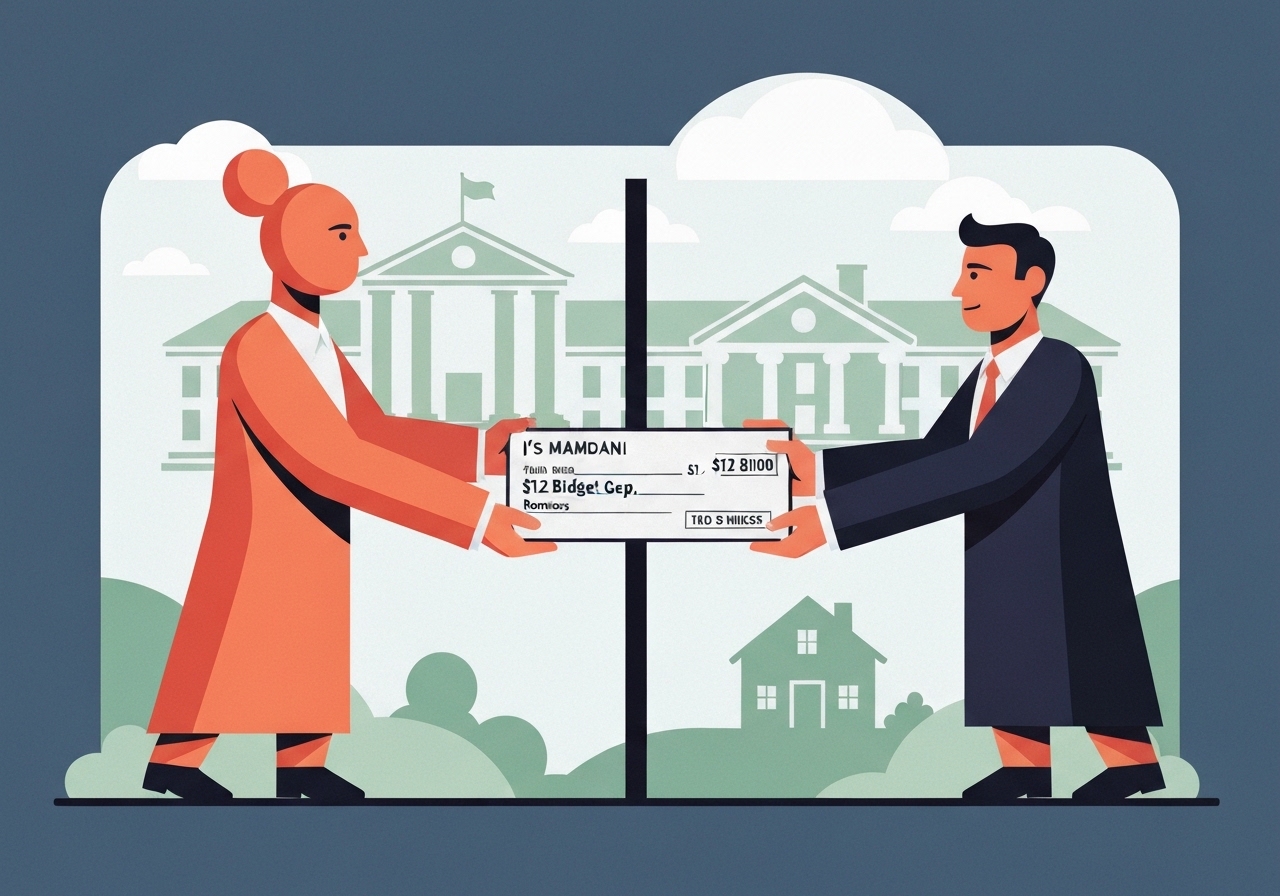
Mayor Zohran Mamdani on Jan. 28, 2026, told reporters at City Hall that New York City faces a severe fiscal shortfall — a $12 billion gap across two years — and pinned much of the responsibility on his predecessor, former Mayor Eric Adams. Mamdani repeated his demand that the state legislature and Gov. Kathy Hochul raise taxes on the wealthiest New Yorkers and on corporations, and that Albany allocate the city a fairer share of state funding. He pledged transparency to residents but provided few immediate details about specific cuts or new revenue measures. The mayor said a preliminary budget due Feb. 17 will offer further detail on how his administration plans to close the gap.
Key Takeaways
- Mamdani attributes a $12 billion two‑year shortfall primarily to the prior administration’s under‑budgeting, citing rental assistance, shelter and special education as examples.
- City Comptroller Mark Levine warned the city could finish this fiscal year (ending June 30) with about a $2 billion deficit and face roughly a $10 billion shortfall next year.
- State Comptroller Thomas DiNapoli and the Citizens Budget Commission have both flagged underestimates of police overtime and housing vouchers under the Adams administration.
- Mamdani urged the state to raise taxes on top earners and corporations and to restore what he calls the city’s fair share of state resources.
- Progressive advocacy groups quickly endorsed Mamdani’s push for tax hikes, while the Citizens Budget Commission cautioned that higher rates could harm competitiveness amid outmigration and weak job growth.
- The mayor said rental assistance programs and voucher spending must be reexamined to understand rapid cost growth.
Background
New York City’s budget has been strained since the combined public‑health and economic shocks of the COVID‑19 pandemic, with revenues and spending patterns diverging from projections. In recent years, administrations have used accumulated surpluses and one‑time maneuvers to balance annual budgets; Mamdani says those cushions have been exhausted. The Adams administration, according to audits and public statements from state and civic watchdogs, underestimated several expense lines — most prominently police overtime and housing voucher costs — which has widened the fiscal gap.
The state–city funding relationship is central to the dispute. Mayoral calls for additional state aid and targeted tax increases have a long history in Albany politics, and Gov. Kathy Hochul has been reluctant to accept sweeping rate hikes. Fiscal watchdog groups and the State Comptroller’s Office have repeatedly warned about structural risks if recurring obligations are funded with short‑term fixes. Those systemic pressures set the stage for Mamdani’s public critique of his predecessor and his push for state action.
Main Event
At a Jan. 28 press conference inside City Hall, Mamdani characterized the fiscal situation as a “serious fiscal crisis,” saying the previous administration left the city with a “poisoned chalice.” He said officials undercounted costs for services New Yorkers depend on daily, singling out rental assistance, shelter and special education as under‑budgeted programs that have created future liabilities.
The mayor repeated a call for Albany to raise taxes on high‑income individuals and corporations, and to provide more state aid. He said those steps are essential to avoid deep cuts to services but offered limited immediate detail on which programs would be trimmed or how revenue increases would be structured. Mamdani set Feb. 17 as the date for his preliminary budget release, promising fuller transparency then.
Representatives for former Mayor Eric Adams pushed back. Adams spokesperson Todd Shapiro said Adams inherited nearly $10 billion in debt and faced the worst combined public‑health and economic crisis in city history, arguing it is misleading to single him out for long‑standing city–state funding imbalances. State Comptroller Thomas DiNapoli and others, however, have publicly documented specific underestimates in the Adams-era budgeting process.
The new city comptroller, Mark Levine, made similar warnings earlier in January, putting the near‑term hole at about $2 billion for the current fiscal year and near $10 billion the following year. Analysts say those figures reflect a mix of rising program demand, inflationary pressures and earlier accounting choices rather than a single cause.
Analysis & Implications
Short term, the mayor faces a constrained set of options: use remaining reserves or one‑time fixes, enact spending cuts, raise new revenues locally, or press Albany for state relief. Each path has political and economic tradeoffs. Drawing down last reserves risks leaving the city exposed to unexpected shocks; recurring spending cuts can worsen service delivery; and tax hikes could influence migration and business decisions at a moment when domestic outflows and slow job gains are concerns.
Politically, Mamdani’s strategy links blame for the gap to a predecessor while simultaneously seeking Albany’s cooperation on taxation — a dual posture aimed at mobilizing progressive allies and putting pressure on state leaders. That calc is risky: success depends on persuading both voters and lawmakers that increased taxes will not accelerate relocations or depress economic activity.
Economically, rising costs in rental assistance and voucher programs may reflect broader housing market dynamics, including higher rents and lengthening program participation. Without reforms to program design or eligibility, those pressures could make fiscal stabilization temporary. Analysts will watch whether Mamdani couples revenue proposals with programmatic reforms intended to slow cost growth.
On intergovernmental relations, the dispute underscores the fragility of city–state fiscal arrangements. If Albany rejects tax increases or additional aid, the city may have to pursue deeper cuts or more aggressive local revenue measures. Conversely, substantial state assistance would shift both political accountability and long‑term budget dynamics back toward Albany.
Comparison & Data
| Fiscal Period | Noted Shortfall |
|---|---|
| Current year (ends June 30, 2026) | ~$2 billion deficit (NYC Comptroller estimate) |
| Next fiscal year (2026–27) | ~$10 billion deficit (NYC Comptroller estimate) |
| Two‑year total cited by mayor | $12 billion shortfall |
| Prior inherited gap referenced by Adams team | Nearly $10 billion in debt at transition (Adams statement) |
The table summarizes publicly stated deficit estimates from Mamdani’s office and the new city comptroller. Analysts caution that these headline numbers depend on assumptions about revenues, federal and state aid, and program demand; small changes in those drivers can materially alter the outyear gap. Historical practice of using surpluses and one‑time items to balance recurring obligations is a recurrent factor in the city’s fiscal stress.
Reactions & Quotes
I will be blunt: New York City is facing a serious fiscal crisis.
Mayor Zohran Mamdani
Context: Mamdani used this language to press Albany for tax changes and to frame the budget shortfall as a legacy issue tied to previous budgeting choices.
He inherited a city facing nearly $10 billion in debt, compounded by the worst public‑health and economic crisis in New York City history.
Todd Shapiro, spokesperson for former Mayor Eric Adams
Context: The Adams team stressed the exceptional economic shocks during its tenure and argued that systemic city–state funding issues extend beyond a single administration’s control.
It’s been really hard to follow the budget in recent years, and it’s already a complicated document. This is a positive step.
Rahul Jain, Deputy State Comptroller (commenting on increased scrutiny)
Context: Officials at the State Comptroller’s Office have called for greater transparency and clearer accounting to clarify drivers of rising program costs.
Unconfirmed
- Specific line‑by‑line remedies Mamdani will include in the Feb. 17 preliminary budget are not yet public and remain unconfirmed.
- Precise projected impacts of any proposed state tax increases on migration, jobs and revenue are uncertain and depend on the final design and economic responses.
- Any claims that under‑budgeting was intentional or uniformly applied across departments remain unverified; audits identify patterns but do not conclusively establish intent.
Bottom Line
Mamdani’s public attribution of a $12 billion two‑year shortfall to his predecessor shifts attention to decisions made under the Adams administration and to structural city–state fiscal questions. His demand for higher taxes on the wealthy and corporations is politically charged and will require Albany’s buy‑in to be effective without deepening other risks, such as outmigration or business relocation.
Fiscal outcomes will hinge on the mix of one‑time fixes, recurring revenues and program reforms the city adopts after the Feb. 17 preliminary budget. Observers should focus on whether Mamdani pairs new revenues with changes to program design — especially for rental assistance and vouchers — and on how Albany responds to requests for state aid or tax changes.
Sources
- THE CITY — Coverage of Mamdani press conference and budget estimates (news)
- New York State Comptroller — Office homepage; statements and audits on city budgeting (official/analysis)
- Citizens Budget Commission — Fiscal analysis and commentary on NYC budgets (nonprofit research)
- Mayor’s Office of the City of New York — press materials and announcements (official)
- New York City Comptroller — office statements and fiscal reports (official)