
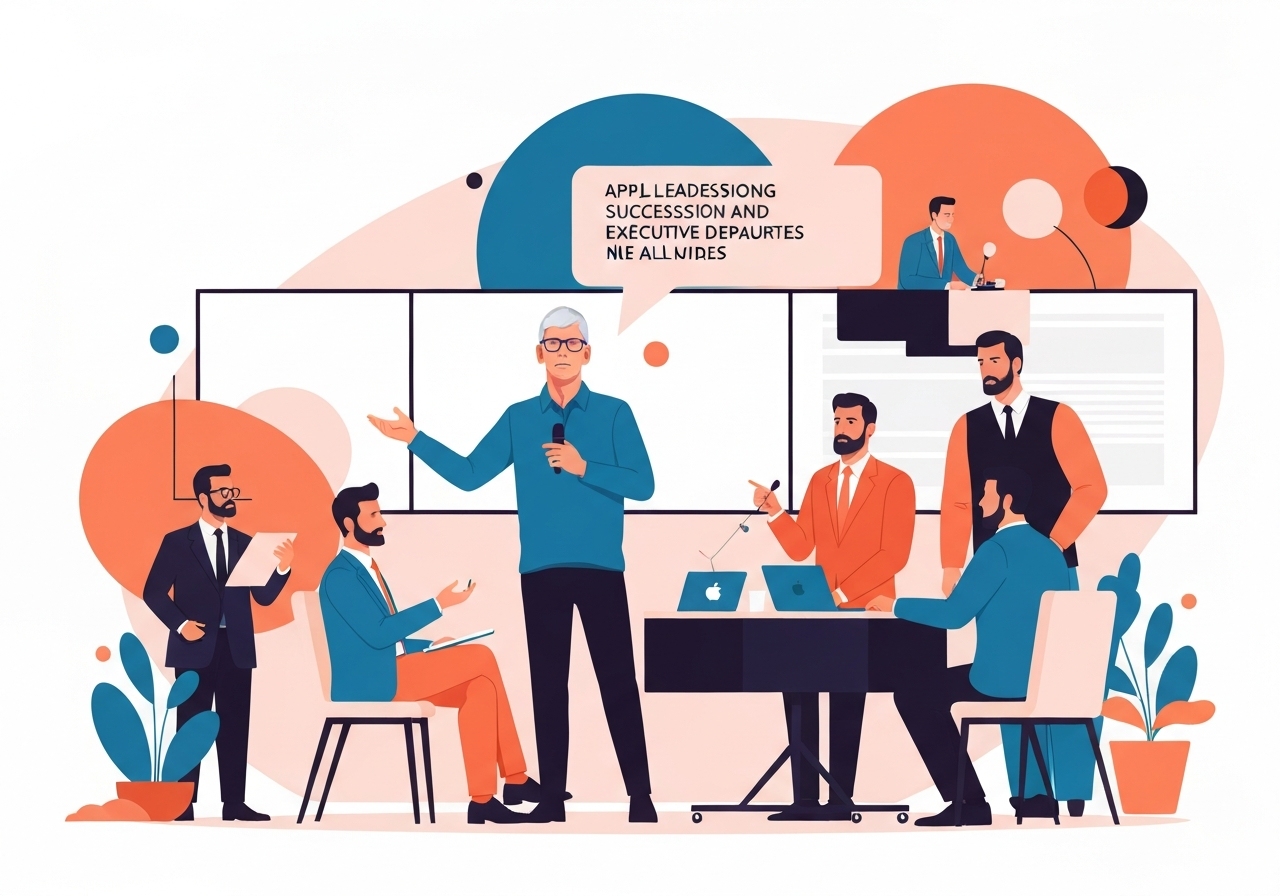
Apple CEO Tim Cook told employees at an internal all-hands meeting on Feb. 5, 2026, that leadership is actively planning for the company’s future while answering staff questions on immigration and personnel changes. He said he regularly thinks about who will be ‘‘in the room’’ five, ten and 15 years from now and described retirement as a normal part of leadership transitions. Cook also acknowledged Apple’s upcoming 50th anniversary in April and promised internal celebrations. He framed recent exits by several senior executives as planned, while leaving some departures unaddressed.
Key takeaways
- Tim Cook held an all-hands meeting on Feb. 5, 2026, and took employee questions on succession, immigration, and other topics.
- Cook said he thinks about the company’s leadership five, 10 and 15 years out, signaling succession planning is active.
- Speculation persists that Cook may retire within the next two years; John Ternus is widely named as a likely successor.
- Cook described the recent departures of Lisa Jackson, Jeff Williams and Katherine Adams as long planned and “not surprises.”
- He did not comment publicly on the exits of John Giannandrea and Alan Dye during the meeting.
- Apple will mark its 50th anniversary in April 2026, and Cook promised employees some form of celebration.
Background
Apple was founded in April 1976 and will reach its 50th anniversary in April 2026, a milestone that has prompted internal reflection on the company’s past and future. Tim Cook became Apple’s CEO in August 2011 and has overseen a period of sustained growth and product expansion, which has intensified public and investor interest in eventual leadership transition. Succession planning at major technology firms is often discussed years in advance because continuity matters for product roadmaps, supply chains and investor confidence. In recent months media speculation about Cook’s retirement timetable has increased, driven by typical market curiosity around long-tenured CEOs and visible leadership changes across the company.
Apple’s executive team has seen several departures and role changes, creating heightened attention to who will lead key functions going forward. Some exits have been characterized by the company and reporting outlets as orderly and anticipated; others lack publicly stated explanations. Internal all-hands meetings are a primary forum for senior leaders to address staff concerns directly, manage expectations and restate strategic priorities, which is why Cook’s comments drew coverage beyond the company.
Main event
During the meeting on Feb. 5, Cook said succession and long-range leadership questions are an active part of his thinking. He told employees he contemplates who will be in leadership seats five, 10 and 15 years from now and emphasized the importance of planning. Those remarks were delivered in the context of broader employee questions that also touched on immigration policy in the United States and other operational issues.
On the subject of retirements and turnover, Cook described exits by Lisa Jackson, Jeff Williams and Katherine Adams as planned and not unexpected. He positioned these moves as part of normal leadership cycles rather than abrupt or unanticipated changes. That framing aims to reassure staff and investors that Apple has succession plans in place and that operational continuity is being managed.
Cook also highlighted Apple’s upcoming 50th anniversary, saying leaders have been discussing how to mark the milestone and that employees should expect celebrations. The comment served both as recognition of the company’s history and as an internal morale message. Notably, Cook did not address the departures of John Giannandrea and Alan Dye during the meeting, leaving questions about those changes unanswered in the all-hands setting.
Analysis & Implications
Cook’s repeated emphasis on long-range leadership planning is a signal to employees and markets that Apple is treating succession as a strategic priority rather than a speculative topic. For a company of Apple’s scale, named successors reduce uncertainty for partners, suppliers and investors who rely on stable executive direction for multi-year product cycles. If messaging convinces stakeholders that transitions are being staged thoughtfully, it can dampen volatility around product roadmaps and hiring.
The ongoing public speculation that John Ternus could be Cook’s successor underscores a common pattern in tech: internal candidates with deep engineering and operations experience are often viewed as natural heirs. Ternus, Apple’s senior vice president of hardware engineering, is frequently mentioned in coverage because his portfolio aligns with Apple’s core strengths. Still, until Apple names a formal plan, such expectations remain market speculation rather than corporate fact.
Planned departures described by Cook help Apple contain narrative risk; describing exits as anticipated reduces the sense of crisis. However, unanswered questions about other executives signal incomplete disclosure and will likely prompt follow-up reporting and investor queries. The company’s approach to messaging—balancing transparency with discretion—will influence how both employees and external stakeholders interpret the pace and direction of leadership change at Apple.
Comparison & Data
| Item | Year or detail |
|---|---|
| Apple founding | April 1976 |
| 50th anniversary | April 2026 |
| Tim Cook became CEO | August 2011 |
| Reported all-hands | Feb. 5, 2026 |
The table places the recent meeting alongside key corporate dates to show the context for succession talk: Cook has led Apple for over 14 years, and the company is entering its 50th year, a moment when leadership succession naturally draws attention. For investors and partners planning multi-year commitments, these dates frame the timeframe during which Apple may shift leadership and strategy.
Reactions & Quotes
I focus on who will be in leadership seats five, 10 and 15 years from now and how we prepare for that reality.
Tim Cook, Apple CEO (paraphrased)
Cook used this line to underline that succession planning is an ongoing leadership responsibility rather than a reaction to current events. The remark was presented as part of broader internal conversation rather than a formal announcement.
When people reach a certain age, retirements occur; planning for those transitions is part of good leadership.
Tim Cook, Apple CEO (paraphrased)
This comment framed retirement as a routine component of organizational life and was intended to normalize change for Apple staff.
Apple’s recent exits appear to be staged and managed, but the company still faces questions about undisclosed departures and their operational impact.
Industry analyst (paraphrase)
Analysts noted that while some exits were presented as planned, omitted details on other departures leave open questions for stakeholders monitoring Apple’s executive bench strength.
Unconfirmed
- Tim Cook’s exact retirement timetable is unconfirmed; media speculation about a retirement within two years has not been verified.
- Reports that John Ternus will definitively succeed Cook are based on industry expectation, not an official Apple announcement.
- The company has not publicly explained the circumstances of John Giannandrea’s and Alan Dye’s departures; their reasons remain unconfirmed.
Bottom line
Tim Cook used the all-hands setting to convey that Apple is actively thinking about long-term leadership and to present several recent executive exits as planned moves. He linked succession planning to steady governance and sought to reassure employees that transitions are part of normal corporate life. The emphasis on a structured approach is aimed at maintaining confidence among staff, partners and investors ahead of the company’s 50th anniversary in April 2026.
Nonetheless, unanswered questions about certain departures and the absence of a formal succession announcement mean markets and observers will continue to watch Apple’s executive decisions closely. If Apple follows through with clear, staged plans, it can minimize disruption; if not, uncertainty may grow until leadership choices are made explicit.
Sources
- 9to5Mac — news report summarizing the all-hands meeting and Cook’s remarks (media)
- Bloomberg / Mark Gurman — reporting referenced for succession coverage (media/reporting)
- Apple Newsroom — official Apple communications hub (corporate/official)