
Lead
Two powerful earthquakes struck Venezuela on the night of June 24, 2026, devastating coastal areas around La Guaira and shaking Caracas. Officials reported at least 188 deaths and thousands of injured in early tallies; later health ministry briefings indicated the toll may be higher, with some sources citing about 235 fatalities and several thousand injured. Rescue teams — local, national and international — are racing to reach people trapped under collapsed buildings while survivors sleep outdoors amid repeated aftershocks. Authorities and aid agencies warn the humanitarian needs are acute and likely to grow as search operations continue.
Key Takeaways
- Confirmed fatalities: Early official counts put deaths at 188; later health ministry remarks indicated around 235 fatalities (June 24–25, 2026), reflecting evolving tallies from multiple jurisdictions.
- Injuries and displacement: Initial reports listed more than 1,500 injured; some ministry updates and humanitarian sources raised that to several thousand (reports vary by source).
- Seismic facts: The USGS recorded a 7.2-magnitude event followed within seconds by a 7.5 pulse (a reported “doublet” or complex rupture) affecting coastal Venezuela near La Guaira.
- Damage footprint: La Guaira sustained the worst structural damage, with dozens of collapsed buildings and around 250 reported damaged or destroyed structures in preliminary assessments.
- International support: The United States, Mexico, Colombia, Spain, Cuba and other countries pledged aid or deployed search-and-rescue teams; the US announced $150 million in humanitarian assistance.
- Search-and-rescue capacity: Fairfax County and Los Angeles County’s urban search-and-rescue teams were activated, sending specialists, dogs and heavy breaching equipment to assist.
- Humanitarian risk: UNICEF and aid organizations say nearly 3.9 million children live in affected areas and face risks from displacement, service disruptions and disease.
Background
Venezuela has faced prolonged economic and public-service challenges for several years, weakening health care, water and electrical systems and reducing institutional capacity to absorb large-scale disasters. That fragility magnifies the impact of a major seismic event: hospitals already operating with limited supplies quickly become overwhelmed when trauma cases surge.
The affected region includes densely populated coastal municipalities and parts of the Caracas metro area where older apartment blocks and informal housing are common. Engineers and seismologists have long warned that poorly reinforced concrete structures are particularly vulnerable to the kind of vertical, sudden collapse described by rescuers as “pancake” failures.
Scientifically, the Venezuela shocks drew attention because they were recorded as closely spaced large pulses — sometimes called a doublet — a relatively rare occurrence that complicates rapid seismic interpretation and emergency response planning.
Main Event
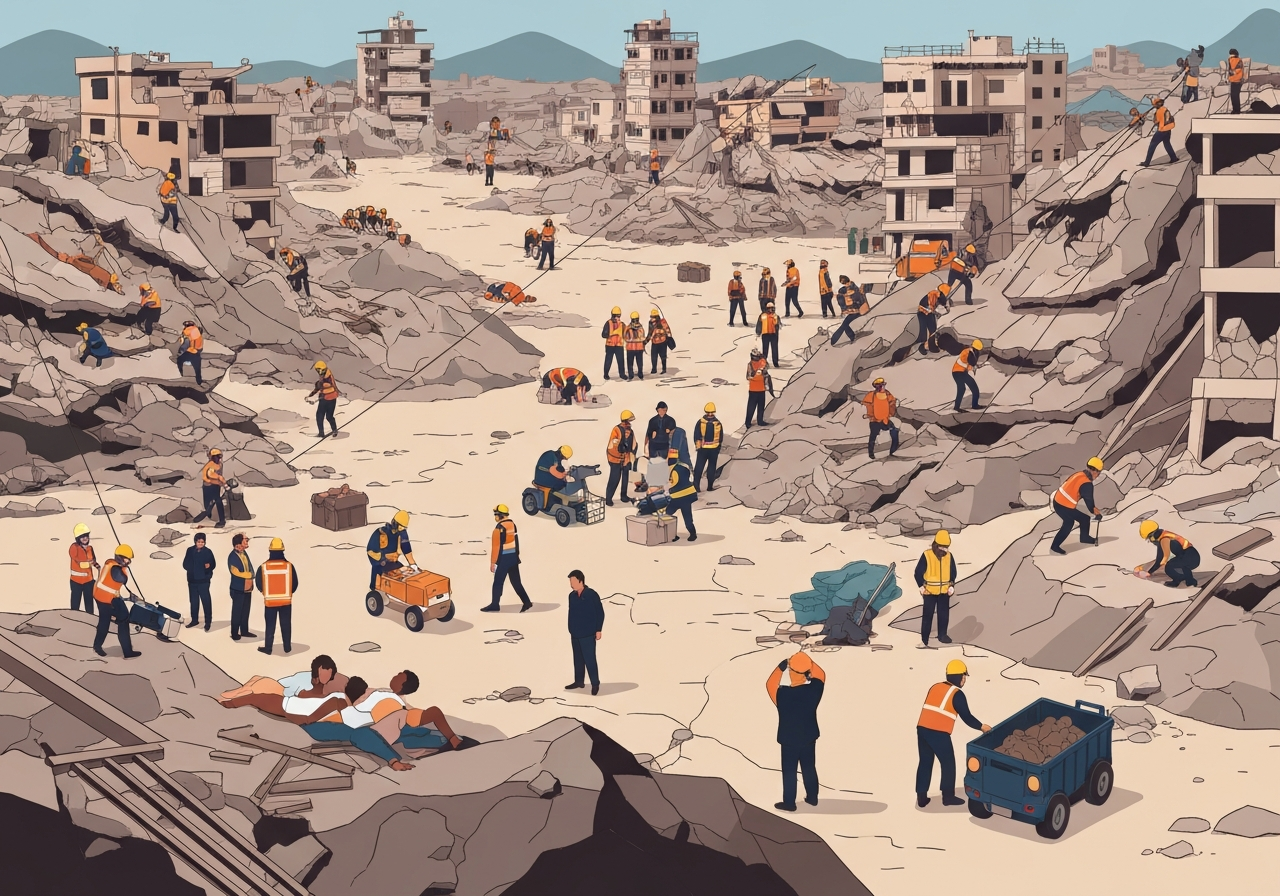
The first major tremor struck on the night of June 24, followed almost immediately by a second powerful pulse. In coastal La Guaira, video and satellite imagery show entire apartment blocks reduced to rubble, roads blocked by debris and fires in some neighborhoods. Local firefighters and civil-protection teams joined community volunteers to pull survivors from crushed floors and vehicles.
National and regional authorities declared disaster zones and prioritized search-and-rescue in the hardest-hit municipalities. Interior Minister Diosdado Cabello urged residents to remain outdoors while structural assessments are carried out and said heavy machinery and brigades were being mobilized to speed extraction work.
On the ground, makeshift camps appeared outside damaged buildings as families salvaged a few possessions and waited for information on missing relatives. Hospitals reported improvised wards in corridors and outdoor triage areas as health workers struggled with high numbers of trauma cases amid power outages.
Volunteers and civic groups set up missing-person registries and social-media platforms to help relatives locate loved ones; authorities cautioned that many crowd-sourced lists are not yet verified and that numbers of missing remain fluid.
Analysis & Implications
In the immediate term, the priority is life-saving search, medical care and safe shelter. The collapse pattern — numerous multi-storey failures — requires sustained heavy-equipment operations and specialist urban search teams with listening devices, search dogs and shoring expertise. That level of technical response is why international teams from the US and other countries were requested or volunteered.
The health system’s pre-existing shortages in staffing, supplies and infrastructure will complicate trauma care, routine services and public-health responses. Aid groups stress that water, sanitation and infection prevention will be urgent priorities to reduce secondary health crises in displaced-population centers.
Politically and logistically, the disaster arrives at a delicate moment. Large-scale foreign assistance can be lifesaving but must be coordinated carefully with local authorities to ensure access, customs clearance of equipment and equitable distribution. The need for long-term reconstruction funding and building-safety upgrades reinforces existing debates over public investment and international financing.
Economically, the shocks will likely deepen local fiscal strain: emergency spending, damaged private property and disrupted commerce can slow recovery and increase humanitarian dependency. Reconstruction of collapsed structures will demand engineering assessments and likely changes to building enforcement if resources permit.
Comparison & Data
| Metric | Early official report | Later/alternative figures |
|---|---|---|
| Reported fatalities | 188 (National Assembly update) | ~235 (health ministry statement) |
| Injured | 1,500+ (initial) | ~4,300 (health ministry, later) |
| Aftershocks | 138 reported aftershocks | Ongoing sequence |
| Damaged/Collapsed buildings | ~250 reported damaged/collapsed | Satellite imagery confirms multiple full collapses in La Guaira |
The table shows why casualty and damage figures vary during fast-moving disasters: numbers are updated as local registries, hospital tallies and field assessments are reconciled. Satellite and aerial imagery provide rapid area-wide damage estimates, but on-the-ground verification is critical for survivor counts and precise damage tallies. Expect official totals to continue changing as search teams reach isolated neighborhoods and mortuary and hospital reporting is consolidated.
Reactions & Quotes
“The U.S.A. stands ready, willing, and able to help!”
U.S. President (public statement)
Federal authorities in the United States announced expedited humanitarian funding and the deployment of search-and-rescue assets; officials emphasized coordination through diplomatic channels and the UN system.
“It’s a cataclysmic scene. Our teams are focused on food, shelter, water and preventing disease spread.”
Ciarán Donnelly, International Rescue Committee
Humanitarian organizations warned the public-health risks are heightened by damaged sanitation and overcrowded shelters, calling for rapid delivery of water, trauma care and psychosocial support services.
“Remain outdoors until buildings are certified safe.”
Diosdado Cabello, Venezuelan Interior Minister (state broadcast)
Authorities repeatedly urged caution about aftershocks and announced structural inspections before people re-enter damaged housing.
Unconfirmed
- Exact total fatalities and injured: local, national and international tallies differ and remain provisional until consolidated.
- Authenticity of some social-media lists and hospital patient lists shared online has not been independently verified.
- Whether the seismic recordings represent two fully separate earthquakes (a doublet) or one complex, multi-pulse rupture remains under technical review.
Bottom Line
The immediate focus in Venezuela is saving lives and stabilizing survivors: search-and-rescue teams, emergency medical care and rapid delivery of shelter, water and sanitation are urgent. International teams and funding can provide critical capacity, but coordination with Venezuelan authorities and local responders will determine how quickly survivors are reached and needs are met.
Over the medium term, the event highlights the vulnerability of aging and poorly reinforced housing stock in seismically active zones and underscores the need for investment in resilient infrastructure, emergency preparedness and robust health systems. Expect casualty and damage numbers to be revised as search operations conclude and official counts are reconciled.
Sources
- CNN live updates — news outlet with rolling reporting from the scene.
- UNICEF statement — UN agency press release on children at risk (agency/official).
- U.S. Geological Survey — seismic event data and technical analysis (government science agency).
- U.S. Department of State — announcement of aid and deployed assets (official/government).
- Fairfax County Search and Rescue — local public-safety agency reporting team activation (local government).
- International Rescue Committee — humanitarian assessment and field response (NGO).