
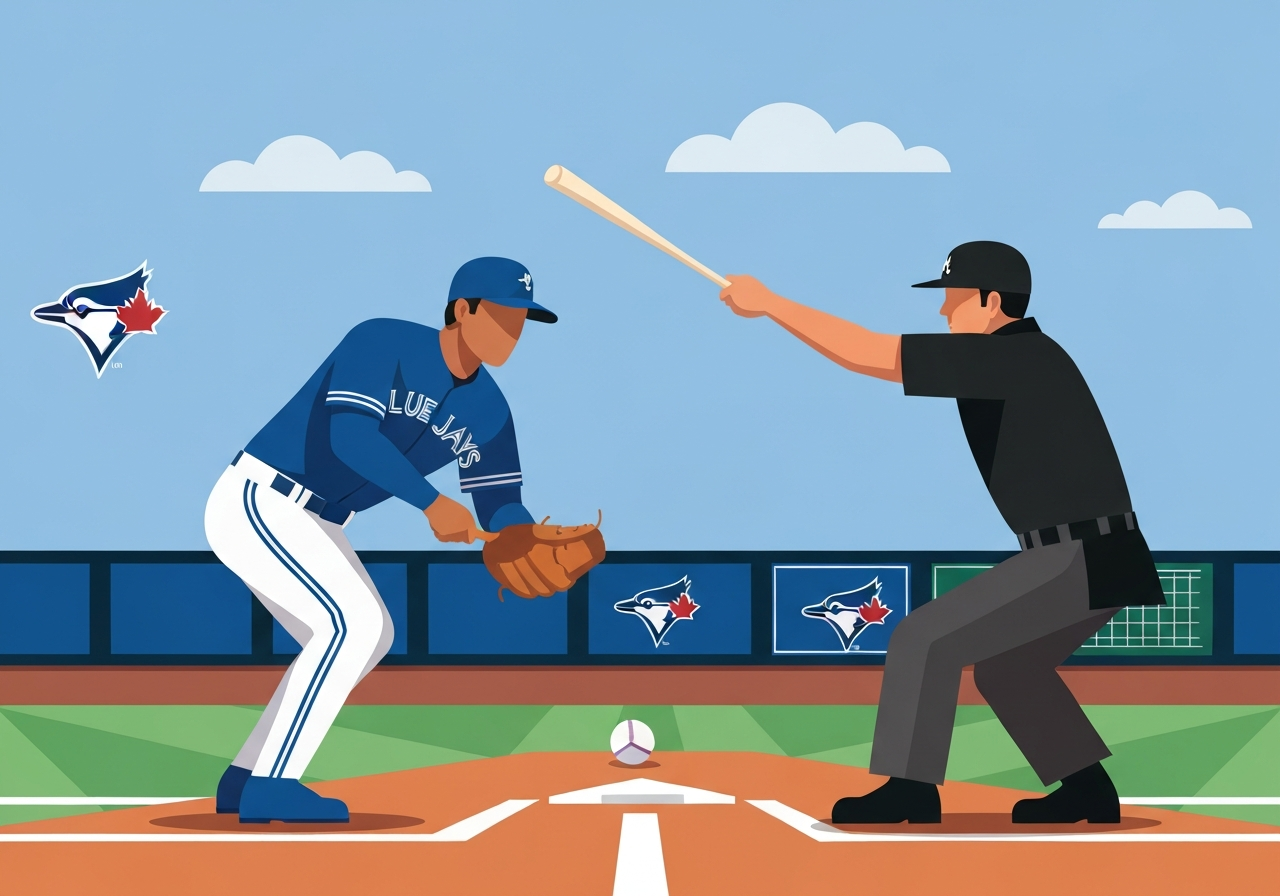
Lead: On Thursday at CoolToday Park, a Blue Jays–Braves game ended when an umpire’s two-strike call was overturned by the league’s Automated Ball Strike (ABS) review. With two outs in the ninth and the Blue Jays threatening with the bases loaded, home-plate umpire Ryan Wills initially ruled the pitch a ball. Braves catcher Archer Bookman tapped his helmet to signal a challenge; Hawk-Eye review showed the pitch was on the upper edge of Josh Rivera’s zone and was ruled strike three. The ruling reversal gave Atlanta a 9-5 victory, ending the game instantly.
Key takeaways
- The game ended on a late ABS review: Braves 9, Blue Jays 5, after a two-strike offering to Josh Rivera was overturned.
- Umpire on the play: Ryan Wills initially called the pitch a ball; the review ruled it a strike at the top of the zone.
- Challenge trigger: Braves catcher Archer Bookman tapped his helmet to signal the challenge, leading to an automated Hawk-Eye review.
- Timing: The challenge occurred with two outs in the ninth and a bases-loaded Blue Jays threat, immediately ending the inning and game.
- Policy context: MLB’s competition committee approved ABS in September 2025; the system had been tested in the minors since 2022 and in 2025 spring training.
- League estimate: MLB said the challenge process added roughly “about 57 seconds of added time” per spring training game in testing, a metric now under scrutiny in live, late-game situations.
Background
The Automated Ball Strike system—built on Hawk-Eye tracking data—was adopted by MLB’s competition committee in September 2025 after multi-year trials. MLB framed the rollout as an attempt to balance technological accuracy with the sport’s long-standing human-umpire tradition, permitting managerial and catcher-initiated challenges in certain situations. Tests began in the minor leagues in 2022 and expanded to spring training in 2025, where league reports measured only modest additions to game length during trials.
Supporters view ABS as a remedy for inconsistent strike-zone enforcement that can decide close games, while detractors worry about late-game timing, diminished human judgment and the effect on the sport’s drama. Stakeholders—players, managers, umpires and broadcasters—have debated the mechanical and cultural trade-offs since testing began. The system’s September 2025 approval set the stage for full-season use and the eventual live-game, game-ending application seen Thursday.
Main event
In the ninth inning at CoolToday Park, the Blue Jays loaded the bases with two outs and sent Josh Rivera to the plate. Braves pitcher Luis Vargas threw a two-strike offering that home-plate umpire Ryan Wills judged a ball, preserving the Blue Jays’ opportunity to bat around. Braves catcher Archer Bookman immediately tapped his helmet—a team signal to request an ABS review—and the stadium feed switched to the automated ball-strike graphic.
Hawk-Eye’s tracking placed Vargas’ pitch at the very top edge of Rivera’s calculated strike zone. The review overruled Wills’ initial call and the plate umpire signaled strike three, concluding the inning and the game. The reversal erased the Blue Jays’ bases-loaded threat and cemented a 9-5 final score for Atlanta.
CoolToday Park staff and broadcast crews executed the review sequence within the league’s established protocol, with the replay graphic visible to fans in the stands and viewers at home. The pause and reversal drew immediate reaction from the crowd and from commentators, reigniting debates over ABS’s role in deciding critical late-game outcomes.
Analysis & implications
First, the incident highlights an operational reality: ABS can arrive in the game’s most consequential moments and produce immediate, binary outcomes. For managers and catchers, the ability to trigger a review creates a new tactical lever—knowing when to risk a challenge in exchange for potentially ending an opponent’s rally. That tactical calculus will evolve as teams accumulate usage data and internal analytics on success rates and time costs.
Second, the episode raises questions about pace and perception. MLB’s testing reported roughly 57 seconds of added time per spring training game, but a game-ending review generates outs rather than incremental plays; in close late innings, that difference can feel much larger. Fans and broadcasters may perceive ABS interventions in late innings as altering the flow and emotional arc of games even if average added time remains small.
Third, the ruling has implications for umpiring and accountability. Human umpires remain central to MLB’s model, but ABS introduces an objective backstop for marginal calls. That may reduce missed-call disputes over time, yet it also shifts some decision-making from an on-field official to an algorithm-plus-camera system, prompting debate about transparency, measurement thresholds and appeals procedures.
Finally, the broader competitive effect depends on consistency and communication. If ABS produces predictable outcomes near the edges of defined strike zones, teams will adjust pitcher and hitter approaches accordingly. But if reviews are perceived as uneven—varying by ballpark tracking calibration or by broadcaster presentation—controversies could persist, prompting calls for standardized protocols and public calibration reports.
Comparison & data
| Year | Stage | Notes |
|---|---|---|
| 2022 | Minor-league testing | Initial Hawk-Eye trials and data collection |
| 2025 | Spring-training testing | Broader trial; league reported ~57s average added time |
| Sept 2025 | Competition committee approval | ABS approved for controlled MLB use |
| 2026 | Regular-season use | First game-ending ABS challenge occurred Thursday |
The table places Thursday’s outcome in the rollout timeline: multi-year testing moved to formal approval in September 2025 and live-game application in 2026. Measured averages from testing—like the 57-second figure—help quantify impact but do not capture the high-stakes feel of a single ninth-inning reversal, which can disproportionately shape public debate.
Reactions & quotes
“about 57 seconds of added time”
MLB competition committee (official announcement)
“a compromise between ‘robot umpires’ and the century-old tradition of human umpires”
The Big Lead (media report)
Unconfirmed
- Whether any internal timeliness or communication delays occurred between the catcher’s helmet tap and the triggering of the review remains unreported.
- No official public breakdown yet explains if stadium-specific Hawk-Eye calibrations affected the exact placement measured at the upper edge of the zone.
Bottom line
Thursday’s finish at CoolToday Park represents the first high-profile example of ABS deciding a game’s outcome in real time. The ruling underscored why leagues test automated systems over multiple seasons: small technical decisions can produce outs and alter results instantly. Teams will study the play to refine when to initiate challenges and how to manage late-inning strategy.
For fans and league officials, the episode crystallizes the trade-offs inherent in introducing automated review into baseball’s most dramatic moments. If MLB wants ABS to be broadly accepted, the league will need clear communication about calibration, consistent application across venues and an explanation of how marginal calls are categorized. Otherwise, game-ending reviews like this one will continue to generate debate proportional to their immediate impact.
Sources
- The Big Lead — national sports media report on the game
- MLB — official league site; competition committee announcement and ABS implementation materials