
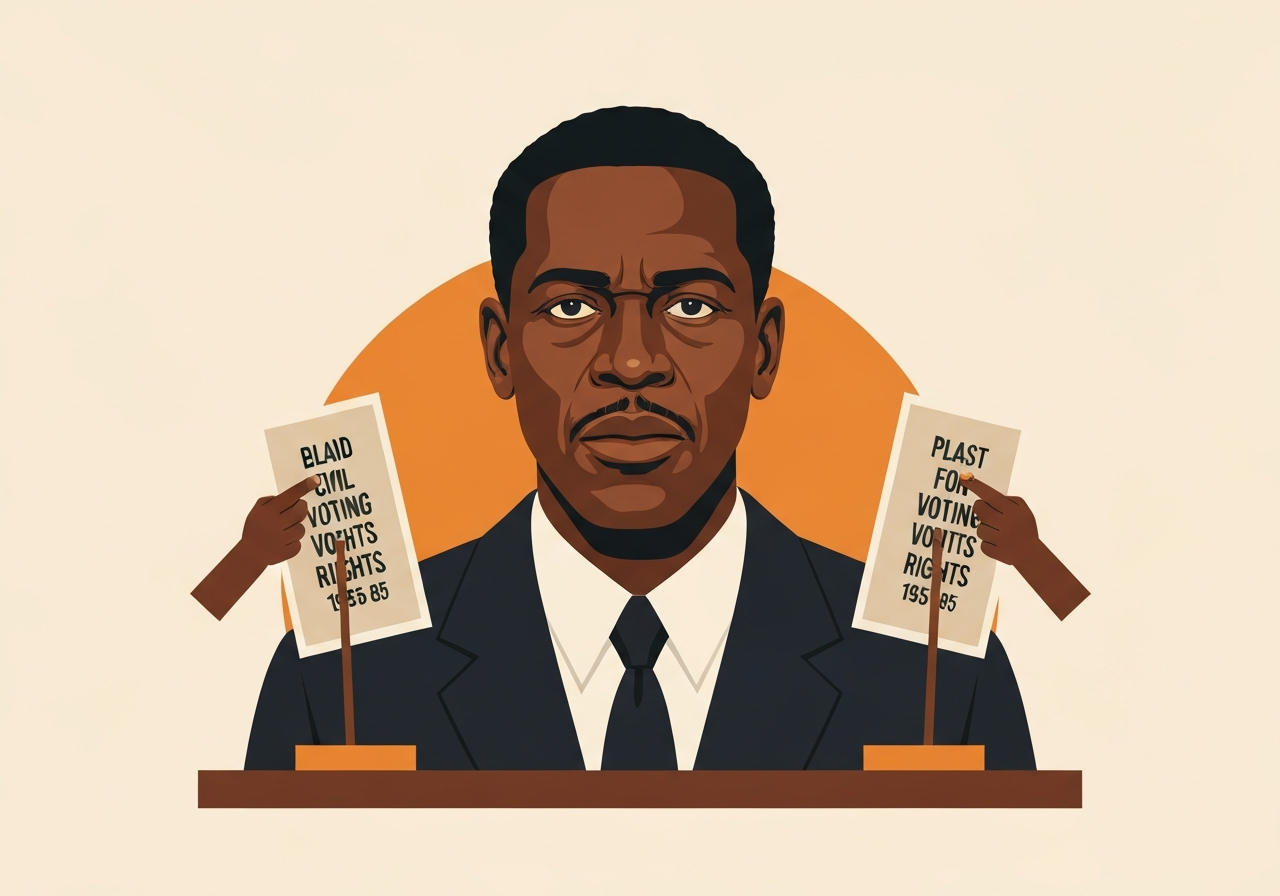
Bernard LaFayette, a key organizer whose behind-the-scenes work helped make Selma the focal point of the 1965 voting rights breakthrough, died on Thursday morning of a heart attack at age 85, his son Bernard LaFayette III said. LaFayette had led risky voter-registration and community leadership efforts in Alabama that laid the groundwork for the mass marches that pushed Congress to pass the Voting Rights Act of 1965. Though the March 7, 1965 attack on marchers on the Edmund Pettus Bridge drew national outrage, LaFayette’s quieter organizing in the years before was critical to that moment and to the movement that followed. His death closes a life spent training local leaders, teaching nonviolence, and carrying civil-rights strategies from the Deep South to cities and nations around the world.
Key takeaways
- Bernard LaFayette died Thursday morning of a heart attack at age 85, according to his son Bernard LaFayette III.
- LaFayette helped found the Student Nonviolent Coordinating Committee in 1960 as part of a Nashville student delegation and became director of Alabama voter registration in 1963.
- He moved to Selma in 1963, building local leadership and voter-registration capacity alongside community members and his then-wife Colia Liddell.
- LaFayette missed Bloody Sunday on March 7, 1965 because he planned to join the Selma-to-Montgomery march on day two; he helped mobilize reinforcements from Chicago for the subsequent successful march.
- He was beaten as a 1961 Freedom Rider, jailed at Parchman with more than 300 others, and survived an assassination attempt the night Medgar Evers was murdered.
- LaFayette later earned a doctorate from Harvard, led nonviolence training and academic centers, and worked internationally on peace and justice initiatives.
- Colleagues credit his Chicago organizing with helping create tenant protections and his global workshops with spreading nonviolence training to South Africa, Nigeria and Latin America.
Background
LaFayette came of age amid the concentrated campaigns of the early 1960s that used disciplined nonviolent direct action to challenge segregation and voter suppression across the South. He was one of a group of Nashville students who in 1960 helped establish the Student Nonviolent Coordinating Committee, an organization that coordinated sit-ins, freedom rides and voter drives aimed at dismantling Jim Crow barriers. Nashville had become an early laboratory for coordinated nonviolent protest, and LaFayette and peers used that experience to push into riskier settings where African Americans faced entrenched electoral exclusion.
By the early 1960s, southern states still maintained legal and extralegal systems to block Black registration and participation. Organizers frequently encountered threats, arrests and violence; LaFayette himself was beaten during a 1961 Freedom Ride and jailed at Parchman Farm in Mississippi with hundreds of other riders. Despite early assessments that Selma posed unusually steep risks for organizers and local residents, LaFayette accepted a role as director of the Alabama voter registration campaign in 1963 and moved to the city to work directly with Black residents to build organizing capacity.
Main event
Once in Selma, LaFayette and local activists invested in training, leadership development and trust-building that steadily expanded willingness among residents to attempt voter registration and public protest. He worked closely with local leaders and with his then-wife, Colia Liddell, to recruit and prepare volunteers, teach nonviolent practice, and couch voter drives in a broader strategy of community empowerment. Those day-to-day organizing choices were pivotal for turning isolated protests into a sustained campaign with national reach.
On March 7, 1965, state troopers violently attacked marchers attempting to cross Edmund Pettus Bridge, an event later known as Bloody Sunday that shocked national opinion and helped tip Congress toward action. LaFayette did not cross the bridge that day; he had planned to join on the second day and so avoided the initial police assault. He moved quickly after Bloody Sunday, mobilizing supporters from Chicago and elsewhere and arranging transport so they could participate in the renewed, ultimately successful march to Montgomery two weeks later.
The visibility and moral force of the Selma demonstrations contributed directly to President Lyndon Johnson introducing legislation that became the Voting Rights Act. LaFayette had faced repeated personal danger in the years leading up to that breakthrough, including an assassination attempt the same night Medgar Evers was murdered. Those risks underscored the stakes organizers confronted as they sought to make federal protections for voting rights politically possible.
Analysis & implications
LaFayette’s career underlines how movement breakthroughs often rest on sustained, low‑profile organizing rather than single dramatic moments. The Selma-to-Montgomery marches became symbolic because organizers had built local leadership and organizational capacity over years; without that foundation, national attention might not have translated into effective pressure on Congress. That pattern matters for contemporary civic struggles: durable policy change tends to follow patient institution-building as well as spectacle.
LaFayette also exemplified the nonviolence pedagogy that civil-rights leaders sought to institutionalize. Martin Luther King Jr.’s final admonition to expand and formalize nonviolence shaped LaFayette’s subsequent work in academia and international trainings. By turning nonviolent tactics into teachable, transferable methods, LaFayette helped movements worldwide adapt direct-action strategies to varied cultural and political contexts.
The legacy of Selma and the Voting Rights Act faces continuing tests: legal challenges, shifts in federal enforcement, and modern voter-access disputes. LaFayette’s emphasis on local leadership development offers a strategic answer to such erosion: where institutional protections weaken, resilient, locally anchored organizations can sustain participation and press for policy restoration. The history also highlights the ongoing need to document, teach and fund grassroots organizing as a complement to litigation and legislative advocacy.
Comparison & data
| Date | Event |
|---|---|
| 1960 | Founding activity of Student Nonviolent Coordinating Committee by Nashville students |
| 1961 | Freedom Rides; LaFayette beaten in Montgomery and jailed at Parchman |
| 1963 | LaFayette named director of Alabama voter registration; assassination attempt same night Medgar Evers murdered |
| 7 March 1965 | Bloody Sunday, Edmund Pettus Bridge |
| 6 August 1965 | Voting Rights Act signed into law |
The timeline above shows how incremental organizing from 1960 onward converged with high‑visibility events in 1965 to produce statutory reform. The sequence makes clear the interplay between sustained grassroots work and catalytic public moments in securing federal action.
Reactions & quotes
Colleagues and scholars highlighted LaFayette’s dual role as a hands‑on organizer and a teacher of nonviolence whose influence extended beyond the South.
The tenant protections we have today are really a direct outcome of that work in Chicago.
Mary Lou Finley, professor emeritus, Antioch University Seattle
Finley worked with LaFayette in Chicago and credited his local organizing for concrete policy changes in housing and tenant rights. Her observation ties grassroots training to later institutional reforms in northern cities.
Bernard literally went everywhere he was invited as sort of a global prophet of nonviolence.
Andrew Young, civil rights leader and former U.S. ambassador
Young spoke to LaFayette’s international engagement, noting workshops in South Africa, trips to Nigeria during crisis, and nonviolence work across Latin America. Those activities show how tactics developed in U.S. civil‑rights struggles were adapted to other movements globally.
Unconfirmed
- Details of the 1963 assassination attempt linked to Medgar Evers’ murder remain incompletely documented in public records and are described differently across sources.
- Precise counts of how many Chicago organizers LaFayette mobilized for the second Selma march vary in retrospective accounts and are not fully reconciled in contemporary reports.
Bottom line
Bernard LaFayette’s death marks the loss of an organizer whose patient, practical work made headline moments like Bloody Sunday consequential in law and policy. While the dramatic photos and news clips of police violence drew national outrage, it was the quieter years of training, local leadership development and risk-taking that created the capacity to translate outrage into legislative change.
As debates over voting access continue, LaFayette’s model — build local power, teach nonviolence as strategy, and pair grassroots pressure with legal and legislative advocacy — remains instructive. His life underscores that enduring reform depends as much on everyday organizing and education as on landmark court decisions and statutes.
Sources
- The Guardian — news report detailing LaFayette’s life, organizing in Selma, and contemporary reactions