
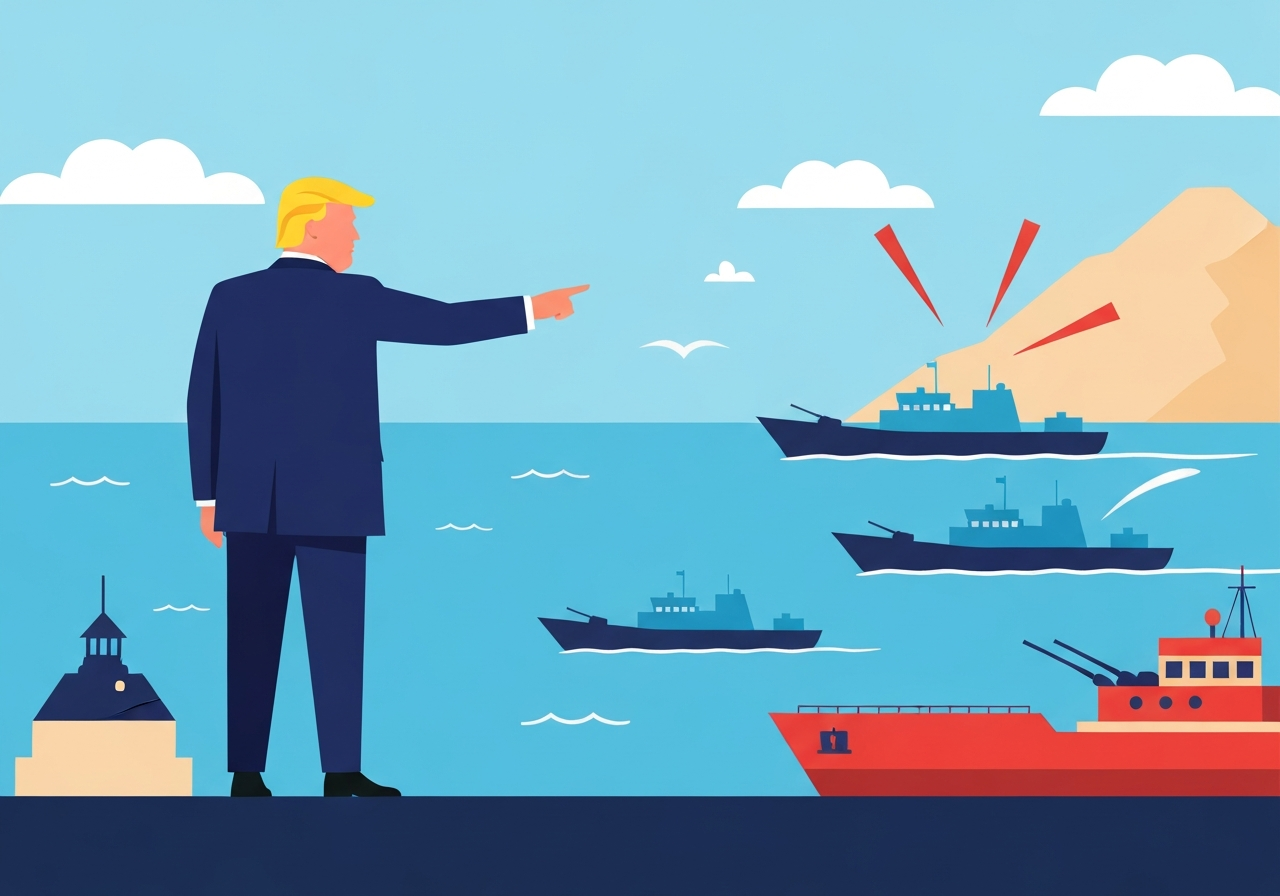
Lead: U.S. President Donald Trump announced on Monday that American forces had begun enforcing a blockade of Iranian ports and maritime approaches to the Strait of Hormuz, while warning that Iranian ships approaching the cordon would be destroyed. The declaration followed failed face-to-face talks in Islamabad over the weekend and preceded a 10 a.m. EDT start time for the blockade. Tehran responded with threats of strong retaliation and described U.S. moves as unlawful. The dispute has raised fresh alarms about disruptions to a waterway that normally carries nearly 20% of global oil and gas shipments.
Key Takeaways
- The U.S. announced a blockade of Iranian ports and coastal approaches on Monday, with enforcement said to begin at 10 a.m. EDT; President Trump warned ships nearing the blockade would be eliminated.
- Face-to-face U.S.-Iran talks in Islamabad over the weekend ended without agreement after 21 hours; the two-week ceasefire is set to expire on April 22, 2026.
- Britain refused to join the U.S. blockade and instead is coordinating a “peaceful multinational mission” with France to restore freedom of navigation in the Strait of Hormuz.
- Iran’s Revolutionary Guard called U.S. naval moves a violation of the ceasefire and threatened firm response; Tehran has been selectively allowing traffic and reportedly levying transit fees.
- Humanitarian and civilian tolls are mounting: Lebanese authorities say more than 100 people died over the weekend and roughly 40,000 houses have been destroyed in the past 35 days in Lebanon; at least 57 medics have been killed in six weeks.
- A joint watchdog report cited by NPR says Iran carried out 1,639 executions in 2025, a 68% rise from the prior year.
Background
Relations between Washington and Tehran have sharply deteriorated since the U.S. and Israel launched strikes on Iranian territory more than six weeks ago. The attacks triggered restrictions by Tehran on commercial traffic through the Strait of Hormuz, a narrow chokepoint through which nearly one-fifth of the world’s traded oil and gas normally flows. Iran has allowed only a limited number of vessels to transit, according to state media and international shipping notices, and some passages reportedly involved hefty transit fees.
The weekend diplomatic effort in Islamabad was billed as the highest-level face-to-face meeting between the two countries since 1979 and the first direct talks since 2015-level diplomacy. U.S. officials said the session lasted roughly 21 hours but ended without a mutual accord; U.S. Vice President Vance said Iran declined to accept U.S. terms aimed at securing a clear pledge not to pursue nuclear weapons or enabling capabilities. Tehran argued there had been progress on several items but accused the U.S. of shifting demands and pursuing a blockade.
European partners have moved to distance themselves from a unilateral U.S. enforcement posture. British Prime Minister Keir Starmer told the BBC he would not participate in a U.S. blockade, and French President Emmanuel Macron announced plans with Britain to convene countries willing to contribute to a defensive multinational mission to ensure free navigation in the strait.
Main Event
On Monday President Trump publicly declared that a blockade of Iranian ports and coastal approaches had begun and restated a posture of force toward any Iranian vessel that approaches the enforced cordon. The president framed the measure as a response to what he described as Iran’s extortionate charging of tolls and the placement of sea mines in the strait.
The United Kingdom Maritime Trade Operations posted a notice that maritime access restrictions were being enforced affecting Iranian ports and coastal areas, including parts of the Arabian Gulf, Gulf of Oman and the Arabian Sea east of the Strait of Hormuz. CENTCOM also reported setting conditions to clear mines and encourage the free flow of commerce, noting U.S. guided-missile destroyers had transited the strait during the weekend for the first time since the outbreak of hostilities six weeks earlier.
Iran’s Islamic Revolutionary Guard Corps (IRGC) publicly warned that U.S. movement of warships close to the Strait constitutes a violation of the ceasefire reached last week and vowed a firm response. Tehran’s state outlets labeled the U.S. naval action unlawful and akin to piracy. At the same time, Washington maintains the blockade is lawful enforcement against a regime it accuses of charging unlawful transit fees and risking safe passage by minelaying.
On the diplomatic front, Israel and Hezbollah continued strikes linked to the wider regional conflict. Israeli officials said they were seizing border villages to create a buffer and prevent rocket fire; Lebanese authorities reported heavy civilian losses and widespread housing destruction. Meanwhile, envoy-level talks between U.S., Israeli and Lebanese representatives were being arranged in Washington as regional and international actors sought to prevent escalation.
Analysis & Implications
The U.S. blockade and the president’s public threats raise immediate legal and military questions. Retired naval experts note a blockade that prevents a country’s normal foreign trade is classically considered an act of war under international law, even as the U.S. frames its step as a measure to uphold freedom of navigation and punish alleged Iranian economic coercion.
Economically, disruptions to the Strait of Hormuz risk short-term spikes in energy prices and longer-term supply-chain ripples for commodities such as fertilizer and helium. Given that about 20% of global oil and gas flows through the strait, sustained closure or repeated interdictions would pressure global markets and could prompt extra production from non-regional suppliers while driving strategic stockpile releases.
Politically, divergence among Western partners complicates unified action. Britain and France favor a multinational, defensive mission rather than joining a U.S. blockade, reflecting wariness in European capitals about being drawn into unilateral coercive measures. That split limits the U.S. ability to claim multilateral legitimacy for aggressive enforcement and narrows diplomatic options for de-escalation.
Militarily, mine clearance and escorts to protect commercial traffic will be resource-intensive and hazardous. CENTCOM’s stated intent to set conditions for mine-removal acknowledges the breadth of the challenge: mines pose asymmetric risks to both military and civilian vessels and require specialized assets and time to neutralize, while any misstep could trigger direct confrontations at sea.
Comparison & Data
| Metric | 2025 (reported) | 2024 (approx., extrapolated) |
|---|---|---|
| Executions in Iran | 1,639 | ~976 (based on reported 68% increase) |
| Proportion of global oil/gas via Hormuz | ~20% | — |
The execution totals come from a joint watchdog report cited in coverage; the 2024 figure in the table is derived by reversing the 68% year-on-year increase reported for 2025. The strait’s share of global hydrocarbons is an established industry estimate used to illustrate the strategic stakes of maritime disruption.
Reactions & Quotes
President Trump warned that ships approaching the enforced blockade would be destroyed, framing the measure as necessary to stop Iranian “tolls” and protect navigation.
U.S. President Donald Trump (public statement)
Retired U.S. Admiral James Foggo said that while charging transit fees is unlawful, a blockade of a country’s export capabilities can be viewed as an act of war under international law.
Ret. Adm. James Foggo (military analyst)
British Prime Minister Keir Starmer said the U.K. will not join a U.S. blockade and emphasized efforts should focus on reopening the strait through political coordination and minesweeping.
UK Prime Minister Keir Starmer (BBC interview)
Unconfirmed
- Precise revenue from Iran’s reported transit fees is not independently verified; a lawmaker cited in reporting claimed fees reached up to $2 million per vessel but the full scope and frequency of such charges remain unconfirmed.
- The legal classification of the U.S. blockade as an “act of war” is disputed among legal scholars and officials; no international adjudication has determined the blockade’s status.
- Claims that an ambulance convoy was deliberately targeted remain contested; Lebanese authorities reported a drone strike on a Red Cross site, while Israel denies intentionally targeting medics.
Bottom Line
The U.S. decision to enforce a blockade of Iranian ports and approaches to the Strait of Hormuz, paired with President Trump’s public threats to destroy Iranian vessels that approach the cordon, sharply raises the risk of maritime clashes and wider escalation. European partners’ reluctance to join a unilateral blockade narrows diplomatic cover for Washington and points toward a divided international response centered on defensive multinational measures instead of offensive enforcement.
Immediate priorities will include mine-clearance operations, protection of merchant shipping, and efforts to salvage the fragile ceasefire that extends until April 22, 2026. Absent quick diplomatic progress, markets and regional security dynamics may experience sustained instability, and the legal contest over blockade versus lawful interdiction will likely intensify in international forums.