
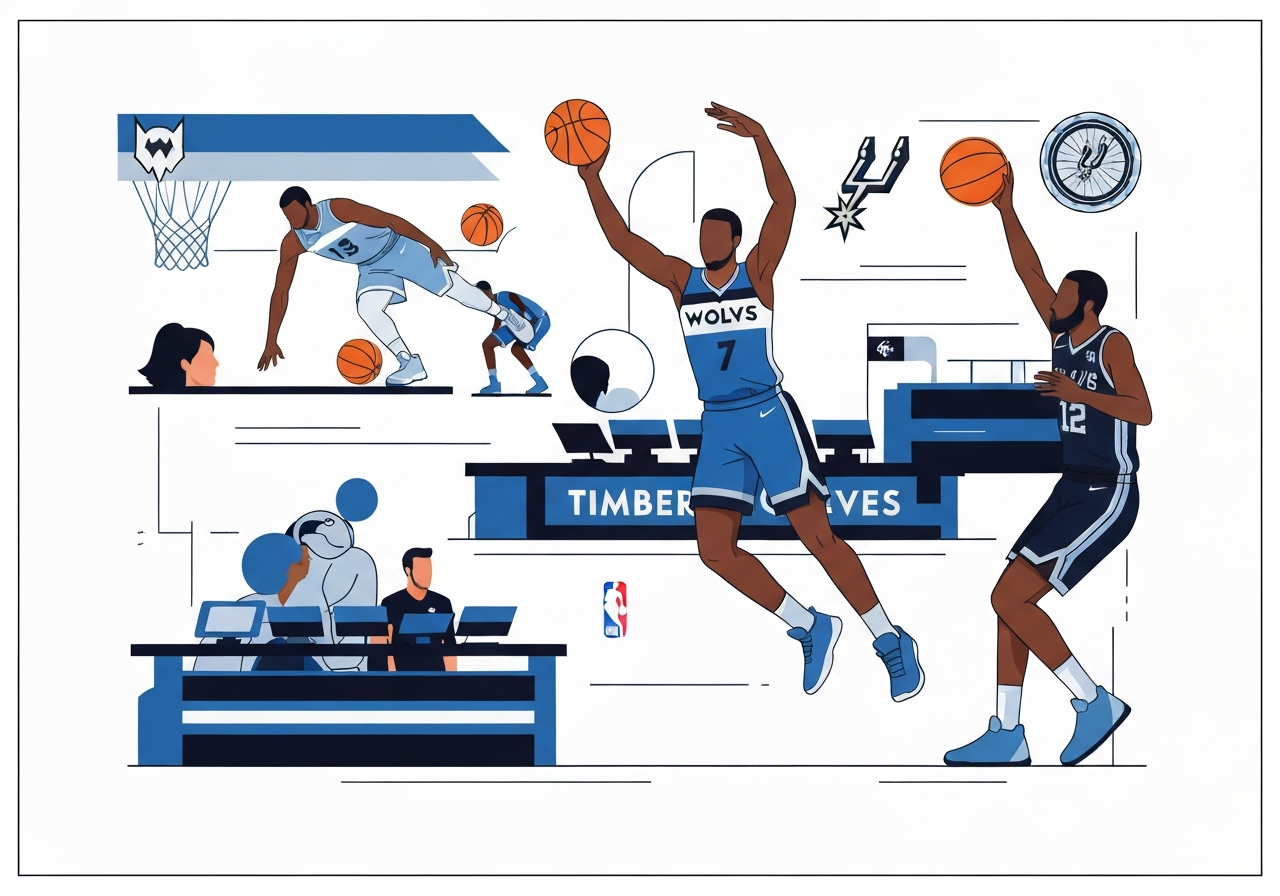
— At Frost Bank Center on Monday night, the sixth-seeded Minnesota Timberwolves edged the No. 2 San Antonio Spurs 104-102 in a tightly contested Western Conference semifinal opener. Anthony Edwards returned from a knee injury off the bench and supplied a late burst while Minnesota’s balanced attack overcame a historic shot-blocking performance by Victor Wembanyama. The game featured repeated rim-protection duels between Rudy Gobert and Wembanyama and came down to the final possessions. The Wolves’ depth and defensive length made the difference in a matchup that figures to remain close throughout the series.
Key Takeaways
- The Timberwolves won Game 1, 104-102, at Frost Bank Center on May 5, 2026, handing the No. 2 Spurs a home loss in the opening game.
- Anthony Edwards, making his first appearance since April 25, came off the bench and scored 18 points in 25 minutes, including 11 early in the fourth quarter.
- Minnesota had six players in double figures; Julius Randle led the club with 21 points and 10 rebounds, and Terrence Shannon Jr. added 16 points and five rebounds.
- Victor Wembanyama produced 12 blocks — the most in a playoff game since blocks became an official stat in 1973–74 — along with 11 points and 15 rebounds.
- Rudy Gobert contributed seven points and 10 rebounds and traded early blocks with Wembanyama, setting the tone for a defensive contest.
- The Spurs struggled offensively at times: Wembanyama was 0-for-8 from three, De’Aaron Fox had an off shooting night, and guard Stephon Castle fouled out late in the game.
- A late Timberwolves turnover led to a Dylan Harper dunk that cut the margin to two, but Julian Champagnie missed a potential game-winning 3 at the buzzer.
Background
This series pits Minnesota’s veteran interior presence and perimeter scorers against San Antonio’s young, length-driven core anchored by Victor Wembanyama. The matchup was billed as a contrast of styles: Gobert’s championship-era rim protection and pick-and-roll craft versus Wembanyama’s unprecedented combination of size, mobility and shot-blocking. Seedings sharpen the stakes — the Timberwolves advanced as the No. 6 against a Spurs club that finished the regular season second in the West — making each possession, matchup and adjustment magnified in a best-of-seven setting.
Both franchises entered the series with distinct priorities. Minnesota leaned on defensive identity and role-player spacing to complement its stars, while San Antonio’s offense depends heavily on creating corner 3s and using Wembanyama as a drop point that can either score or supply kick-outs. The Wolves’ ability to send help and contest perimeter shots without compromising paint coverage had been a recurring theme this postseason and set the stage for Monday’s chess match.
Main Event
The game opened with immediate signs of a defensive duel: Gobert and Wembanyama traded blocks at midcourt within the opening minute, signaling frequent rim-protection contests. Wembanyama accumulated seven blocks by halftime and finished with 12, repeatedly altering shots even when opponents avoided finishing at the rim. Gobert, meanwhile, impacted glass and paint defense while drawing fouls and switching on to perimeter actions when necessary.
Anthony Edwards’ return was the headline subplot. After hyperextending his left knee on April 25 in the previous round, Edwards accelerated his rehab and was available off the bench. He spent early minutes probing limits and then exploded in the fourth quarter, scoring 11 of his 18 points in the first five minutes of that period to lift Minnesota into the lead. Edwards logged 25 minutes and his presence reshaped the Wolves’ late offense.
Minnesota’s scoring was distributed — six players reached double figures — and the Wolves countered Wembanyama’s interior defense by generating movement, offensive rebounds and pick-and-roll mismatches. San Antonio struggled to establish half-court rhythm; De’Aaron Fox and other primary ball-handlers failed to find consistent looks while Stephon Castle’s foul trouble culminated in a disqualifying fifth foul late, removing a key penetrator from crunch-time play.
The closing sequence tightened dramatically: a Timberwolves turnover enabled a Dylan Harper dunk that reduced the margin to two, but the Spurs’ final chance ended when Julian Champagnie missed a contested 3-pointer at the buzzer. Minnesota escaped with a two-point victory that belied how close the contest truly was.
Analysis & Implications
Minnesota’s win highlighted two strategic truths: first, defensive length can blunt San Antonio’s half-court offense by denying simple catch-and-shoot corner opportunities; second, balanced scoring reduces the burden on any single star when games tighten. The Wolves’ ability to rotate, contest without fouling excessively and keep Wembanyama from consistently finishing at the rim forced the Spurs into lower-percentage shots and late-clock possessions.
For the Spurs, the game exposed the need to diversify creation beyond Wembanyama and De’Aaron Fox. When Fox struggled to shoot effectively and Castle was unavailable late, San Antonio’s secondary scorers could not reliably step up. The Spurs must refine actions that get Wembanyama rolling to the rim on the roll and generate quicker corner kick-outs before Minnesota’s long defenders can close out.
Edwards’ quicker-than-expected return changes Minnesota’s outlook. If he remains effective and durable, the Wolves gain a late-game shotmaker who can relieve pressure on Randle and other creators. However, Edwards’ minutes will likely be managed across the series to mitigate reinjury risk, making Minnesota’s depth crucial. San Antonio will also be forced to consider different defensive coverages and possibly use more mobility on the perimeter to limit Edwards and other wings.
Comparison & Data
| Player | PTS | REB | BLK |
|---|---|---|---|
| Julius Randle (MIN) | 21 | 10 | 0 |
| Anthony Edwards (MIN) | 18 | — | — |
| Terrence Shannon Jr. (MIN) | 16 | 5 | — |
| Victor Wembanyama (SAS) | 11 | 15 | 12 |
| Rudy Gobert (MIN) | 7 | 10 | — |
The table isolates the primary box-score lines that shaped the result: Minnesota’s multiple double-figure scorers contrasted with Wembanyama’s defensive counting stats. The 12-block total is the standout single-game defensive performance and was offset by limited offensive volume (11 points) and a 0-for-8 mark from beyond the arc. Minnesota’s scoring distribution (six players in double figures) lowered the Spurs’ ability to focus defensive attention on one scorer.
Reactions & Quotes
Edwards’ return shifted the late-game dynamic and provided a desperately needed scoring spark off the bench.
Jon Krawczynski, game recap analysis
The Spurs must adapt to Minnesota’s length and find cleaner half-court actions to generate corner threes and roll finishes.
Jared Weiss, series preview commentary
Postgame, coaching staff for both teams emphasized adjustments rather than the final score, pointing to execution and foul management as key for Game 2.
Team officials — postgame remarks
Unconfirmed
- Long-term impact of Edwards’ knee work: his performance was strong, but whether he can sustain heavy minutes through the series without setback is not yet confirmed.
- San Antonio’s specific schematic changes for Game 2 (rotations, play calls to free Wembanyama on the roll) were not finalized publicly.
- The extent to which Wembanyama’s 12-block night will produce fatigue or altered conditioning across subsequent games is not confirmed.
Bottom Line
Game 1 underscored how playoff series often turn on matchups and depth. Minnesota’s combination of veteran rim defense, timely scoring from Edwards and Randle, and a bench that produced points gave the Wolves a narrow but meaningful road victory. San Antonio’s defensive identity remained intact with Wembanyama’s shot protection, but offensive execution and late-game management must improve for the Spurs to avoid being dictated to by Minnesota’s length.
The series is likely to be a tug-of-war of adjustments: the Spurs must create cleaner looks and protect their ball-handlers from foul trouble, while the Wolves will look to manage Edwards’ minutes and continue to leverage balanced scoring. Expect coaches on both sides to emphasize matchups and situational substitutions as they attempt to swing small margins back in their favor across the coming games.