
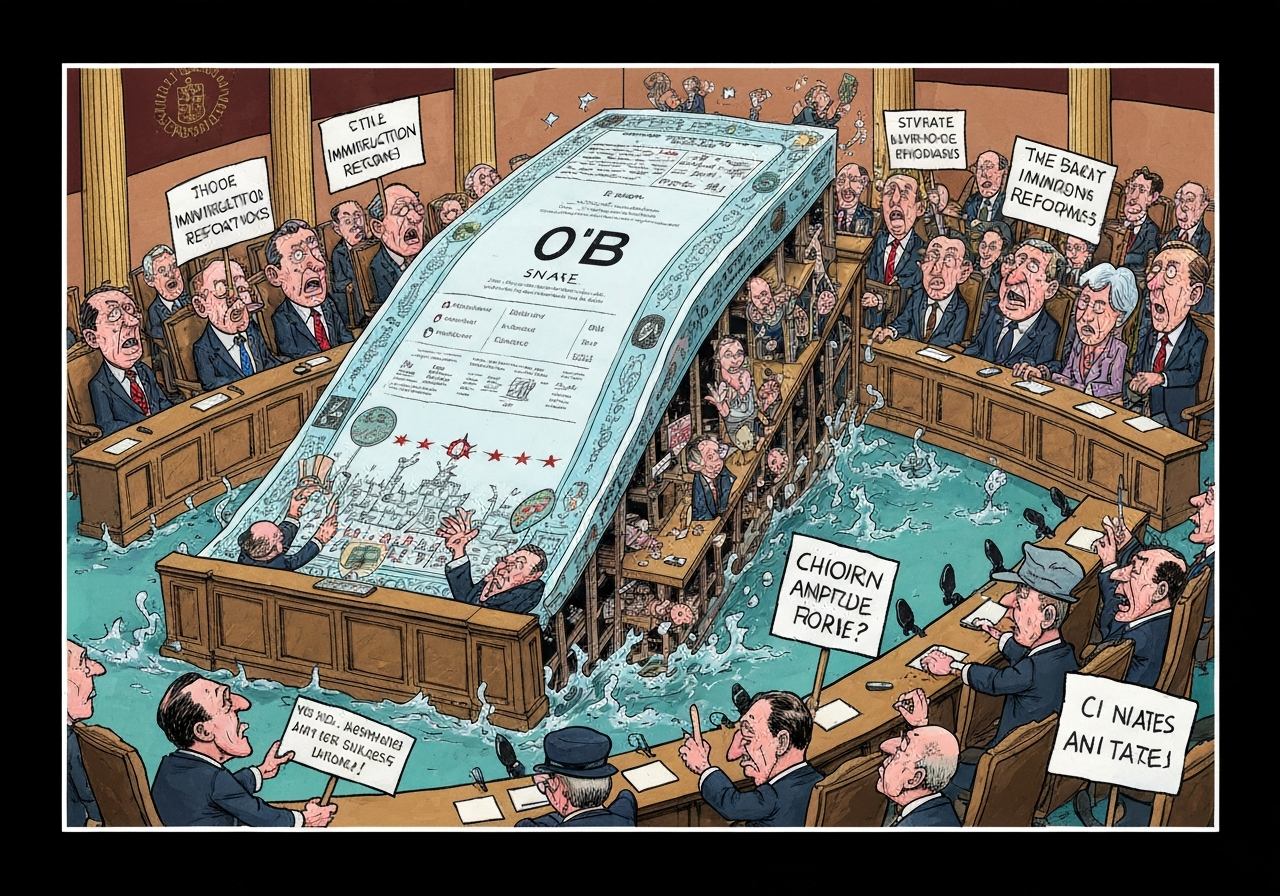
Lead: The Senate approved a $70 billion package to fund Immigration and Customs Enforcement (ICE) and U.S. Border Patrol early Friday, voting 52-47 after weeks of delays and contentious debate over an unrelated $1.776 billion settlement tied to former President Donald Trump. The measure funds those agencies through the end of Trump’s term — roughly three years — and now moves to the House, which is expected to consider it next week. Lawmakers repeatedly defeated amendments from both parties seeking to bar or redirect payments from the settlement, and much of the final-day rancor centered on whether the fund should be legislatively blocked.
Key Takeaways
- The Senate passed the measure 52-47 to provide $70 billion for ICE and Border Patrol through the end of President Trump’s term, with most Republicans voting in favor and Sen. Lisa Murkowski the lone GOP dissent.
- A separate $1.776 billion settlement fund tied to Trump’s lawsuit over leaked tax returns sparked repeated amendment votes; senators rejected efforts to permanently ban or redirect its payouts.
Background
The $1.776 billion settlement emerged from litigation between former President Trump and the Internal Revenue Service over leaked tax information; the agreement has infuriated many Republicans who view payouts to allies as politically fraught. Conservatives pressed for a statutory block on the fund’s distribution, arguing it would send taxpayer money toward politically motivated claims. Supporters of the settlement say it resolves a legal dispute and is managed under existing judicial and settlement processes.
Funding for Homeland Security components has been a fracture point for months. Democrats delayed ICE and Border Patrol funding after two protesters were fatally shot by federal agents in January, demanding reforms such as clearer identification for federal officers and greater judicial oversight. While Congress funded much of the Department of Homeland Security at the end of April, ICE and Border Patrol remained without an enduring appropriation until this Senate action.
Main Event
Votes stretched into the early hours as senators debated a series of amendments aimed at limiting or eliminating the settlement fund’s payouts. The final roll call, 52-47, was nearly party-line; Sen. Lisa Murkowski was the only Republican to vote against the bill, and Sen. Michael Bennet of Colorado missed the vote. Republicans used a procedural maneuver to overcome the filibuster barrier and advance the funding without Democratic votes.
Multiple amendments were offered and rejected. A Democratic motion to ban the settlement was held open for hours while senators negotiated; it ultimately failed when Sen. Bill Cassidy switched to oppose it. Cassidy later offered an amendment to redirect settlement funds to compensate law enforcement officers injured on Jan. 6; that proposal was also defeated. Sen. Thom Tillis proposed moving funds into a DOJ anti-fraud account, winning some Republican support but not enough for passage.
The disputes complicated what Republican leaders wanted presented as an otherwise straightforward law-and-order funding measure for an election year. Senate Majority Leader John Thune publicly pressed colleagues to keep the text narrowly focused on immigration enforcement funding, saying late Thursday that the vote would have occurred “several hours ago” if not for the fund controversy.
Analysis & Implications
Political calculus shaped many votes: Republicans sought to deliver a message of border enforcement while avoiding intra-party fights that could fracture their congressional majority heading into the campaign season. The settlement fund became a magnet for those political tensions because it touches on both legal vulnerability for the former president and raw emotions around Jan. 6. Defeating amendments to permanently ban the fund preserves future legal and administrative options for payouts, even as DOJ commentary complicated the picture.
Legislatively, the bill now faces the House, where members may attach riders or insist on policy changes demanded by Democrats. If the House amends the Senate language, the measure could return to the Senate or be reconciled in conference. The timing — with the funding set to run through the end of Trump’s term — gives Congress a limited window to re-examine enforcement priorities and oversight conditions for federal agents.
Operationally, passage should restore stable appropriations for ICE and Border Patrol, ending months of ad hoc or emergency arrangements. That stability affects staffing, facility management, and cross-border operations. However, congressional rancor over accountability and use of force suggests oversight hearings and new administrative guidance are likely regardless of funding, particularly in light of the January fatal shootings that helped trigger the impasse.
Comparison & Data
| Measure | Amount | Senate Vote |
|---|---|---|
| ICE & Border Patrol funding | $70 billion | 52-47 (passed) |
| Trump-related settlement | $1.776 billion | Multiple anti-fund amendments rejected |
The table highlights the scale difference between the core appropriation and the settlement fund that provoked the amendments. While $70 billion funds ongoing agency operations through the end of the administration, the $1.776 billion settlement is a discrete legal payout whose distribution and political implications drove the most contentious floor votes.
Reactions & Quotes
Senate Republican leadership framed the vote as a necessary step to secure immigration enforcement budgets while urging colleagues to avoid extraneous riders.
“This would have been done several hours ago if we weren’t having to deal with some of the issues around the fund,”
Sen. John Thune (R-S.D.)
Thune’s comment underscored GOP frustration with how the settlement eclipse complicated a priority spending item and delayed funding for operational needs at the border.
Democrats, meanwhile, criticized the decision to pass funding without stronger accountability language tied to civil liberties and use-of-force reforms.
“You’re leaving taxpayers to rely on nothing more than a promise from Donald Trump’s personal fixer. That is not accountability,”
Senate Minority Leader Chuck Schumer (D-N.Y.)
Schumer’s remarks framed Democratic objections as rooted in demands for enforceable conditions on federal agents and skepticism about relying on executive assurances regarding the settlement.
The Justice Department’s acting official response influenced votes by suggesting the settlement may not be actively executed.
“This is largely inoperative,”
Acting Attorney General Todd Blanche
Blanche’s characterization provided some Republicans political cover to oppose additional statutory bans, but it did not end calls for legislative fixes from members on both sides.
Unconfirmed
- Whether any individual payouts from the settlement will ultimately be made remains unresolved pending implementation and possible legal challenges.
- It is uncertain whether the House will accept the Senate language intact or attach amendments that would change settlement or oversight provisions.
- The long-term political effect on Republican primaries and general-election dynamics from the settlement controversy remains unclear.
Bottom Line
Passage of the $70 billion ICE and Border Patrol funding bill ends months of delay and restores multi-year appropriations for agencies central to the administration’s immigration agenda. However, the surrounding fight over the $1.776 billion settlement fund left open legal and political questions that are likely to reemerge in committee hearings and floor fights, particularly in an election year.
As the bill moves to the House next week, lawmakers and administration officials will confront whether to codify restrictions on the settlement, add accountability measures for federal law enforcement, or leave the settlement matter to the courts and executive branch. The outcome will shape not only operational funding but also the political terrain heading into upcoming races.