
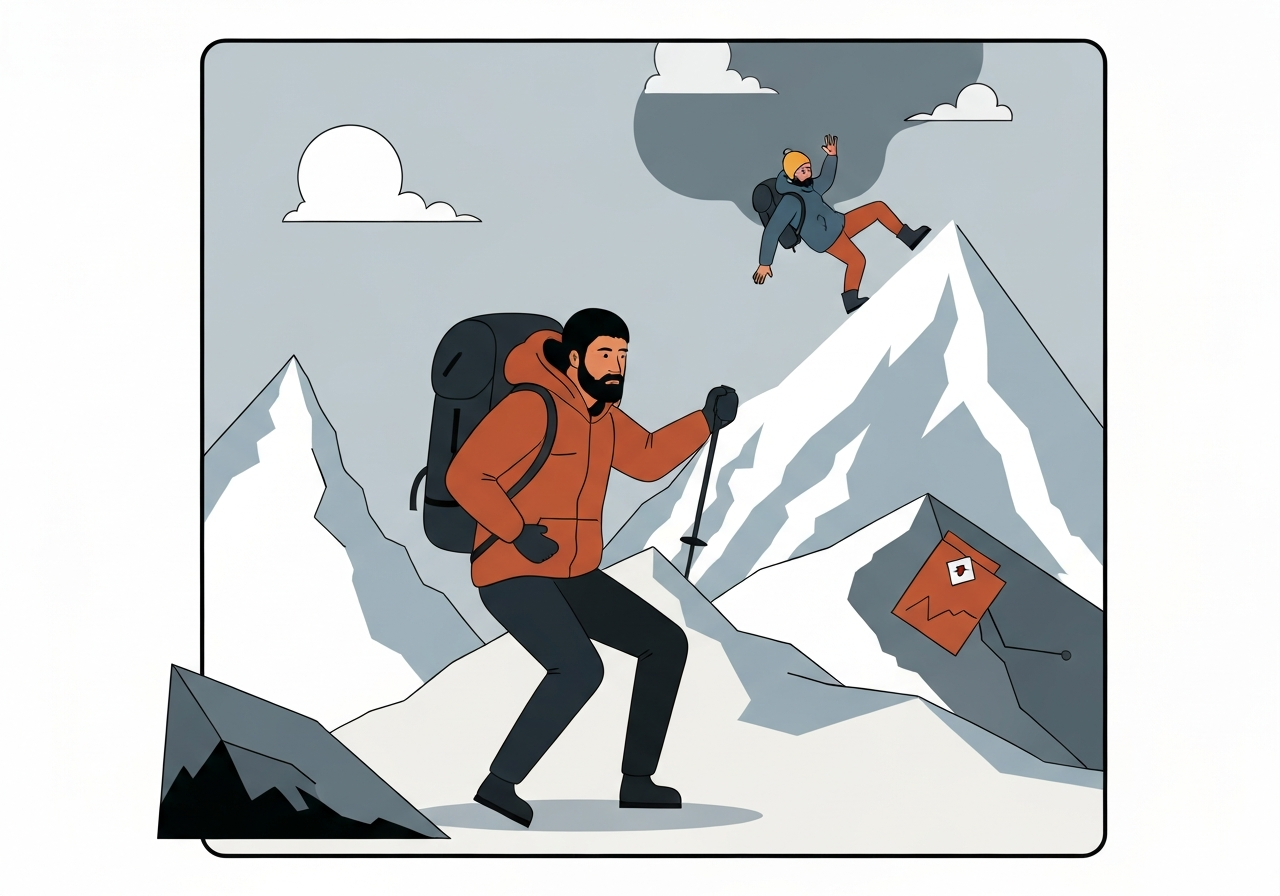
Lead: A 52-year-old Nepali guide, Dawa Sherpa—also known as Hillary Dawa Sherpa—was found alive and crawling toward Everest base camp on Thursday, a week after he went missing on 29 May and after his family had begun funeral rites in Kathmandu. He was located just above base camp near the Khumbu icefall with frostbite on his hands and taken by helicopter to a Kathmandu hospital where his wife and daughter were waiting. The search had involved a helicopter team and coordination from 8K Expeditions and local route crews; the discovery was made by a climbing support team tied to the Sagarmatha Pollution Control Committee. Officials say he was guiding a Polish climber and had last been seen near the Yellow Band above Camp 3 at about 7,200 metres.
Key takeaways
- Dawa Sherpa, 52, went missing on 29 May and was found alive on 4 June, roughly seven days later, near the Khumbu icefall above base camp.
- He was located around the Yellow Band area above Camp 3 (≈7,200 m); Everest base camp sits at about 5,300 m.
- Rescuers reported frostbite to his hands but described him as otherwise in a stable condition before airlifting him to Kathmandu for treatment.
- The recovery followed a failed helicopter search and coordination by 8K Expeditions and route crews from the Sagarmatha Pollution Control Committee.
- His family in Kathmandu had already begun multi-day funeral rituals; confirmation came after photos were exchanged with relatives.
- More than 1,000 climbers and guides summited Everest this May, the busiest season on record; five deaths were reported during the season.
- Witnesses say Dawa’s client was found suffering severe hypoxia and frostbite, and footage shared online included a video tribute by a British climber who had thought Dawa had died.
Background
The Himalayas have long relied on Nepali high-altitude workers—often described collectively as Sherpas—whose local knowledge and acclimatisation make them central to commercial expeditions. After Nepal opened its borders in the 1950s, Sherpas shifted from trade and herding to guiding and porter roles, eventually becoming dominant in Everest operations. That dependence has heightened both the mountain’s commercial throughput and scrutiny of safety management on routes that enter the so-called “death zone” above about 8,000 metres.
This spring’s season was delayed by an ice block that took roughly two weeks to clear the standard route above base camp, compressing summit windows and contributing to a historically high turnout. More than 1,000 climbers and their guides reached the peak this May, a record season that critics say increases risk from congestion and exposure. Authorities and expedition operators have faced renewed criticism after multiple fatalities and crowded bottlenecks in high-altitude sections.
Main event
Dawa Sherpa was last seen on 29 May near the Yellow Band above Camp 3 at about 7,200 metres; he did not descend with other groups to base camp as expected. Colleagues and climbers reported him missing when he failed to arrive, triggering searches that included helicopter reconnaissance but initially turned up no sign. During the following days, a local climbing support unit linked to the Sagarmatha Pollution Control Committee continued ground searches on the approach to base camp.
On Thursday morning a climbing support team found Dawa crawling on the snowy slope just above base camp and carried him down to safer ground. He had frostbite on his hands but was able to receive food and water before being flown to Kathmandu. Pemba Sherpa of 8K Expeditions, which coordinated aspects of the search, confirmed the find and said rescue teams moved quickly to stabilise and evacuate him.
Family members in Kathmandu had already begun traditional funeral ceremonies when news of the rescue arrived. Dawa’s wife, Damu Sherpa, said the family first learned via local reports and only accepted the rescue after seeing photographs. Their teenage daughter, Mendo Lhamu Sherpa, described the emotional confusion before confirmation and the relief once they were certain the survivor was indeed their father.
Analysis & implications
The case highlights several persistent stresses in contemporary Everest seasons. Large numbers of climbers, compressed weather windows and route maintenance challenges can increase the likelihood that individuals become separated from teams or face delayed rescues. When a guide goes missing, the operational and human costs escalate quickly: search teams must balance risk to rescuers with the urgent need for recovery in extreme-altitude conditions.
Survival for multiple days in the high alpine environment, even below the formal death zone, is rare and underscores both individual resilience and the limits of formal search capabilities. Dawa’s case may prompt operators to re-evaluate communications checks, client-to-guide ratios and the monitoring of returning parties, particularly in sectors like the Khumbu icefall where terrain and weather change rapidly.
The episode also puts a spotlight on cultural practices around death and mourning. Families begin multi-day funeral rites based on presumption of death, creating acute emotional and logistical strain when outcomes change. For operators and regulators, that cultural dimension complicates messaging and the management of missing-person events, and it may affect how quickly families are informed and how resources are marshalled for searches.
Comparison & data
| Item | Figure |
|---|---|
| Altitude — Yellow Band / Camp 3 | ≈ 7,200 metres |
| Base camp altitude | ≈ 5,300 metres |
| Climbers/guides summited (May season) | More than 1,000 |
| Deaths reported this season | 5 |
These figures show the vertical distance Dawa had to cover to reach base camp and place this rescue in the context of an unusually busy season. The altitude differential of roughly 1,900 metres between Camp 3 and base camp highlights the physiological challenge of descending after exposure and injury; operationally, large summit counts correlate with greater logistical strain on route teams and rescue assets.
Reactions & quotes
Rescue coordinators and community leaders framed the recovery as extraordinary while noting the harsh realities of Himalayan rescue work.
“This is nothing short of a miracle surviving so many days on the mountains facing such harsh conditions.”
Ang Tshering Sherpa, senior community leader
Ang Tshering Sherpa placed the survival in the context of Sherpa acclimatisation and experience, while cautioning that not everyone exposed to similar conditions would survive. Community leaders emphasised the role of local route crews in spotting and stabilising the guide.
“We first heard he was alive on local news; we asked for photos to be sure before we could accept it.”
Damu Sherpa, wife of Dawa Sherpa
Damu Sherpa’s comments underline the emotional turmoil for families when ritual and rescue collide; relatives were midway through funeral rites and only paused them after visual confirmation. Pemba Sherpa of 8K Expeditions provided operational context, noting the earlier helicopter searches that had failed to locate Dawa.
Unconfirmed
- Whether Dawa’s satellite phone and radio were functioning during the period he was missing remains unclear; reports mention devices but their status is not independently verified.
- The precise sequence of events that led to his separation from colleagues—whether rest, aid to his client, or sudden weather change—has not been fully reconstructed.
- Details about any supplemental oxygen Dawa may have had or used during the days he was missing have not been confirmed by medical or expedition records.
Bottom line
Dawa Sherpa’s survival after nearly a week missing on Everest is an exceptional and human story amid a season marked by record traffic and several fatalities. The recovery underscores the capability and limits of current high-altitude search operations: local route crews and coordination between operators can be decisive, but weather, terrain and crowding continue to constrain response times.
For regulators and expedition leaders, the incident is likely to renew calls for stronger communication protocols, clearer client-to-guide responsibilities and possibly tighter limits on how many teams operate simultaneously in critical sections of the route. For families and the climbing community, the episode is a reminder of both the risks of commercial high-altitude climbing and the deep cultural stakes tied to life-and-death events in Nepal.
Sources
- The Guardian (news report)
- Sagarmatha Pollution Control Committee (local route/cleanup organisation overview)