
Lead
Californians voted in a statewide gubernatorial primary on June 2, 2026, and ballots continued to be tallied through the following week. With a majority of ballots counted as of 9:07 a.m. on June 8, Democrat Xavier Becerra is leading the contest and has officially advanced, followed by Republican Steve Hilton. Billionaire Democrat Tom Steyer trails both and Republican Riverside County Sheriff Chad Bianco is leading in a small number of counties. The top-two jungle primary will send two candidates to a November runoff to replace Gov. Gavin Newsom when the new term begins in January 2027.
Key Takeaways
- The primary was held June 2, 2026, under California’s jungle primary system where the top two finishers advance regardless of party.
- Statewide tallies show Xavier Becerra currently leading; the campaign announced he officially advanced on Friday following the first tabulations.
- Republican Steve Hilton, a British-born former TV host who became a U.S. citizen five years ago, is the apparent second-place finisher in statewide returns so far.
- Tom Steyer, a Democrat and high-dollar self-funder, remains in contention but is behind the two leaders in the current count.
- Riverside County Sheriff Chad Bianco leads vote totals in several counties but not statewide.
- California has 58 counties and the secretary of state has until July 10, 2026, to certify final results, so margins can shift as mail and provisional ballots are processed.
- Counting remains slow by national standards because of California’s extended mail-ballot and cure processes; additional tallies are expected in the coming weeks.
Background
California uses a nonpartisan primary often called a jungle primary: all candidates appear on the same ballot and the top two vote-getters move on to the general election. That system can produce same-party runoff races and shapes campaign strategy, fundraising and voter outreach across the state. This year the primary determines who will contest the November 2026 general election to succeed Gov. Gavin Newsom, whose current term ends in January 2027.
The field included high-profile figures from across the political spectrum: established Democrats, wealthy self-funders and Republicans seeking to expand their statewide footprint. Campaign spending, advertising saturation and targeted get-out-the-vote efforts have been unusually intense, particularly in media markets around the Bay Area, Los Angeles and the Central Valley. Local dynamics in the 58 counties — from urban precincts to rural suburbs — strongly influence early maps and media narratives about who appears favored to advance.
Main Event
On primary night, June 2, Republican candidate Steve Hilton held an event in Huntington Beach where a photograph showed him with a small American flag sewn into his jacket as he addressed supporters and reporters. That visual became one of several campaign images circulated in post-election coverage. Across the state, county election offices continued to count mail ballots, provisional ballots and late-arriving returns, producing a steadily updated picture of county-by-county outcomes.
By the early hours of June 8, with a majority of ballots tallied, state-level returns put Xavier Becerra ahead and Steve Hilton in second place. Campaign teams and local election officials cautioned that final percentages remained provisional until county canvasses conclude and the secretary of state certifies results by July 10. In some inland and rural counties, Chad Bianco led local totals, reflecting his base in parts of Southern California.
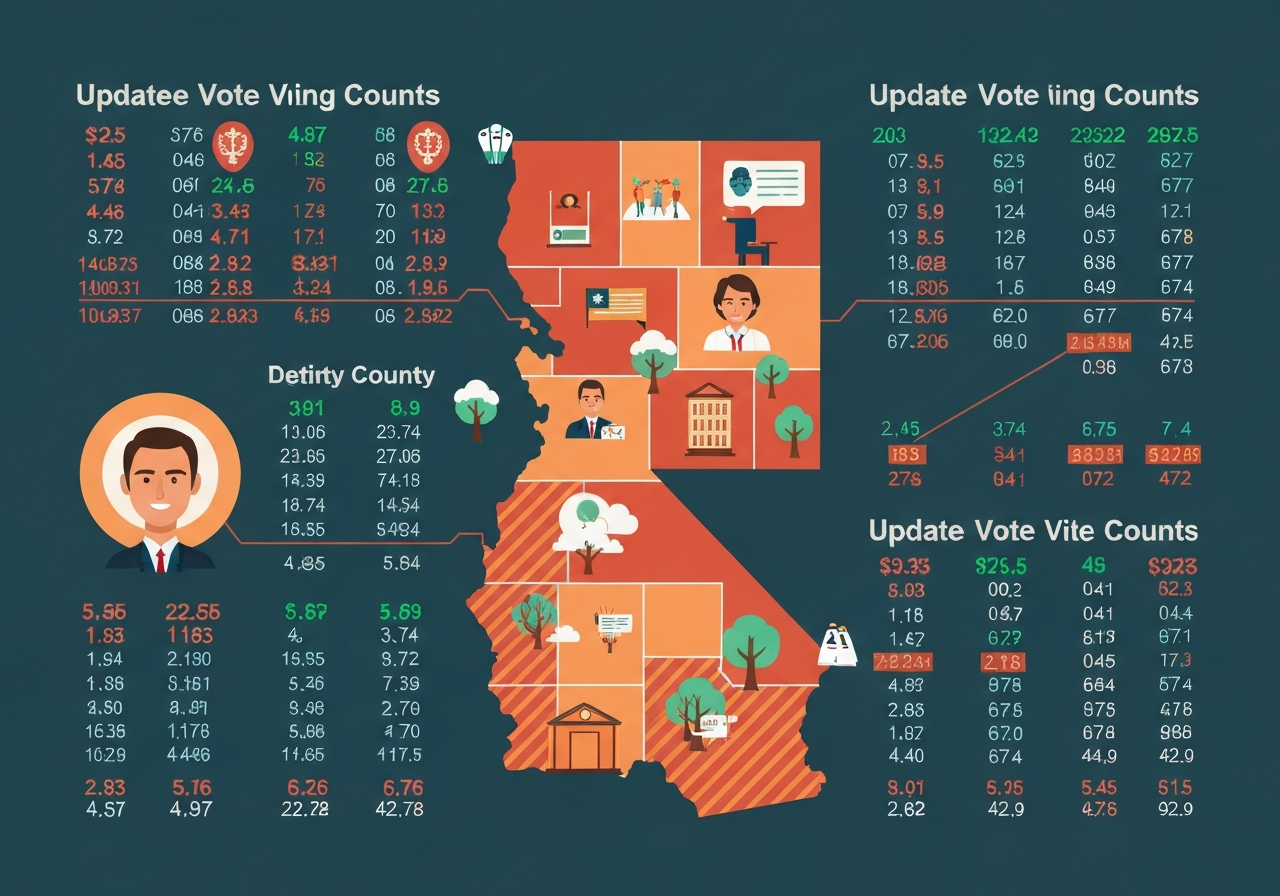
News outlets compiled county maps showing which candidate led in each of the 58 counties. Those visualizations give an early read on regional strengths but do not yet reflect all outstanding ballots, including late mail returns and certain provisional ballots that require verification. Officials reiterated that small shifts in turnout patterns or the processing of outstanding ballots could alter margins in close counties and potentially the statewide order in tightly contested scenarios.
Analysis & Implications
The most immediate implication is the likely November matchup between a Democrat and a Republican, with Xavier Becerra and Steve Hilton positioned to square off if current standings hold. That pairing would frame November as a contrast between an establishment Democratic figure and a Republican with a media profile and recent citizenship history that has attracted national attention. Fundraising, early voter contact and messaging will shift quickly to general-election strategic themes once candidates confirm their November campaigns.
Tom Steyer’s role as a self-funding candidate means he influenced messaging and advertising throughout the primary, but his trailing position reduces the odds he will shape the final two-candidate narrative unless remaining tallies move him upward. For Republicans, Hilton’s statewide showing signals an ability to consolidate a segment of the GOP electorate, but translating a primary performance into a victory in a deeply Democratic state will require broader crossover appeal and turnout gains in populous counties.
County-level leaders such as Chad Bianco show how localized campaigns can win in regions with distinct political and law-enforcement appeal, but leading a handful of counties does not translate directly into statewide victory without substantial support in urban centers. The slow pace of final counts also introduces uncertainty: candidates trailing by narrow margins have opportunities to close gaps as provisional and mail ballots are resolved. National observers will watch whether California’s extended counting window changes perceptions of momentum or the allocation of outside resources.
Comparison & Data
| Metric | Value |
|---|---|
| Primary date | June 2, 2026 |
| Number of counties | 58 |
| Certification deadline | July 10, 2026 |
| Latest update cited | June 8, 2026, 9:07 a.m. |
These fixed markers frame the unfolding results. The county map snapshots circulating in media reports show geographic patterns but should be read alongside outstanding ballots and county canvass reports. Put another way, a lead in a low-population county can be symbolically important but practically limited unless paired with strong results in California’s major population centers.
Reactions & Quotes
We are reviewing returns county by county and remain optimistic about the path forward,
Becerra campaign (statement)
Supporters turned out in force on primary night and those early returns reflect energy in key regions,
Hilton campaign (statement)
California’s vote-counting process includes multiple verification steps and final tallies will be certified by July 10,
California Secretary of State (official)
Explainer
Unconfirmed
- Final vote shares in several counties remain provisional until late-arriving or provisional ballots are validated and could shift current leaders.
- Any assertions that the current early county map determines the November matchup are premature while outstanding ballots are processed.
Bottom Line
The June 2 primary produced an early picture of how California’s 58 counties are leaning, with Xavier Becerra and Steve Hilton positioned to advance if current tallies hold. The jungle primary framework and a drawn-out counting calendar mean that results will continue to evolve through county canvasses and the secretary of state’s certification on July 10.
For voters and observers, the coming weeks will be decisive: campaigns will pivot to the general election playbook, outside spending may intensify, and county-level tallies will determine whether the early statewide order is final. Until certification, readers should treat county maps and percentiles as informative but not definitive.