
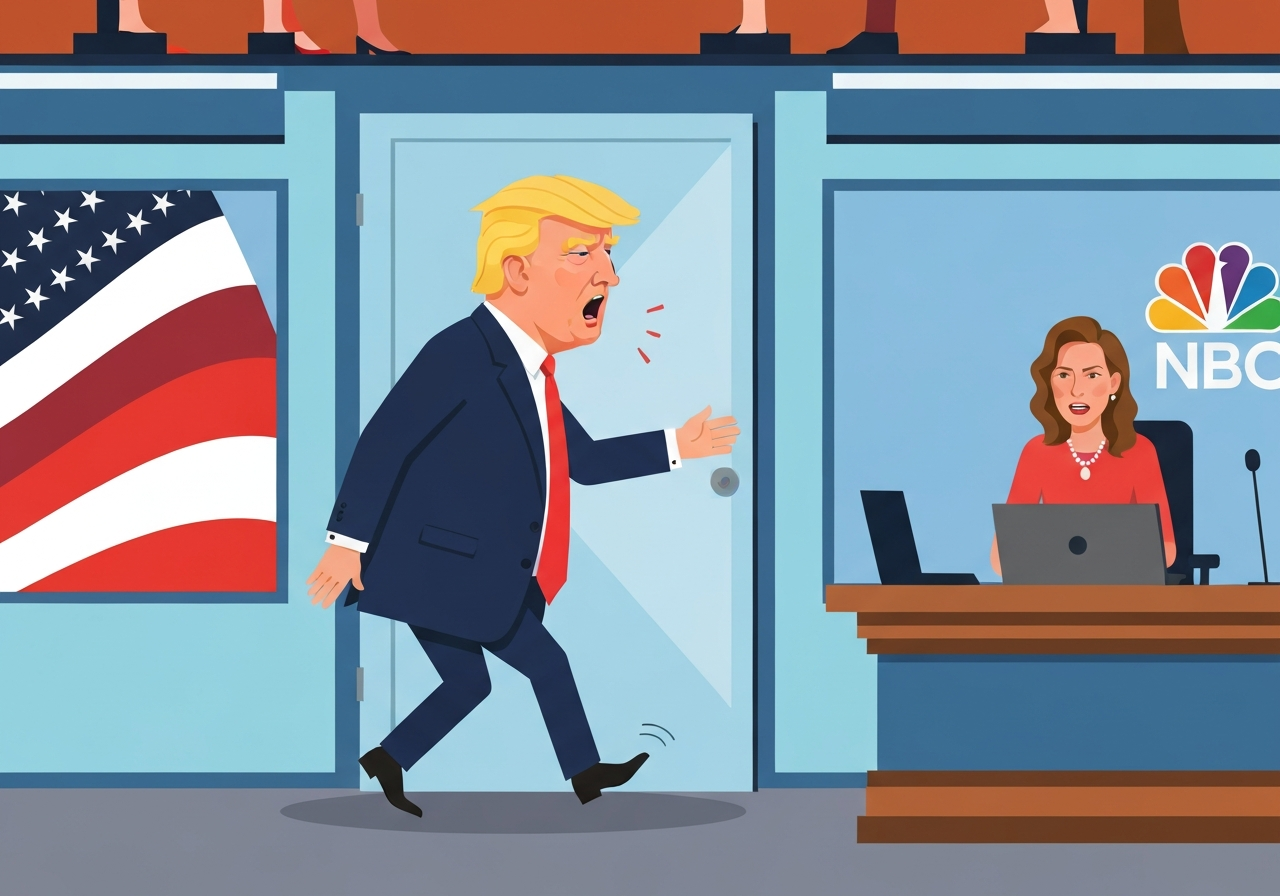
Lead: On June 8, 2026, a taped interview in Wisconsin between President Donald Trump and NBC News’ Kristen Welker ended abruptly after the president was pressed about his election-fraud allegations and could not produce corroborating evidence. The exchange, recorded Friday and aired Sunday on Meet the Press, centered on Mr. Trump’s assertions about both the 2020 election and ongoing problems in California’s primaries. Welker repeatedly asked for proof; Mr. Trump cited slow counting as suggestive but did not present concrete data. The interview concluded when he called the outlet “crooked” and left the set.
Key Takeaways
- The interview was taped Friday and broadcast Sunday, with the CBS report dated June 8, 2026.
- Trump asserted California’s slow tallying means “they’re cheating,” while state officials say multi-day counts are normal due to widespread mail-in voting.
- Welker noted the Trump legal team’s record: 62 post-2020 election cases filed, with only one meaningful victory.
- After repeated questioning, Trump accused the reporter and network of bias, then ended the interview and walked off camera.
- Trump-nominated Bill Essayli said his office opened “multiple election fraud investigations” and seeks audits of voter rolls in California.
- The president defended allocating money from an “anti-weaponization fund” toward Jan. 6 defendants, though the acting attorney general said the administration was “not moving forward” with that plan and did not provide a written commitment.
- Political scientists and California officials warned before the primary that ballots could take days or weeks to finalize because of state law and large mail-in volumes.
Background
The confrontation comes against a broader backdrop of persistent claims from Mr. Trump and his allies that the 2020 election was stolen. Those claims produced extensive litigation nationwide: Trump and his supporters filed roughly 62 legal challenges, winning only one tangential, limited ruling. Courts repeatedly dismissed the bulk of those suits for lack of evidence.
California’s election system allows for a high volume of mail-in ballots and late-arriving returns, a design that routinely extends counting timelines in close contests. In 2026, the state’s gubernatorial primary and the Los Angeles mayoral race remained unresolved nearly a week after Election Day, a delay state officials and election experts anticipated and publicly explained to counter misinformation.
Main Event
During the taped Meet the Press interview, Kristen Welker pressed Mr. Trump for specific evidence supporting his claims that the 2020 contest was rigged and that fraud was affecting current California primaries. Mr. Trump repeatedly pointed to the time California took to count ballots, saying “All I have to do is look,” but did not cite forensic findings, sworn affidavits, or court rulings to substantiate systemic fraud.
Welker challenged that line of reasoning, noting that extended counting is a well-documented consequence of California’s laws and procedures. She pointed to the litigation record: across dozens of post-2020 suits, the president’s side secured only a single minor legal win, undermining claims of widespread judicial validation of fraud allegations.
The exchange grew heated when Mr. Trump attacked Welker and NBC, calling them “crooked or stupid” and asserting similar judgments about other networks. After telling Welker, “You’re a one-sided crooked network,” he said, “Let’s call it quits,” and walked off camera following additional back-and-forth.
The interview also touched on other topics: Mr. Trump disputed that he had promised no new U.S. wars, pointing to military strength as a rationale. That comment contrasted with public campaign rhetoric from 2024 in which he pledged to keep the nation out of new conflicts. NBC published a full transcript of the interview after airing.
Analysis & Implications
The immediate political effect is twofold: the episode reinforces Mr. Trump’s combative media posture, which energizes supporters who view mainstream outlets skeptically, while providing critics fresh evidence of evasiveness under direct questioning. For undecided or moderate voters, televised walkouts can signal an unwillingness to submit claims to scrutiny, potentially eroding credibility on matters that rely on factual substantiation.
Legally, the interview highlights the limits of rhetorical proof. Courts require admissible evidence—documents, sworn testimony, forensic audits—not the appearance of anomalies or slow tabulation. The record of post-2020 litigation, where most suits failed on evidentiary grounds, remains a powerful counterpoint to repeated public assertions of a stolen election.
Administratively, moves by Trump-nominated officials like Bill Essayli to open investigations or audit voter rolls could increase tension between federal and state election authorities. California officials and many election administrators argue that audits and additional scrutiny should follow established, transparent procedures to avoid undermining public confidence in valid results.
Finally, the episode may affect how future interviews are conducted: journalists may press harder for verifiable sources when public figures repeat claims with legal and civic consequences, while politicians who face persistent fact-checking may increasingly avoid extended on-camera exchanges.
Comparison & Data
| Metric | Detail |
|---|---|
| Post-2020 suits filed by Trump allies | Approximately 62 cases, one significant victory |
| California primary counting timeline | Often takes days to weeks for close contests due to mail-in ballots |
Those figures illustrate the contrast between legal outcomes and public claims. The 62-case figure reflects litigation nationwide after the 2020 election; courts dismissed most cases on procedural or evidentiary grounds. California’s slower count stems from statutory allowances for late-arriving mail ballots and a large electorate, not court findings of fraud.
Reactions & Quotes
Before the primary, political scientists and state leaders sought to explain the mechanics behind multi-day counts and to pre-empt false narratives.
“California really cares about counting its ballots. And so as a result, we have a lot of different ways to vote.”
Christian Grose, USC professor of political science (comment to CBS News)
This comment was offered ahead of the primary to contextualize why California’s process can be lengthy even when handled correctly.
“Do you have evidence to support that?”
Kristen Welker, NBC News (during the interview)
Welker used this prompt multiple times to press for specific proof beyond the observed pace of counting.
“All I have to do is look.”
President Donald Trump (during the interview)
The president used that response to justify his assertion, a reply Welker and election experts characterized as insufficient as legal proof.
Unconfirmed
- Claims that California is “cheating on the election” based solely on counting speed remain unverified by forensic audits or court findings.
- Statements that Bill Essayli’s office has opened multiple investigations are reported; the scope and findings of any probes were not detailed publicly at the time of reporting.
- Whether funds from the “anti-weaponization” account will be reallocated remains unresolved; the acting attorney general said the administration is “not moving forward” but did not offer a binding written guarantee.
Bottom Line
The interview underscored a continuing pattern: the president frequently repeats election-fraud assertions without presenting documentary or judicial evidence, and when pressed in long-form interviews he may disengage rather than supply substantiation. That pattern affects public discourse about election integrity, complicates interactions between federal nominees and state election systems, and gives both supporters and detractors fresh material for debate.
For voters and officials, the practical takeaway is clear: counting timelines and administrative rules explain many delays in jurisdictions like California, while legal remedies require credible evidence and due process. How the administration, state authorities, and the courts respond to audit requests and investigations in the coming weeks will determine whether public concerns are assuaged or amplified.
Sources
- CBS News — media report summarizing the interview and related developments.
- NBC News (Meet the Press transcript) — media (transcript published by NBC News)