
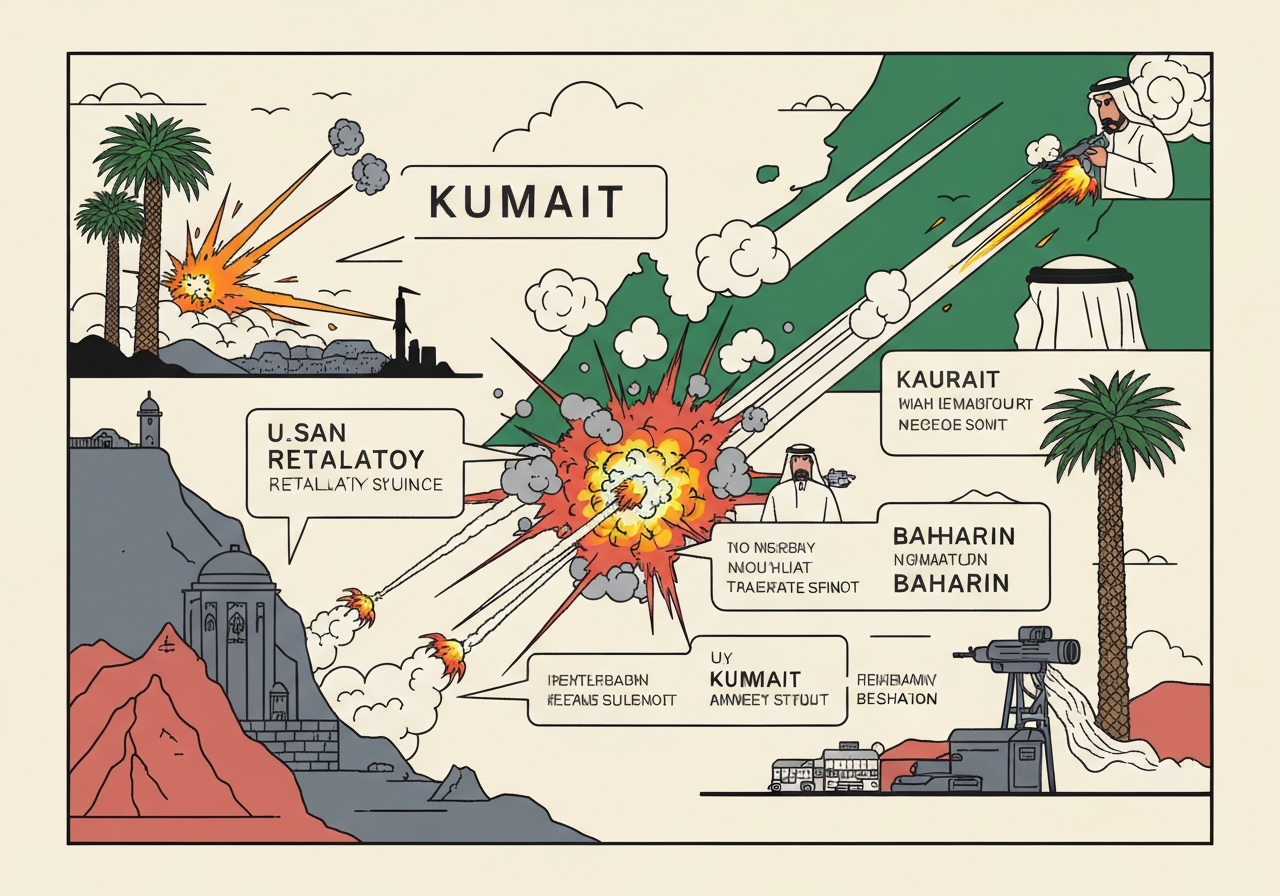
Lead: U.S. military aircraft struck multiple Iranian coastal military sites on Saturday at President Donald Trump’s direction, citing renewed attacks on commercial shipping. Early Sunday, Iran’s Islamic Revolutionary Guard Corps (IRGC) said it hit U.S. military positions in Kuwait and Bahrain in retaliation, according to the state news agency IRNA. The exchanges followed drone attacks on commercial vessels in and near the Strait of Hormuz and have strained a fragile interim ceasefire and 60-day memorandum of understanding reached earlier this month. There were no immediate, independently confirmed reports of large-scale damage or U.S. military casualties.
Key Takeaways
- U.S. strikes: On Saturday, U.S. Central Command said American aircraft struck Iranian surveillance, communications, air-defense, drone storage and minelaying-related sites along Iran’s coast.
- Iranian response: Early Sunday the IRGC announced strikes on U.S. military sites in Kuwait and Bahrain, reported by the state-run IRNA agency.
- Kiku tanker hit: CENTCOM said Iranian forces struck the Panama-flagged tanker M/T Kiku with a one-way drone at about 4:30 a.m. ET while it carried more than 2 million barrels of crude oil.
- Earlier incidents: The Singapore-flagged Ever Lovely was attacked days earlier while exiting the Strait of Hormuz after U.S. forces cleared mines from that route.
- Diplomatic risk: The exchanges come amid a 60-day window for a broader settlement and negotiations over Iran’s highly enriched uranium stockpile.
- Regional alarm: Bahrain, Egypt and Kuwait publicly condemned the attacks; the UK Maritime Trade Operations Centre also reported a commercial-vessel attack near Oman.
- Frequency: U.S. officials said this was the third time in three weeks U.S. warplanes struck similar Iranian targets following drone attacks in the strait.
Background
Negotiators in Tehran and Washington reached a temporary memorandum of understanding earlier in June that set a 60-day window to work out a broader settlement, including limits on Iran’s stockpile of highly enriched uranium. The interim arrangement included a practical ceasefire around commercial shipping routes in the Strait of Hormuz, but disagreements persisted over which maritime corridors vessels should use. Iran has insisted ships transit closer to its coastline and has repeatedly warned against using the U.S.-supported corridor near Oman; U.S. forces have cleared mines and escorted ships along the latter route.
The Strait of Hormuz is a strategic chokepoint for global oil flows, and recent weeks have seen a string of asymmetric attacks — notably one-way attack drones and suspected mine strikes — on tankers and cargo ships. Those incidents prompted both military escorts and alternate routing through Omani coastal waters; a U.N. maritime agency began moving stranded vessels along that Omani route before pausing operations after a fresh attack. Against that backdrop, both sides have treated violations of the interim arrangements as intolerable, raising the prospect of rapid military escalation.
Main Event
On Saturday, U.S. Central Command posted that American aircraft had struck multiple Iranian targets identified as missile and drone storage locations, coastal radar installations and other surveillance and minelaying infrastructure. CENTCOM framed the action as a response to an earlier Iranian attack on the Ever Lovely and then to the drone strike on the Kiku tanker, saying Iran ‘‘elected not to honor the ceasefire agreement.’’ The U.S. statement named specific categories of Iranian capability but did not provide a full operational inventory or a casualty count.
Shortly after those U.S. strikes, Iran’s IRGC issued a statement carried by IRNA saying it had targeted several locations it described as belonging to the “U.S. terrorist army in the region.” Iran’s announcement said strikes in Kuwait and Bahrain were carried out in retaliation, but state reporting did not provide a detailed damage assessment or identify individual facilities by name. Bahrain state media accused Tehran of exporting chaos and undermining regional stability.
CENTCOM reported that the Panama-flagged oil tanker M/T Kiku was struck by a one-way drone early Sunday, with the vessel reportedly carrying more than 2 million barrels of crude. The UK Maritime Trade Operations Centre separately reported an attack on a commercial vessel near the Omani coast on Saturday; shipping-data firm Windward said the strait remained operationally open but that the pace of normalization in traffic had slowed. U.S. officials said the American strikes were the third such response in three weeks to similar Iranian drone attacks in the strait.
Analysis & Implications
The immediate implication is a marked increase in the risk of broader escalation. Reciprocal strikes on multiple states’ soil — even if limited in scale — raise the chances of miscalculation, especially when attacks involve third-party states such as Kuwait and Bahrain. The asymmetric nature of the confrontations (one-way drones, coastal radars, minelaying) allows both sides to signal resolve while attempting to limit large-scale conventional warfare, but such signaling can still spiral if a strike causes substantial civilian casualties or damages critical infrastructure.
For international shipping and energy markets, persistent attacks through the Strait of Hormuz can raise insurance costs, slow tanker movements and create price volatility. Although there were no immediate major reported disruptions to global oil supply after these actions, the prospect of repeated incidents over a 60-day negotiation window increases uncertainty for markets and for companies planning shipments through the region.
Diplomatically, the strikes complicate the ongoing 60-day talks. Washington and Tehran had been using the interim ceasefire to negotiate longer-term limits and inspections on sensitive materials. Each side’s public posture — the U.S. striking to deter further attacks and Iran responding to show red lines — reduces political space for compromise and could harden domestic constituencies opposed to concessions. Regional actors, including Gulf states and European mediators, may face pressure to rebalance security arrangements and maritime escorts.
Comparison & Data
| Date (2026) | Actor | Action |
|---|---|---|
| June 24 | Iranian forces | Drone attacks on Ever Lovely (near Omani coast) |
| June 26 (late) | U.S. forces | Air strikes on Iranian coastal missile/drone storage and radar sites |
| June 27 (early) | IRGC | Announced strikes on U.S. military sites in Kuwait and Bahrain; Kiku tanker hit by one-way drone |
The table above summarizes the recent sequence of events that drove the latest round of retaliation. Analysts note that this pattern — an attack on a commercial vessel followed by limited strikes — has repeated three times in three weeks, making the current period the most active for state-on-state maritime confrontations in the region since the interim agreement began.
Reactions & Quotes
“There may come a point when we are no longer able to be reasonable,”
President Donald Trump, Truth Social
Context: President Trump posted on his social platform after the U.S. strikes, warning of stronger measures if Iranian actions continued. His remarks were framed as both a justification for the strikes and a general warning about future U.S. options.
“We have targeted several locations of the U.S. terrorist army in the region.”
Islamic Revolutionary Guard Corps (IRNA)
Context: The IRGC statement, relayed by state media, framed its strikes as direct retaliation and warned that further U.S. action could end negotiations tied to the ceasefire.
“The Strait of Hormuz is governed by Iran.”
Ebrahim Azizi, Chair, Iran parliamentary national security commission
Context: Iranian parliamentary officials have insisted Tehran has authority over transit decisions in its coastal waters and described recent actions as “ceasefire management.” Western officials reject that framing when the actions affect vessels using U.S.-supported routes.
Unconfirmed
- Independent confirmation of physical damage or casualties at the named U.S. sites in Kuwait and Bahrain is incomplete; official IRGC claims lack corroborating third-party assessment.
- The precise chain of command and whether IRGC actions were coordinated with other Iranian military branches has not been publicly verified.
- The full extent of damage to the M/T Kiku and whether oil transfer or environmental impact assessments are underway remain unconfirmed.
Bottom Line
The tit-for-tat strikes on June 26–27 show how quickly a fragile interim deal can be strained by asymmetric attacks on maritime traffic. Both sides have signaled willingness to use limited military force to defend perceived red lines, which creates recurring episodes of risk for commercial shipping, regional partners and global markets.
Looking ahead, the negotiation window for a broader settlement is threatened by reciprocal military actions and hardening rhetoric. International mediators and regional states will face increased pressure to provide guarantees for safe passage or to broker a renewed de-escalation framework, but the immediate weeks will likely remain volatile as both Tehran and Washington weigh deterrence against the political costs of further escalation.