
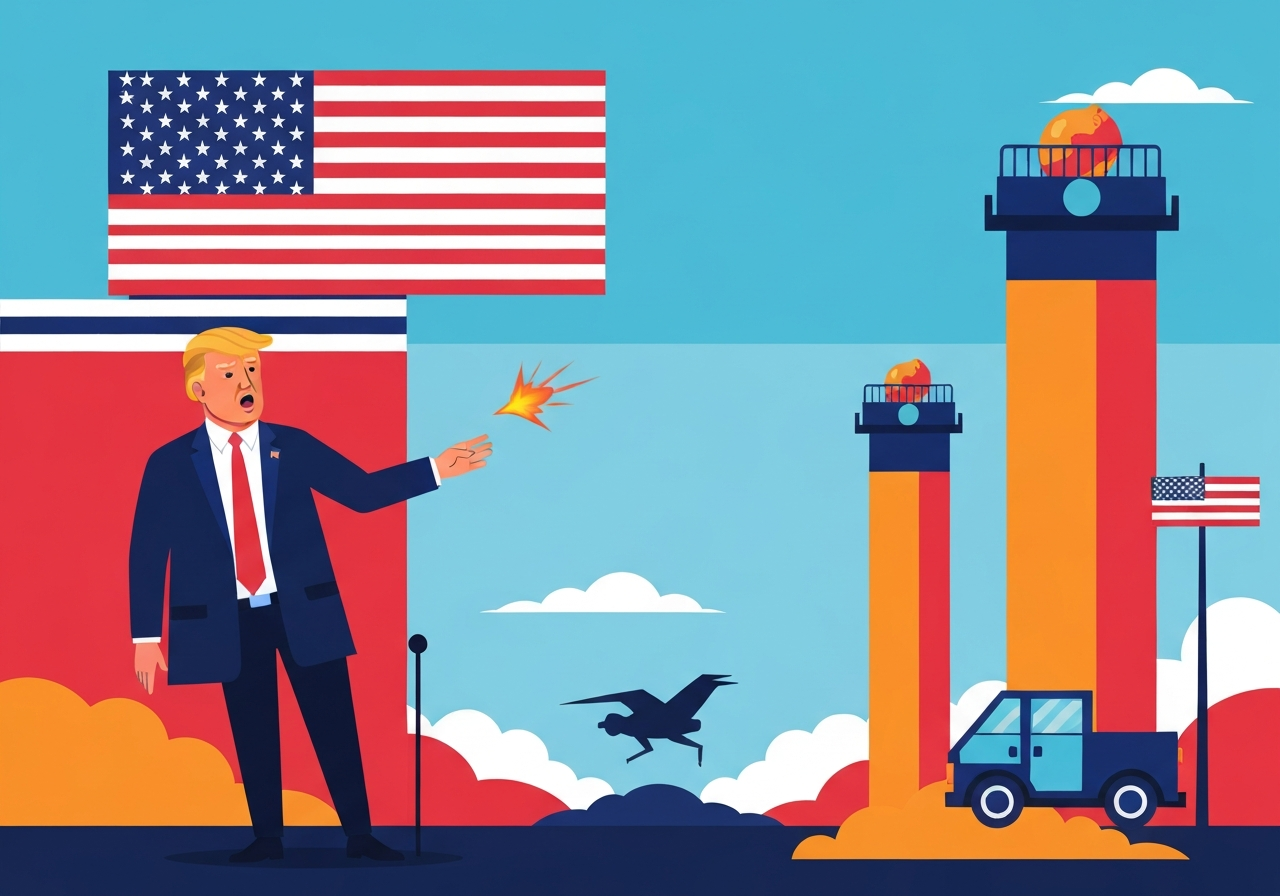
Lead: Over June 26–27, 2026, U.S. and Iranian forces exchanged air and drone strikes across the Persian Gulf and near the Strait of Hormuz after an Iranian drone struck a commercial vessel. Iran’s Islamic Revolutionary Guard Corps (IRGC) said it hit U.S. military facilities in Kuwait and Bahrain in retaliation for earlier U.S. attacks; U.S. Central Command (CENTCOM) said additional U.S. strikes targeted Iranian missile and drone infrastructure. President Trump publicly accused Tehran of violating a recent ceasefire and warned of heavier action if Iran continues. There are no confirmed U.S. combat casualties reported so far, but the exchanges have disrupted shipping and heightened regional tensions.
Key Takeaways
- Iran’s Revolutionary Guard claimed it “destroyed eight important US military facilities” at Ali al-Salem (Kuwait) and Port Salman (Bahrain) on June 27; U.S. sources have not corroborated those damage or casualty claims.
- CENTCOM said U.S. forces struck Iranian targets again on June 27, describing attacks on surveillance, communications, air defense sites, drone storage and minelaying capability; U.S. officials earlier said four targets were hit by six land-based aircraft on June 26.
- A commercial Singapore-flagged cargo ship was struck by a projectile/detected drone on June 25–26 in the Strait of Hormuz; the vessel sustained bridge damage but reported no injuries.
- Maritime disruption: the International Maritime Organization reported about 115 vessels and roughly 2,500 seafarers evacuated from the Strait region since Tuesday (week of June 24–27).
- Economic signal: Brent crude fell about 4% to roughly $72 a barrel on June 26 as markets digested the attack and subsequent strikes.
- Domestic pressures in Iran are acute: official statistics show year-on-year inflation reached 88.6% in June (Khordad), with food prices more than doubling year-on-year in that period.
- Regional diplomacy remains fragile: a U.S.-brokered trilateral agreement involving Israel and Lebanon is contested by Hezbollah and Iran, complicating de-escalation efforts.
Background
The exchanges are part of a broader conflict that has involved Iran, the United States, Israel and Iran-aligned groups since early 2026. Last month the U.S. and Iran negotiated a memorandum of understanding (MOU) that temporarily extended a ceasefire, including provisions on the Strait of Hormuz and some confidence-building measures. Despite that MOU, incidents—especially attacks on commercial shipping and strikes near sensitive bases—have continued to erode trust and test the ceasefire’s durability.
The Strait of Hormuz is a strategic choke point through which a substantial share of the world’s oil and liquefied natural gas flows. Control or contestation of transit routes has immediate commercial and insurance consequences for global shipping. Gulf Arab states, many allied with the U.S., have repeatedly condemned Iranian attacks on Bahrain, Kuwait and vessels, while Iran frames its actions as defensive responses to perceived threats and foreign interference.
Multiple actors complicate diplomacy: Hezbollah in Lebanon remains armed and opposed to some settlement terms, Israel insists on security measures that may include a continued presence in southern Lebanon, and Gulf states have differing priorities on how to secure maritime traffic. International agencies such as the U.N.’s International Maritime Organization (IMO) and the U.N. have been drawn into evacuation and routing decisions for commercial vessels.
Main Event
June 26: U.S. forces launched strikes on several Iranian targets after a drone struck a commercial cargo vessel transiting near Oman, according to U.S. officials. CENTCOM described the targets as missile and drone storage sites, radar installations and other military surveillance and minelaying capabilities. A U.S. official told reporters that four targets were hit by six land-based aircraft during the initial response.
June 27: Iran’s Revolutionary Guard announced strikes it said hit U.S. military locations at Ali al-Salem Air Base in Kuwait and the U.S. Fifth Fleet facilities at Port Salman, Bahrain, claiming eight U.S. facilities were destroyed. CENTCOM and U.S. authorities have not confirmed that level of damage; U.S. statements noted strikes were launched “in direct response to continued Iranian aggression against commercial shipping.” There were no reported U.S. casualties at the time of reporting.
Across the Gulf, Gulf Cooperation Council members and other regional capitals condemned Iranian attacks on Bahrain and expressed support for the kingdom. At the same time, diplomatic moves continued elsewhere: Washington announced a trilateral framework with Israel and Lebanon intended to underpin a longer ceasefire, a plan rejected by Hezbollah and criticized by Tehran as inconsistent with earlier points in the U.S.-Iran MOU.
On social media and at public events, President Trump reiterated that Iran had “violated” the ceasefire and threatened that the U.S. military could be forced to “complete the job” if Iran did not comply. Vice President JD Vance echoed a hardline stance, saying “violence will be met with violence.” These statements raised concern among foreign and domestic critics that rhetorical escalation could drive further kinetic responses.
Analysis & Implications
Military escalation: The tit-for-tat nature of the strikes raises the risk of miscalculation. Both sides appear to be calibrating actions to punish the other while attempting to avoid large-scale direct confrontation; nonetheless, strikes on bases in allied countries (Kuwait, Bahrain) and on maritime traffic increase the chance of unintended collateral effects and third-party involvement.
Economic impact: Disruption to the Strait of Hormuz affects global energy markets and shipping insurance. The immediate market response—Brent crude dipping roughly 4% to near $72—reflects both the short-term selloff and continued market judgment that, while risky, supply shocks remained limited at that moment. If attacks on shipping or ports persist, insurance premiums and rerouting costs could meaningfully raise shipping prices and push energy prices higher.
Political consequences: President Trump’s public threats sharpen domestic politics in the U.S. and complicate multilateral diplomacy. Hardline rhetoric may be intended to deter Iran, but it can also reduce diplomatic space for mediators (Pakistan, Qatar, Oman) and harden Iranian domestic political factions that oppose concessions. In Tehran, record-high inflation (88.6% y/y) increases strain on leaders who must balance domestic pressures with external military posturing.
Regional ripple effects: The trilateral U.S.-Israel-Lebanon framework and the separate U.S.-Iran MOU present conflicting expectations for Israeli withdrawal and disarmament of non-state actors like Hezbollah. Hezbollah’s rejection of the trilateral framework and vows to continue resistance could prolong low-intensity conflict along the Israel-Lebanon border, complicating any Iran-U.S. de-escalation gains.
Comparison & Data
| Date | Actors | Targets | Reported outcome |
|---|---|---|---|
| June 26, 2026 | U.S. (CENTCOM) | Missile/drone storage, radar sites (Iran) | U.S. official: 4 targets hit by 6 aircraft |
| June 27, 2026 | IRGC (Iran) | Ali al-Salem (Kuwait); Port Salman (Bahrain) | IRGC claims 8 U.S. facilities destroyed (unconfirmed) |
| Since June 24, 2026 | IMO / U.N. | Commercial shipping | ~115 vessels and ~2,500 sailors evacuated |
| June 2026 (Khordad) | Statistical Centre of Iran | Inflation (y/y) | 88.6% |
Context: The table aggregates official and open-source figures reported between June 24–27, 2026. Some claims from military spokesmen and state media remain contested; readers should weigh official U.S. and Iranian statements against independent verification such as satellite imagery, third-party maritime reports, and on-the-record confirmations from allied host governments.
Reactions & Quotes
U.S. political leaders framed the strikes as enforcement of the ceasefire terms and deterrence against further attacks on shipping. Critics warn that rhetorical escalation narrows diplomatic options.
“United States aircraft just struck Iranian missile and drone storage locations… for violating the Cease Fire Agreement, AGAIN!”
President Donald Trump (Truth Social)
Trump’s post was part assertion of a ceasefire breach and part public warning to Tehran that Washington might escalate if attacks continue. The White House characterized the strikes as targeted and proportionate; opponents questioned whether public threats would hinder quiet diplomacy.
“Any enemy aggression… will have a crushing response.”
Islamic Revolutionary Guard Corps (IRGC) statement / IRNA
The IRGC framed its June 27 action as retaliation and a deterrent. State media amplified the language; independent verification of the claimed destruction of U.S. facilities has not been provided publicly by neutral sources.
“This is a major blow to Iran and Hezbollah… we will maintain a security zone.”
Prime Minister Benjamin Netanyahu (statement)
Israeli leaders used the moment to defend a trilateral framework with the U.S. and Lebanon that preserves Israeli security prerogatives in southern Lebanon. Hezbollah rejected the deal and promised continued resistance, underscoring how separate tracks of diplomacy are colliding.
Unconfirmed
- IRGC’s claim that eight U.S. facilities at Ali al-Salem and Port Salman were destroyed has not been independently verified by U.S., Kuwaiti, Bahraini or third-party sources.
- The precise intent and source attribution for every projectile or drone that struck vessels in the Strait of Hormuz remains under review; initial reports attribute one strike to an Iranian drone, but full forensic details have not been publicly released.
- President Trump’s assertion that frozen Iranian funds will be used to buy U.S. crops for Iran is disputed by Iranian negotiators and lacks a confirmed implementation timeline.
Bottom Line
Between June 26–27, 2026 the U.S. and Iran re-engaged militarily in the Gulf, puncturing a fragile ceasefire and underscoring how quickly tactical incidents can widen into broader confrontation. While both sides appear to be aiming to punish and deter rather than start a full-scale war, the margin for miscalculation is small: strikes near allied bases, attacks on commercial shipping and blunt public threats raise the risks for third-party casualties and broader escalation.
What to watch next: independent verification of damage at Ali al-Salem and Port Salman; whether the communications line between the U.S. and Iran holds; insurance and routing decisions by major shipping firms; and how regional actors (Oman, Kuwait, UAE, Bahrain, Saudi Arabia) and mediators (Pakistan, Qatar) respond diplomatically. Successful de-escalation will require parallel restraint on the battlefield and quiet, verifiable diplomatic mechanisms to manage maritime safety and ceasefire compliance.