
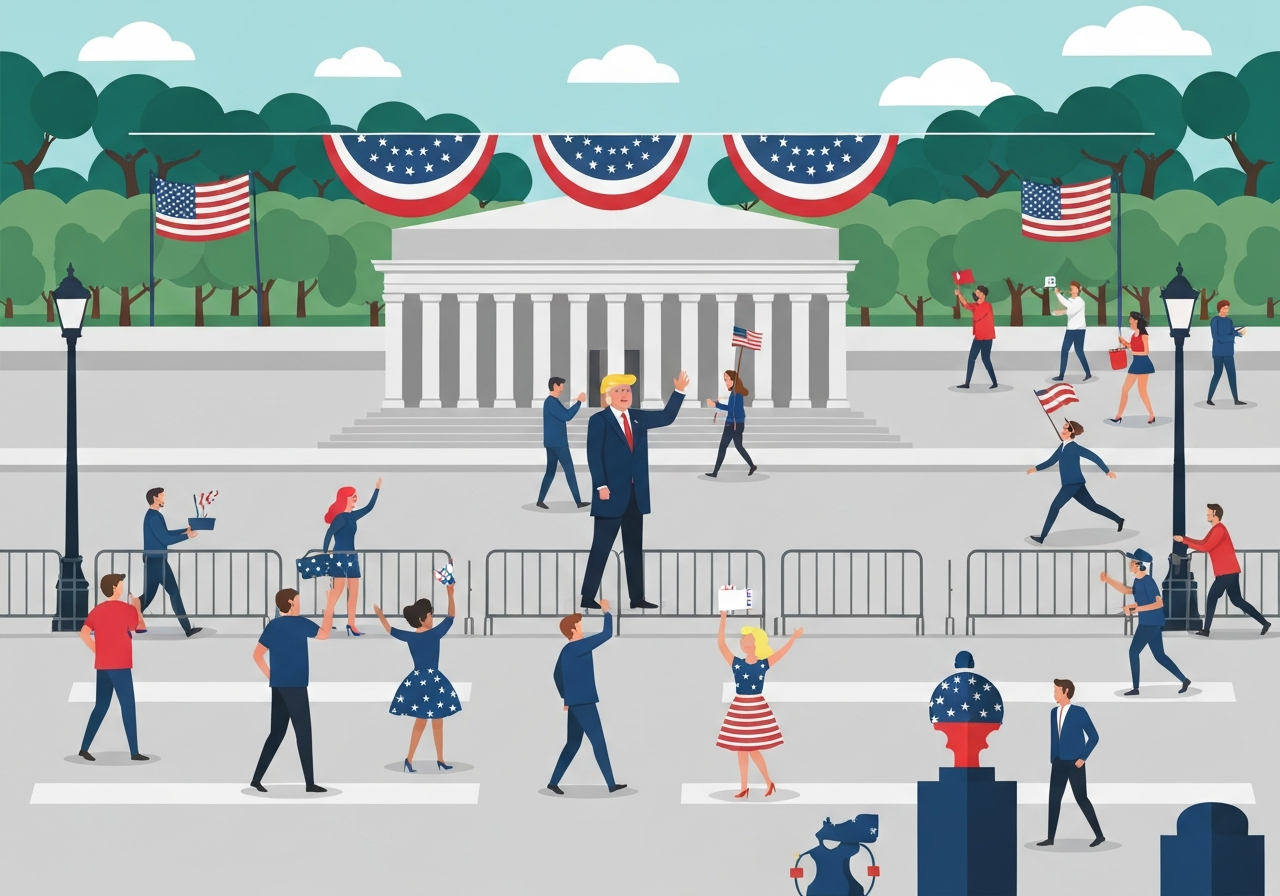
Lead: President Donald Trump arrived at the National Mall on 4 July to deliver remarks marking the United States’ 250th anniversary after a weather-related delay disrupted celebrations across several cities. His address—expected at 23:00 local time—was delivered after the site was briefly evacuated for thunderstorms and later re-opened for attendees. In a roughly 40-minute speech he praised veterans, reiterated policy goals such as the Save America Act and measures on birthright citizenship, and closed with the line that this is “only the dawn of a Golden Age of America.” Officials and organisers said fireworks and other events would proceed once conditions permitted.
Key Takeaways
- President Trump spoke from the National Mall on 4 July during the nation’s 250th-anniversary events; his remarks ran about 40 minutes and concluded with the phrase “the dawn of a Golden Age of America.”
- The speech was delayed and the Mall briefly evacuated because of severe thunderstorms; gates reopened and screening resumed before the event continued.
- Trump honoured veterans on stage, including 104-year-old Pearl Harbor witness Capt. Ken Schubring and Medal of Honor recipient Col. Paris D. Davis.
- The president reiterated support for the Save America Act, which would require proof of citizenship for voting and limit mail-in ballots to narrow exceptions.
- Some planned flyovers were cancelled; several cities adjusted fireworks schedules—New York and Tulsa moved displays earlier, Baltimore postponed theirs, and Philadelphia evacuated a concert.
- Trump referenced foreign interventions in his address, mentioning Venezuela and operations against elements of Iran’s navy as part of his remarks on American strength and policy.
- Security screening delays meant many attendees who left the secure perimeter had to be re-screened to re-enter the Mall.
Background
The speech took place amid a charged domestic debate over presidential power and democratic norms, themes amplified by Trump’s approach to public spectacle and rhetoric. The 250th anniversary of American independence has become a focal point for both national celebration and political contestation, with critics warning that such grand displays can blur lines between state ceremony and partisan messaging. Historically, Fourth of July speeches have ranged from unifying civic addresses to overtly political rallies; this year’s program combined historical commemoration with policy announcements and personal appeals.
Weather complicated programming nationwide: record heat and thunderstorms disrupted events from Washington to Philadelphia and Baltimore, forcing evacuations, schedule changes and delayed flyovers. Organisers such as Freedom 250 and municipal authorities coordinated with the Secret Service and emergency management offices to manage crowd safety and re-screening. At the Mall, the mix of veterans, administration officials and a highly visible stage set amplified the ceremonial and political dimensions of the evening.
Main Event
Trump took the stage after officials reopened the National Mall and resumed security checks. He began by noting the difficulties posed by storms and thanked the crowd for staying through the disruptions. Much of the address blended historical references—commemorating America’s founding—with campaign-style themes, including law-and-order messages and protection of Second Amendment rights.
He paid explicit tribute to veterans standing near a Revolutionary-era 1777 flag he said had draped George Washington’s casket, highlighting service across World War II, Korea and Vietnam. The president singled out Capt. Ken Schubring, aged 104 and a Pearl Harbor survivor, and Col. Paris D. Davis, a Medal of Honor recipient whose service spanned Vietnam, drawing sustained applause. Several cabinet members and visible administration figures, including Secretary of State Marco Rubio and Homeland Security Secretary Markwayne Mullin, were present on the platform.
On policy, Trump restated intentions to pursue the Save America Act—proposals that would require proof of citizenship to vote and tightly restrict mail-in ballots—framing them as necessary to secure electoral integrity. He also referenced an executive effort aimed at limiting birthright citizenship and touted past and proposed actions on foreign policy and security, naming Venezuela and strikes tied to Iran among examples of his administration’s force posture.
The address avoided direct invocation of named Democratic figures; instead Trump used broad language—repeating warnings about “communism” and domestic threats—that critics say equates ideological opponents with existential foes. The speech closed with a religiously framed vision of national destiny and the refrain, “God Bless America,” a traditional presidential sign-off.
Analysis & Implications
Politically, delivering a high-visibility address on Independence Day reinforces Trump’s image as a leader who stages theatrical, large-scale public events to project strength and ownership of national symbolism. That approach can energise supporters while deepening concerns among opponents about the personalization of state ceremonies. The decision to emphasize veteran tributes and historical artifacts underscores a strategy of linking present authority to founding-era legitimacy.
Policy references—particularly the Save America Act and moves on birthright citizenship—signal continued prioritisation of voting restrictions and immigration measures in the administration’s agenda. Those initiatives face legal and legislative challenges: mandating citizenship verification for ballots or revoking birthright principles would require significant judicial and congressional navigation. Mentioning these items during a celebratory speech indicates the White House intends to keep them at the center of public debate.
Operationally, the weather interruptions revealed logistical vulnerabilities for mass public events: evacuees had to be re-screened, flyovers were cancelled, and several municipalities adjusted fireworks timing. Those disruptions could shape planning for future national ceremonies and force coordination improvements between federal agencies and local emergency managers. Internationally, boasting of forceful interventions abroad—cited in the speech—can be read as both deterrent signaling and campaign rhetoric; such statements may affect diplomatic messaging and allies’ perceptions.
Comparison & Data
| City | Fireworks / Event | Weather Impact |
|---|---|---|
| Washington, D.C. | Salute to America / Trump speech (23:00 local) | Mall briefly evacuated; gates reopened and re-screening required |
| New York City | Macy’s Harbor display | Fireworks brought forward to avoid storms |
| Philadelphia | One Philly: Unity Concert for America | Evacuated due to incoming severe weather |
| Baltimore | Harbor fireworks | Display postponed (pushed back) |
| Tulsa | Local fireworks | Schedule moved earlier to dodge storms |
The table above summarises publicly reported scheduling adjustments and interruptions on 4 July. While New York and Tulsa advanced displays to avoid storms, Baltimore delayed its show and Philadelphia’s concert was evacuated. Washington’s event endured a security pause and re-entry screening. These operational shifts reflect regional variability in storm timing and municipal risk protocols.
Reactions & Quotes
“This is only the dawn of a Golden Age of America,” the president declared as he closed his remarks, framing the 250th anniversary as a new chapter for the nation.
President Donald Trump
“It is delayed as of right now,” Monica Crowley, the White House chief of protocol, told a broadcaster during the storm-related pause in programming, describing ongoing coordination between organisers and officials.
Monica Crowley / White House protocol (via broadcaster)
Members of the crowd applauded loudly when veterans such as Capt. Ken Schubring were introduced; observers noted a mixture of patriotic fervour and relief when gates reopened after the evacuation.
On-site reporters and attendees
Unconfirmed
- Precise crowd size at the National Mall after re-opening has not been publicly released and estimates vary among reporters and officials.
- Specific operational details and timing for all rescheduled municipal fireworks were reported by local authorities but are subject to final confirmation from each city’s event office.
- Claims about recent unilateral U.S. forces seizing Venezuela’s Nicolás Maduro were mentioned in the president’s remarks; independent verification and official confirmation of such an operation are not provided in mainstream reporting at this time.
Bottom Line
The 4 July events on the National Mall combined patriotic commemoration with high-stakes political messaging: a veteran-focused ceremony, policy signalling on voting and citizenship, and an assertive closing vision for the country’s future. Weather disruptions forced operational pivots but did not prevent the president from delivering a full speech that blended historical themes with contemporary policy priorities.
For policymakers and the public, the key takeaways are twofold: first, the administration intends to keep voting and citizenship changes at the forefront of its agenda; second, large national ceremonies will require tighter operational contingency planning to handle increasingly frequent extreme weather. Observers should watch for follow-up legal steps on proposed measures and for how such public spectacles influence political momentum ahead of the next electoral cycle.
Sources
- BBC live coverage — media: live reporting and aggregation of the 4 July events.
- Reuters — media: photo and event reports from multiple U.S. cities on Independence Day scheduling and fireworks.
- The White House — official: administration statements and event notices.
- Fox News — media: broadcaster reports cited by on-site sources regarding scheduling comments.