
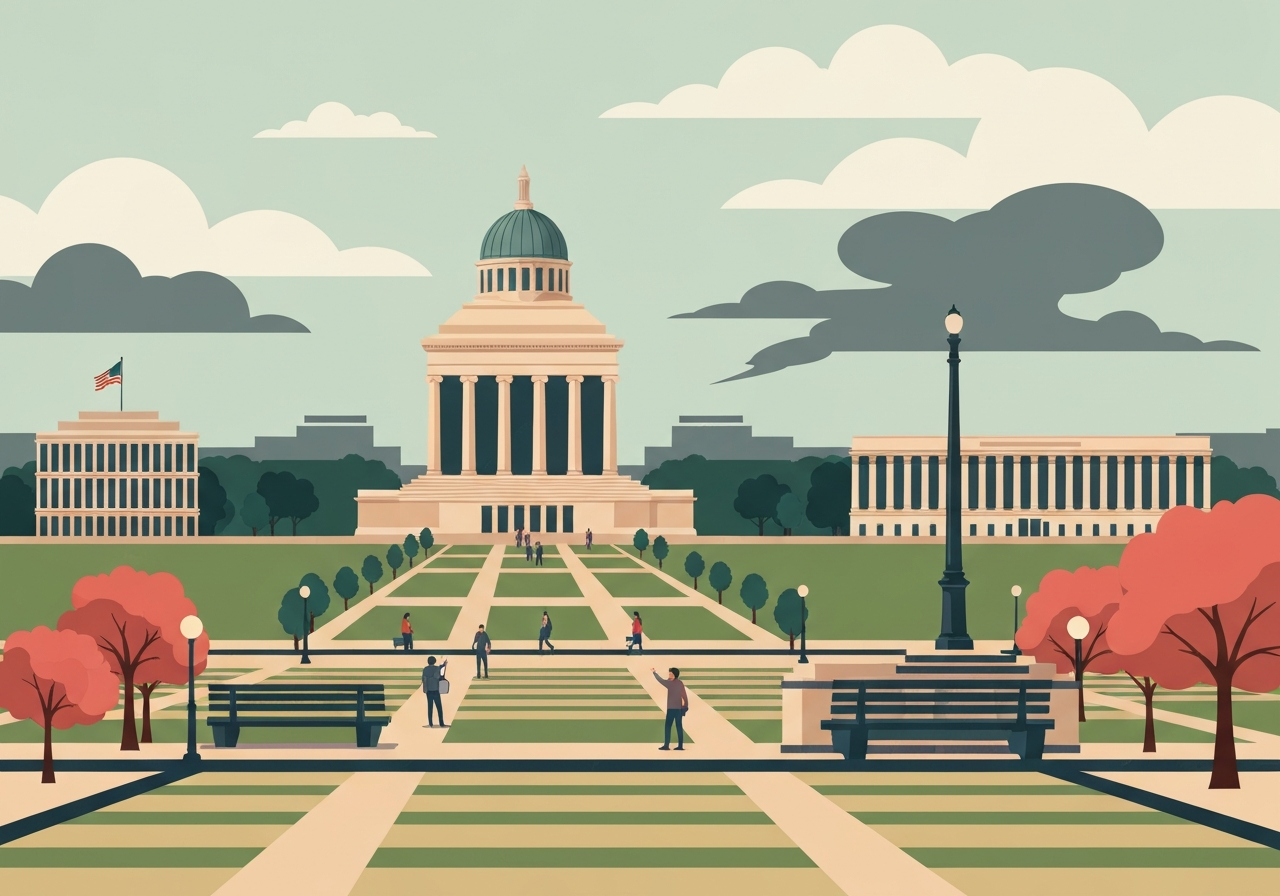
On July 4, 2026, the National Mall in Washington reopened its gates at 9:45 p.m. ET at the direction of President Trump after earlier evacuations prompted by severe thunderstorms, organizers said. The Freedom 250 program resumed with a presidential address scheduled for 11:00 p.m. ET and fireworks to follow. Authorities had ordered attendees to seek shelter in nearby federal buildings and museums earlier in the evening as a line of storms approached. Event partners emphasized safety while moving to restore the program and reopen security screening.
Key Takeaways
- Gates on the National Mall were ordered reopened at 9:45 p.m. ET on July 4, 2026; President Trump was scheduled to speak at 11:00 p.m. ET with fireworks afterward.
- Officials issued evacuation and shelter-in-place instructions earlier after a severe thunderstorm warning; the NWS warned of destructive gusts up to 70–80 mph.
- The D.C. area was under an extreme heat warning for July 4, with heat index values forecast at 110–115°F and overnight lows in the 70s–80s.
- Reagan National Airport recorded 102°F on July 3, breaking a date-specific record set in 1966; parts of the region faced the prospect of the hottest July Fourth on record.
- Multiple events were canceled or delayed nationwide: Washington’s Independence Day parade was canceled, and at least 120 million Americans were under major or extreme heat risk according to the NWS.
- Event partners — including the Secret Service, National Park Service, U.S. Park Police and FEMA — coordinated evacuations, sheltering, and expanded cooling resources on site.
- Emergency responders reported 45 patient contacts and 16 transports at the Great American State Fair on Friday, reflecting heat-related illness pressures on local services.
Background
Saturday’s events were part of the federal government’s semiquincentennial commemoration, organized under the Freedom 250 banner and planned over many months. The anniversary programming drew significant planning from the White House and federal partners and also prompted criticism from some Democrats who argued the events were politically charged. The administration framed the celebrations around Founding-era imagery and broad policy ambitions announced in presidential proclamations and speeches earlier in the weekend.
Weather amplified logistical risks for the milestone. A regionwide heat wave had already strained public health and infrastructure: authorities issued extreme heat warnings and a Code Purple air quality alert for Washington, D.C., and multiple municipalities nationwide canceled or postponed fireworks and parades out of concern for public safety and wildfire risk. Those layers of risk shaped both the planning and the on-the-ground responses on July 4.
Main Event
Organizers and public-safety agencies moved to evacuate portions of the Mall shortly before the evening program after the National Weather Service issued a severe thunderstorm warning for the area. Attendees were instructed to seek shelter in federal buildings, museums, and other nearby structures; event staff and agencies posted guidance and directed people to follow staff instructions immediately. The evacuation followed hours of sweltering heat and long entry lines earlier in the day, when fairgoers waited to pass through airport-style security checkpoints.
Authorities said security checkpoints would reopen and screening would resume; the Secret Service indicated it was working to make re-screening as smooth as possible while maintaining protective measures. Freedom 250 and partner agencies also said they were expanding water stations, cooling resources, and medical support across the grounds to address heat-related illness and crowd safety. Many attendees who left to shelter were required to pass through security again to reenter after the all-clear.
The White House and event organizers confirmed that President Trump would deliver a late-night address and that a large fireworks display would follow, though weather remained a complicating factor through the evening. Agencies on site continued to monitor forecasts and adjust operational plans as thunderstorms moved through the region, and officials cautioned that strong gusts and lightning presented continuing hazards for outdoor assemblies.
Analysis & Implications
The combination of extreme heat and severe storm risk exposed the operational trade-offs of staging major public gatherings during intensifying climate extremes. Planners had to balance commemoration priorities with public-safety imperatives, stretching emergency-medical and cooling resources to serve large crowds. The need to evacuate and then rapidly reopen for a presidential speech illustrates how political imperatives and safety protocols can collide in real time.
From a public-health perspective, the events underscored unequal exposure: heat and poor air quality increase risks for vulnerable populations, and long security lines with limited shade heightened those risks for many attendees. The reported patient contacts and transports at the Great American State Fair are an immediate signal of strain on local EMS and hospital capacity when prolonged heat and crowded events coincide.
Politically, the timing and tone of the weekend’s speeches — including a politicized address at Mount Rushmore and another planned for the Mall — may deepen partisan divides over how national anniversaries are marked. Operational and reputational risks for federal agencies rise when celebrations overlap with emergency responses, as agencies must defend safety decisions while implementing high-visibility events.
Comparison & Data
| Metric | Value |
|---|---|
| Reagan National Airport high (July 3) | 102°F (record for that date) |
| Forecast heat index (July 4) | 110–115°F |
| People under major/extreme heat risk | ~120 million across eastern & southern U.S. |
Those figures frame why event partners emphasized sheltering and cooling measures. The heat-index range of 110–115°F reflects combined temperature and humidity that substantially raises the risk of heat-related illness, while the 102°F airport reading indicates how the heat wave was already breaking local records. Combined, the data explain both cancellations of daytime events and emergency medical contacts recorded by D.C. responders.
Reactions & Quotes
Officials used public messaging to prioritize immediate safety and steer crowd behavior while outlining steps to restore the program.
“A severe thunderstorm is occurring near the National Mall. Seek shelter immediately. Do not wait.”
DC Homeland Security & Emergency Management (social post)
That warning was shared by municipal authorities and amplified by event staff; it led to coordinated shelter-in-place directives across the Mall and adjacent venues. Organizers later posted that safety remained the top priority while announcing steps to reopen and resume the evening program.
“America, it’s time to celebrate! Rain or shine, the American people deserve a celebration worthy of our nation’s historic 250th birthday.”
Freedom 250 (organizer statement)
Freedom 250 used celebratory language in its messaging while also asking guests to evacuate earlier when storms approached. The post combined patriotic framing with operational instructions and an assurance that efforts were underway to restart the festivities.
“We are working to make screening as smooth as possible,”
United States Secret Service (statement)
The Secret Service provided brief operational updates about reopening security checkpoints and re-screening evacuated attendees, stressing the need to keep protective measures in place even as gates reopened for the late program.
Unconfirmed
- Claims that the scheduled fireworks would be the largest in U.S. history are promoted by organizers but are not independently verified in real time.
- Reports of the full size, intent, and coordination level of Patriot Front presence in D.C. vary across open-source videos and local accounts; details about numbers and activity remain incompletely verified.
- Total counts of heat-related illnesses across all event sites and the wider city remain incomplete beyond the reported 45 patient contacts and 16 transports cited by DC Fire for Friday’s fair.
Bottom Line
July 4, 2026, illustrated how extreme weather and public-safety demands are reshaping the logistics of large national events. Rapid evacuations and later reopenings showcased both preparedness systems and the stress those systems face under concurrent heat and storm threats. For planners, the day highlights the need to build greater redundancy into cooling, medical response, and communications for high-profile gatherings as climate-driven extremes become more frequent.
For the public, the most immediate takeaway is practical: heed evacuation and shelter orders, expect possible re-screening after temporary closures, and prepare for heat-related risks when attending large outdoor events. Policymakers and event organizers should treat the day as a case study in balancing commemoration with uncompromising safety protocols and transparent incident reporting.
Sources
- NPR — Media report summarizing event timeline and official statements.
- National Weather Service (NWS) — Federal weather warnings and heat-risk forecasts (official agency).
- DC Homeland Security & Emergency Management — Local emergency guidance and public-safety notices (official agency).
- National Park Service — Park operations and event coordination on the National Mall (federal agency).
- FEMA — Federal emergency partner coordinating resources and support (federal agency).
- United States Secret Service — Security operations and screening updates (federal agency).