
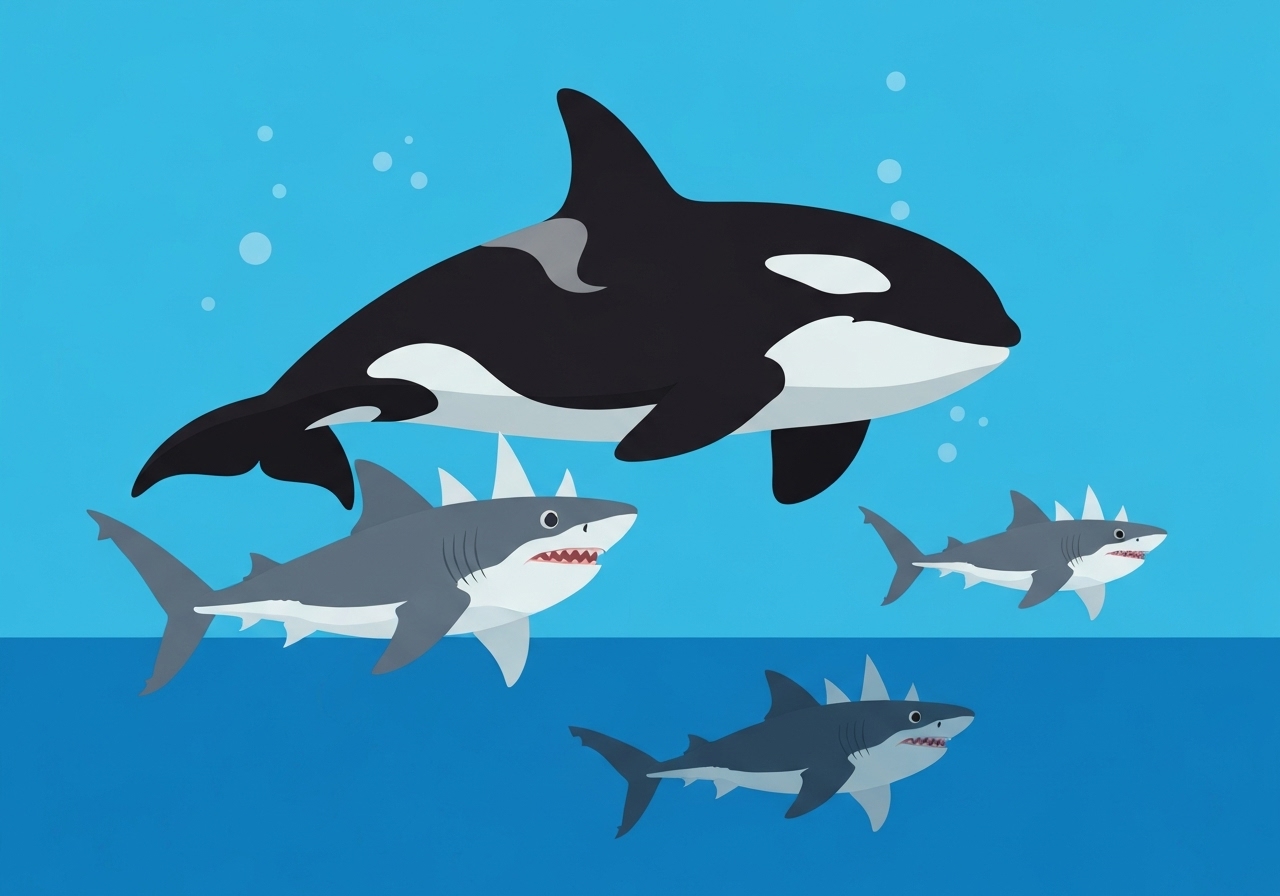
Scientists working in Mexico documented orca pods hunting juvenile great white sharks in the Gulf of California and removing their energy-dense livers. Drone and vessel cameras captured multiple events in August 2020 and August 2022, including one August 2020 incident where five female killer whales shared a shark liver. A study published in Frontiers in Marine Science on Nov 3, 2025, describes the attacks and notes parallels with documented behavior in South Africa, Australia and California. Researchers say repeated strikes at the same site may indicate a seasonal or learned prey specialization with potential conservation implications.
Key Takeaways
- Researchers recorded at least three predation events in the Gulf of California, with footage from August 2020 and August 2022 showing orcas removing shark livers.
- One August 2020 event involved a group of five female orcas that cooperatively attacked a young great white and shared the liver.
- In two of three documented events, orcas flipped sharks onto their backs, a maneuver associated with inducing tonic immobility and reducing risk of bites.
- The study was published in Frontiers in Marine Science on Nov 3, 2025, and is based on drone and boat-based camera records analyzed by researchers including Erick Higuera.
- Similar liver-targeting behavior has been recorded previously in South Africa, Australia and California but this is the first formal documentation for Mexico.
- Authors warn repeated targeting of juvenile white sharks could add seasonal predation pressure and affect local shark population dynamics.
Background
Orcas (Orcinus orca) are known for diverse, culturally transmitted hunting techniques that vary by population. Previous drone-documented cases in South Africa, Australia and California showed some groups selectively removing white shark livers, a high-calorie organ, and sharing the resource. Juvenile great white sharks frequent coastal areas at certain times of year, making them more accessible to predators; researchers observed the Gulf of California events in coastal waters where young whites are present. Scientific attention to these orca–shark interactions has increased with wider availability of aerial drones that capture behavior difficult to see from vessels alone.
Marine scientists emphasize that not all orca populations display the same hunting specializations—techniques can be learned within pods and passed between individuals. The liver-targeting tactic appears both risky and rewarding: livers are large and nutrient-rich but handling sharks presents bite and injury hazards unless attackers use precise maneuvers. Conservationists are monitoring whether such targeted predation is sporadic or becomes a recurring seasonal pressure on juvenile white sharks in affected regions, which would alter risk assessments for local shark management.
Main Event
In the best-documented August 2020 incident researchers used multiple cameras and a drone to record a group of five female killer whales attacking a young great white shark. The footage shows the orcas maneuvering to flip the shark onto its back, apparently to induce a temporary state of immobility, which allowed access to the body cavity. The group removed the liver and later shared it between individuals, behavior the authors describe as coordinated and efficient.
A few minutes after the first attack in 2020, the same orca group attacked a second young white shark at the same location and again removed the liver. In a separate August 2022 recording, a mixed-sex group of orcas was captured attacking a young great white and consuming the liver. The study notes that in at least two events orcas avoided sustaining bite injuries by careful handling and by targeting smaller, juvenile sharks rather than full-grown adults.
Researchers interpret the repeated activity at the site across years as evidence of a learned hunting pattern within those orca groups. The authors document specific handling maneuvers and strike sequences, concluding that the pod-level coordination increased hunting success. Field observers recorded the events from boats while drones provided overhead perspectives that revealed pod roles and prey-handling details not visible from sea level.
Analysis & Implications
The immediate ecological implication is an added source of mortality for juvenile great white sharks in the Gulf of California. Juveniles are vital to population replenishment, so recurring predation on this life stage could reduce recruitment if the behavior is frequent and concentrated. The study cautiously frames this as a potential additional pressure rather than a proven population driver, noting that population-level effects require systematic abundance and mortality data.
From a behavioral perspective, the incidents reinforce the role of cultural transmission in orca hunting: targeted liver removal and safe handling are specialized skills that can spread within and between pods. Where the technique exists, it yields a high energy return for effort invested, which may encourage repeat use and site fidelity. That in turn could create predictable seasonal hotspots of risk for juvenile sharks and shift local predator–prey dynamics.
Conservation and management agencies face a complex trade-off: orcas are protected and ecologically important apex predators, while great whites are also conservation priorities in many jurisdictions. If predation becomes regular and demonstrably impacts shark populations, managers may need to integrate these interactions into stock assessments and protection plans. Researchers recommend expanded aerial monitoring, tagging studies of juvenile sharks, and long-term population surveys to quantify trends and causal relationships.
Comparison & Data
| Event | Date | Pod composition | Prey | Outcome |
|---|---|---|---|---|
| Event A | Aug 2020 | Five females | Juvenile great white | Liver removed, shared |
| Event B | Aug 2020 (minutes later) | Same group | Juvenile great white | Liver removed |
| Event C | Aug 2022 | Mixed group | Juvenile great white | Liver removed |
The table summarizes the three predation events described in the paper. Drone footage provided the critical overhead view that allowed researchers to confirm coordinated handling and liver removal. While sample size is small, repetition at the same site across two years is notable and frames hypotheses about seasonal prey targeting and learned hunting culture in these Gulf of California orcas.
Reactions & Quotes
Study co-author Erick Higuera described his surprise that orcas returned to the same area across years, interpreting it as possible evidence of repeated, site-specific hunting strategy.
“I was surprised that the orcas hunted white sharks in the same area in different years; it suggests juvenile sharks may be a recurring seasonal prey.”
Erick Higuera, Conexiones Terramar (study co-author)
Independent expert Alison Towner, who documented similar behavior in South Africa, emphasized the value of drone footage for revealing otherwise hidden predator–prey dynamics and cautioned that the behavior is not universal among orca populations.
“Drone footage changed what we understood about these interactions; the Mexico footage allows cross-population comparisons and confirms the pattern is learned in certain groups.”
Alison Towner, Rhodes University (marine biologist)
Both the authors and external researchers highlight that frequency and regional prevalence will determine ecological impact, and call for more systematic observation before drawing population-level conclusions.
Unconfirmed
- Whether the observed predation pattern represents an established seasonal migration by orcas to exploit juvenile white sharks; current data are limited to three documented events.
- The magnitude of impact on Gulf of California white shark population trends; long-term abundance and mortality data are not yet available to quantify population-level effects.
- Whether the hunting technique observed in Mexico will spread to other orca groups in the region through social learning; evidence of inter-group transfer is not yet documented.
Bottom Line
Drone and vessel footage from August 2020 and August 2022 provides clear evidence that some orca groups in the Gulf of California have learned to hunt juvenile great white sharks and remove their livers, a high-value food resource. The behavior mirrors documented tactics in other parts of the world and appears to be a culturally transmitted hunting specialization rather than a universal orca trait.
Because the records span multiple years at the same site, researchers consider the behavior potentially seasonal and locally persistent, which could add measurable pressure on juvenile shark cohorts if frequency increases. The next steps are systematic aerial monitoring, tagging of juvenile sharks, and population assessments to determine whether these predation events translate into broader conservation concerns.
Sources
- CNN — News media report summarizing the Frontiers in Marine Science study and interviews with researchers.
- Frontiers in Marine Science — Academic journal where the study was published (journal site).
- Rhodes University — Academic institution associated with external expert Alison Towner.