
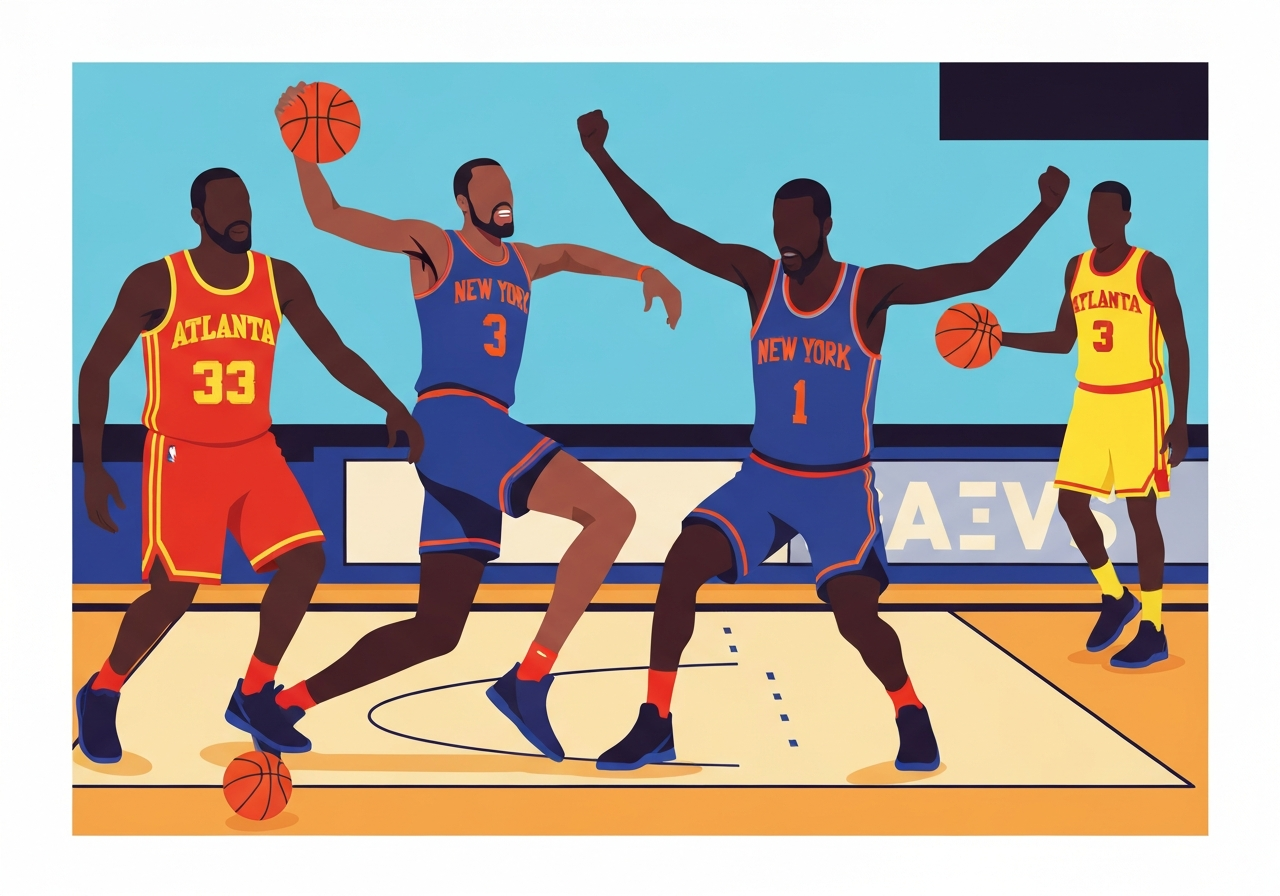
On April 18, 2026 at Madison Square Garden, the New York Knicks defeated the Atlanta Hawks 113-102 in Game 1 of their first-round playoff series. The gap in personnel and experience became clear late, with New York pulling away after a porous first-half defensive showing. Jalen Brunson exploded early, finishing with 28 points, and Karl-Anthony Towns delivered a 25-point, 14-rebound second-half push. The Knicks survived a late Atlanta rally to claim a momentum-setting home win.
Key Takeaways
- The Knicks won Game 1, 113-102, at Madison Square Garden on April 18, 2026.
- Jalen Brunson scored 28 points, including a 19-point first quarter (8-for-11, 3-for-3 from three in Q1).
- Karl-Anthony Towns finished with 25 points and 14 rebounds, most production coming after halftime.
- New York outscored Atlanta by nine in the second half and held the Hawks to 8-for-23 shooting in the third quarter.
- OG Anunoby added 18 points and eight rebounds and briefly left with a rolled left ankle but returned quickly.
- CJ McCollum led the Hawks with 26 points and Jalen Johnson added 23; Atlanta staged an 11-0 run late to cut a 19-point deficit to eight.
- Knicks entered the night 46-2 when leading at the start of the fourth quarter; that mark moved to 47-2 after Game 1.
- Mitchell Robinson was targeted with a Hack-a-Mitch sequence and made 1 of 4 free throws before being subbed out.
Background
The series matchup paired New York, an experienced roster built for late-game execution, against a young, athletic Atlanta team that rode confidence and guard play into the postseason. The Hawks rely on quickness and perimeter scoring, while the Knicks emphasize halfcourt defense and late-quarter execution — a contrast that framed Game 1’s tactical battle.
Both teams entered with distinct narratives: the Knicks as a veteran group expected to close tightly contested games, and the Hawks as an ascending collection of wings and guards seeking to prove they can sustain performance in a playoff series. Personnel matchups — notably Brunson versus Atlanta guards and Towns versus Atlanta’s frontcourt — were flagged as decisive before tipoff.
Main Event
Brunson opened the game in a white-hot rhythm, pouring in 19 points in the first quarter on highly efficient shooting (8-of-11) and hitting three triples. He did not play in the initial part of the fourth, but his early burst established a scoreboard buffer that New York would defend late despite uneven stretches.
The Hawks answered in the second quarter with a 19-8 run that erased a double-digit Knicks lead and tied the game; Onyeka Okongwu’s buzzer-beating 3 made the halftime deficit two. Atlanta’s energy and quick ball movement tested New York’s rotations and forced the visitors to navigate adversity.
New York flipped the script after halftime, tightening on defense and holding Atlanta to 8-for-23 from the field in the third quarter. Towns, who hadn’t scored until late in the first half, heated up after the break and produced 19 second-half points, finishing with a 25-and-14 line that anchored the Knicks’ interior play.
The fourth quarter featured the Knicks’ best stretch without Brunson on the floor, a run that pushed the lead to 16 before Brunson returned with 5:07 remaining. With 3:14 left New York led by 19, but Atlanta countered with an 11-0 spurt to make it 8 with 1:39 to play. The Knicks steadied, converting free throws and defensive stops to close out the win.
Analysis & Implications
Game 1 validated the pregame assumption that experience and execution would matter in late-game moments. New York’s ability to clamp down after halftime exposed a depth and discipline edge over a younger Hawks team that can score in bursts but struggled with efficiency in the third quarter.
Brunson’s scoring outburst in Q1 and his overall 28-point result underscore his role as the Knicks’ offensive engine, though his 1-for-11 stretch after the first quarter indicates volatility that Atlanta will try to exploit in adjustments. Towns’ slow start followed by a dominant second half highlights both matchup issues early and the late-game impact of New York’s bigger pieces.
For Atlanta, the veteran play of CJ McCollum (26 points) and Jalen Johnson’s 23 points show the Hawks can compete offensively. However, their third-quarter shooting dip and defensive lapses against New York’s late possessions expose a margin of error that typically narrows in playoff series against deeper teams.
Strategically, the series will hinge on Atlanta’s capacity to sustain offensive efficiency across halves and New York’s ability to limit quick scoring runs while avoiding self-inflicted slippage at the foul line and in transition defense.
Comparison & Data
| Team | Q1 | Q2 | Q3 | Q4 | Total |
|---|---|---|---|---|---|
| Knicks | — | — | — (held ATL 8/23) | — | 113 |
| Hawks | — | — (19-8 run) | — (8/23 shooting) | — (11-0 run late) | 102 |
The table highlights the flow rather than exact quarter-by-quarter tallies; third-quarter defense (8-for-23 Atlanta shooting) and the late fourth-quarter 11-0 Atlanta run were the game’s statistical turning points. New York’s record when leading to start the fourth improved to 47-2, reflecting the roster’s historical late-game strength.
Reactions & Quotes
Postgame remarks reflected a mix of relief and focus from both sides; coaches and players emphasized adjustments and execution.
“We tightened up on the defensive end after halftime and made the plays we needed down the stretch.”
Knicks head coach (postgame paraphrase)
That summary captures New York’s narrative: a shaky first half followed by defensive recalibration and late-game control. New York staff highlighted Towns’ second-half impact and the depth that helped absorb stretches where Brunson cooled.
“We showed we can fight back — the 11-0 run proves we can challenge any lead.”
Hawks veteran guard (postgame paraphrase)
Atlanta framed the late rally as a confirmation of resilience even while acknowledging execution lapses in the third quarter that widened the gap.
“OG was steady, and getting stops in the third was the turning point for us.”
Knicks player (postgame paraphrase)
Players on both teams pointed to matchups and adjustments as the main takeaways; small injuries (Anunoby’s rolled ankle) and coaching pivots will shape Game 2 planning.
Unconfirmed
- Whether OG Anunoby’s ankle will affect his availability in Game 2 — he returned quickly but the extent of any underlying soreness is not publicly detailed.
- The long-term impact of Brunson’s post-first-quarter shooting slump on series planning — teams will test adjustments, but strategic changes remain speculative.
Bottom Line
New York’s 113-102 Game 1 victory at Madison Square Garden gave the Knicks the early series edge by leveraging halftime defensive adjustments and late-game poise. Key performances from Brunson and Towns, plus timely contributions from role players, masked moments of vulnerability and kept Atlanta from sustaining a comeback.
Atlanta demonstrated it can pressure New York with athleticism and perimeter scoring, but the Hawks must correct third-quarter efficiency and limit self-inflicted scoring droughts to flip home-court advantage. Both teams enter Game 2 with clear adjustments to make; the series balance will be shaped by which side sustains consistency across halves.
Sources
- New York Post (media — game report and boxscore summary)