
Lead
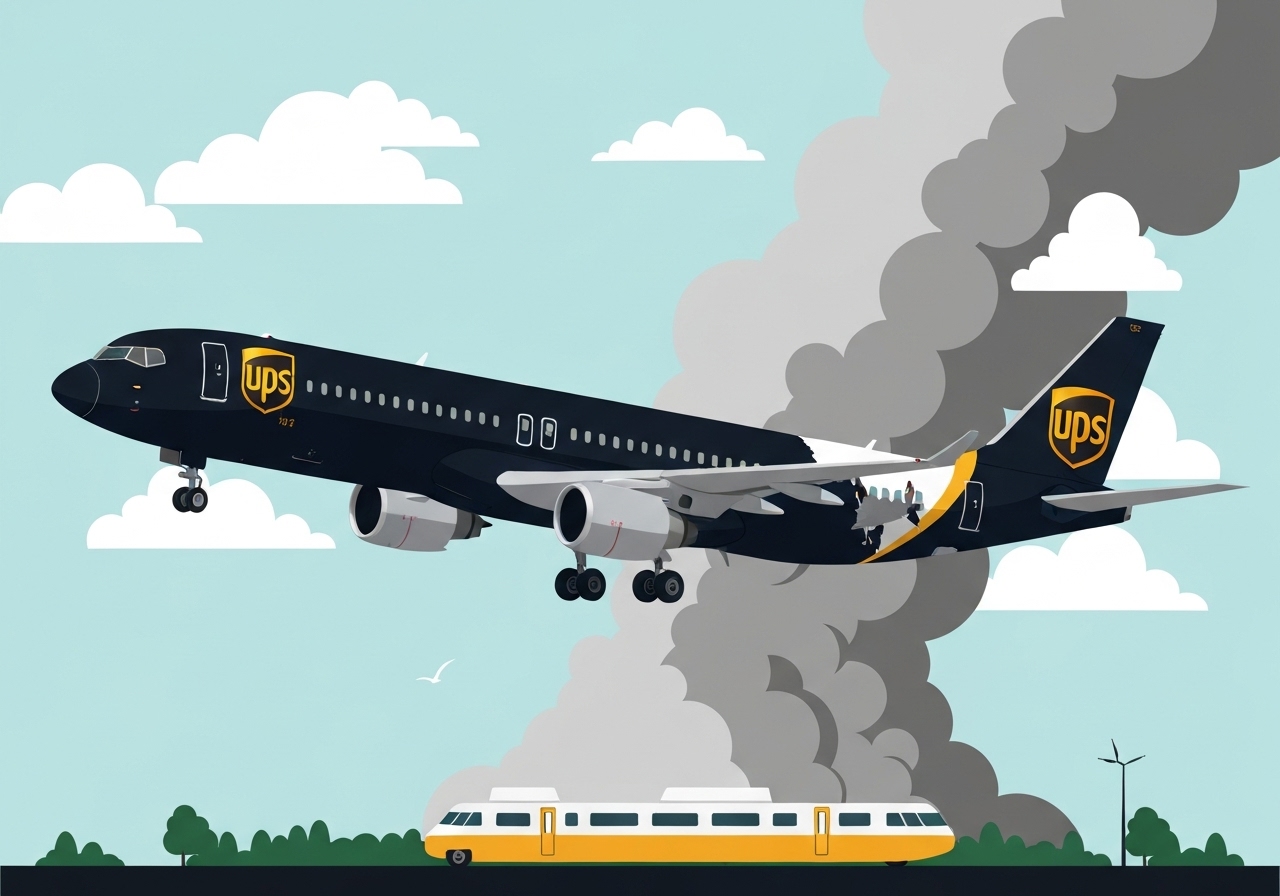
On Nov. 5, 2025, a UPS McDonnell Douglas MD-11 bound for Honolulu suffered the detachment of its left engine while rolling for takeoff at Louisville Muhammad Ali International Airport, U.S. safety investigators said. Seconds after the engine separated, the three-person crew’s jet climbed briefly to about 175 feet, then plunged and struck industrial buildings near the airport, erupting into flames. At least 12 people have died and multiple others were injured; recovery and firefighting operations continued into the following day. The National Transportation Safety Board recovered the cockpit voice recorder and flight data recorder and has opened a multiweek investigation.
Key Takeaways
- The NTSB reported that security footage shows the MD-11’s left engine detached while the airplane was rolling for takeoff on Nov. 5, 2025.
- The flight, UPS 2976, briefly climbed to about 175 feet before descending; the aircraft struck buildings outside Louisville Muhammad Ali International Airport and ignited multiple fires.
- At least 12 people were killed; 15 injured victims were taken to University of Louisville hospitals, 13 discharged and two remained in critical condition.
- The MD-11 was carrying roughly 38,000 gallons of fuel and impacted a petroleum recycling facility, complicating firefighting and recovery efforts.
- Investigators recovered the cockpit voice and flight data recorders, which sustained heat damage but are expected to yield usable data at a Washington lab.
- UPS operates its largest air cargo hub, Worldport, in Louisville; the crash disrupted cargo operations and prompted a state of emergency declaration by Governor Andy Beshear.
Background
The MD-11 is a three-engine freighter developed from the McDonnell Douglas design later acquired by Boeing; it has been involved in fatal accidents in the past, notably the 1998 Swissair crash off Nova Scotia. UPS has been reducing its MD-11 fleet in recent years, operating 27 MD-11s as of September 2025, down from 42 in 2022 according to company filings. The carrier operates a major air hub at Louisville known as Worldport, making the city a central node for domestic and international cargo traffic.
Large freighter operations concentrate fuel, heavy aircraft movements and ground facilities near industrial areas of airports, which can raise stakes if an accident occurs at low altitude or during ground roll. Regulators including the NTSB and the Federal Aviation Administration typically investigate mechanical, maintenance, operational and human factors after a transport-category aircraft accident. Local emergency services and organizations such as the Red Cross and Salvation Army mobilized to support responders and displaced workers as fires were extinguished and searches continued.
Main Event
According to NTSB member Todd Inman, security video shows the MD-11’s left engine separating from the wing while the aircraft was rolling toward takeoff. The jet continued down the runway, cleared a perimeter fence, climbed to roughly 175 feet and then sank rapidly into an industrial area just beyond the airport perimeter. The fuselage and tail section struck buildings and the ground with sufficient force that multiple structures ignited and the airplane was consumed by flames.
First responders described scenes of heavy black smoke and scattered debris across a wide zone; a crane and water trucks worked to cool hotspots as firefighters concentrated on both the wreckage and ground fires at a nearby petroleum recycling facility. Search and recovery teams reported a large debris field that complicated accounting for victims and posed hazards from fuel and structural collapse. Officials said at least 12 fatalities were confirmed by Wednesday, Nov. 6, and that some remains were severely burned, making identification more difficult.
Medical personnel from University of Louisville hospitals said 15 injured people were taken to their facilities, with 13 discharged and two in critical condition as of the latest update. Governor Andy Beshear declared a state of emergency to marshal resources for firefighting, search-and-rescue and victim assistance. Airport operations were partially restored when one runway reopened, although cargo schedules and flights experienced cancellations and delays.
In the immediate aftermath UPS and Boeing offered assistance to investigators; Boeing noted it would provide technical support to the NTSB. NTSB investigators said their onsite work would last at least one week and likely extend for months as they examine structural components, maintenance records and recorder data to determine causal factors and potential safety recommendations.
Analysis & Implications
An in-flight or on-ground engine detachment is a rare but high-consequence event that raises questions about component attachment integrity, maintenance procedures, and inspection regimes. If the left engine separation occurred prior to rotation, investigators will examine whether attachment hardware failed, maintenance actions were performed according to specification, or whether foreign-object damage or improper torqueing played a role. The presence of 38,000 gallons of fuel and impact at a petroleum recycling facility amplified the post-impact fires and complicated suppression and recovery operations.
Operationally, the MD-11’s three-engine layout means a single-engine loss should not, in itself, make the airplane uncontrollable at standard climb speeds and altitudes if the crew has time to apply procedures; the rapid sequence here—from detachment to impact—suggests limited time and possibly secondary structural or control failures. Investigators will combine recorder data, debris metallurgy, maintenance logs and surveillance footage to reconstruct the sequence and test competing hypotheses, including mechanical failure, maintenance error, and unforeseen secondary damage to flight controls or hydraulics.
A broader implication is the regulatory and industry response: if a maintenance or design vulnerability is found, the NTSB and FAA could issue urgent airworthiness directives or recommend fleet inspections, with cascading operational impacts for carriers that still fly MD-11s. For UPS, which has already been shrinking its MD-11 inventory, the accident could accelerate retirements or trigger interim procedures that disrupt cargo capacity at Worldport, with knock-on effects for supply chains that rely on overnight freight movements.
Comparison & Data
| Item | 2013 | 2022 | Sep 2025 |
|---|---|---|---|
| UPS MD-11s in operation | — | 42 | 27 |
| Notable MD-11 fatal events | Swissair 1998 (229 dead) | UPS crashes since 2006 (multiple) | Louisville 2025 (≥12 dead) |
The table provides fleet counts and a short accident timeline to contextualize the MD-11’s operational decline at UPS and the aircraft type’s safety history. The reduction from 42 to 27 MD-11s reflects ongoing fleet modernization and phase-outs. Historical accidents involving MD-11s are rare but severe; that record will factor into public, regulatory and commercial decisions following the Louisville crash.
Reactions & Quotes
Local and state officials described the crash as a traumatic event for the Louisville community, noting the unusual scale of industrial damage and the toll on first responders and nearby businesses. The governor emphasized emergency mobilization and victim support while acknowledging the potential for a prolonged search and identification effort.
“This rocked our community. Louisville looked apocalyptic last night,”
Representative Morgan McGarvey (U.S. House)
McGarvey’s remarks reflected the public shock conveyed in video circulated online and in accounts from nearby residents and business owners who saw the airplane pass low over structures before impact. Local leaders have called for clear, timely updates as investigations proceed and recovery work continues.
The NTSB outlined investigative priorities and confirmed the recovery of the cockpit voice and flight data recorders; agency officials cautioned that extracting usable data can take time but is central to determining sequence-of-events. They also stated that the recorders sustained heat damage but were expected to yield data once analyzed in a specialized laboratory.
“We will seek to understand not only what happened, but why it happened, and recommend changes to prevent it from happening again,”
Todd Inman (NTSB member)
Investigators emphasized that their work will be methodical and that preliminary findings may take days while final reports can take months. The NTSB’s statement set expectations for a multi-stage inquiry involving metallurgical tests, systems analysis and cross-referencing of maintenance and operational records.
Business owners and first responders described a chaotic scene of fire, falling debris and displaced operations; one nearby shop owner said he and his employees were lucky to survive and that they were still assessing structural damage to their property. Humanitarian groups and local agencies organized support for responders and affected workers as the immediate emergency phase shifted to recovery and family assistance.
“I can’t believe we are alive,”
Colin Embry (Local business owner)
Unconfirmed
- Exact mechanical cause of the engine separation (attachment failure, maintenance error, or foreign-object damage) remains unconfirmed and under investigation.
- Final victim identities and the complete count of fatalities may change as recovery and forensic identification proceed.
- Whether any specific maintenance action or deferred inspection on this airframe contributed to the event has not been publicly verified.
Bottom Line
The Louisville crash appears to have begun with a catastrophic left-engine separation during the ground roll, a highly unusual initiating event that immediately created an emergency with little time for corrective crew action. The recovery of the black boxes and detailed debris analysis will be decisive in establishing sequence and root causes, but the presence of large fuel quantities and an industrial impact site worsened the human and material toll.
Short-term consequences will include NTSB-led safety recommendations, potential FAA directives, operational impacts at UPS’s Worldport hub, and renewed scrutiny of MD-11 maintenance and inspection practices industrywide. For the Louisville community, the focus now turns to victim identification, support for affected families and workers, and ensuring investigators produce timely, transparent findings to reduce the risk of a recurrence.
Sources
- The New York Times (news reporting on crash and official statements)
- National Transportation Safety Board (NTSB) (official investigation statements and contact for investigators)
- UPS Press Room (company statements and operational notices)
- Office of the Governor of Kentucky (state emergency declarations and governor briefings)
- University of Louisville Health (hospital statements regarding injured patients)