
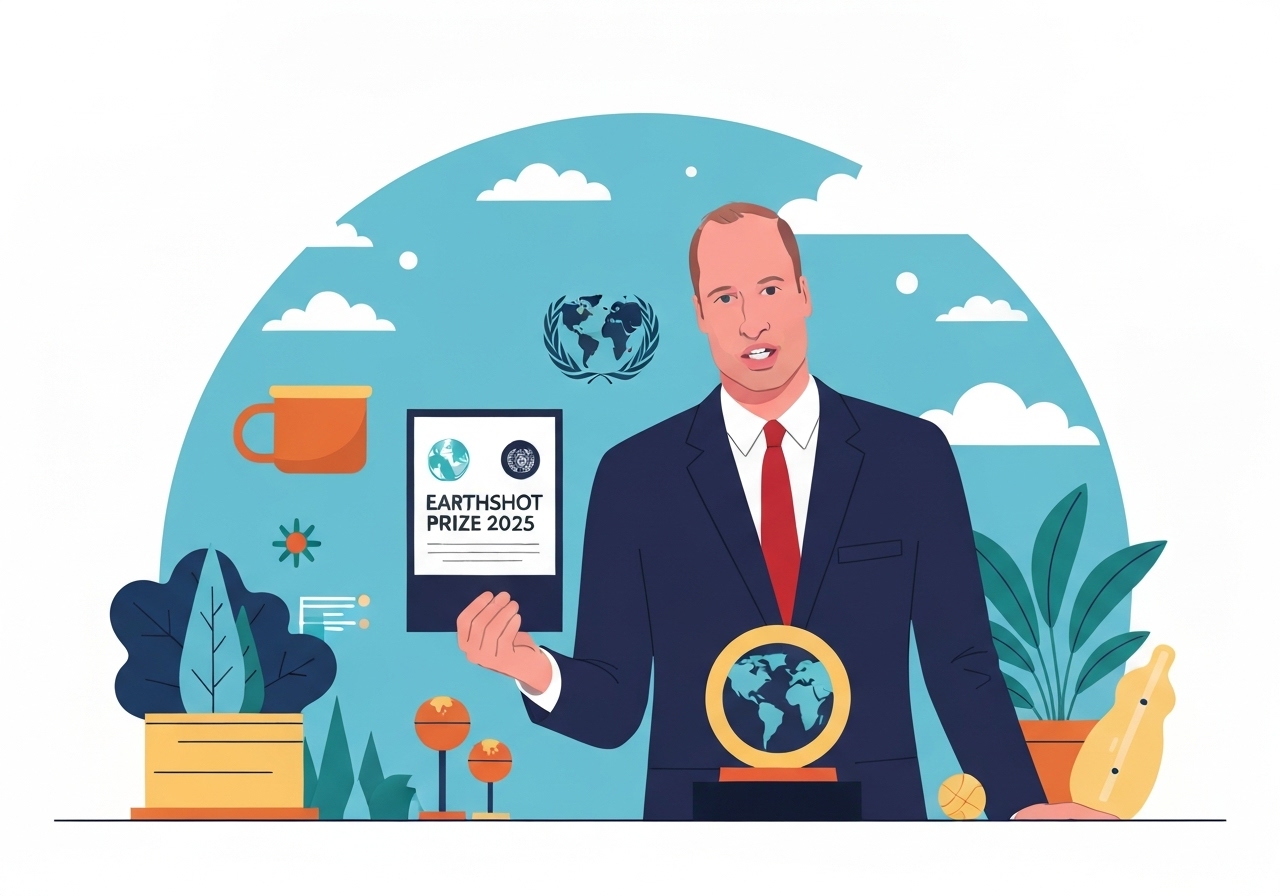
Prince William announced the five winners of the Earthshot Prize 2025 at a ceremony in Rio de Janeiro on Wednesday, each receiving a £1m award to scale climate solutions. The Museum of Tomorrow hosted the event, which featured performances and high-profile presenters, and marked the halfway point of the decade-long prize he founded in 2020. The winning projects span forest restoration, urban clean-air policy, a global ocean treaty, sustainable fashion practices and community resilience efforts in Bangladesh. Organisers said the grants are intended to accelerate proven solutions that can be expanded rapidly to reduce environmental harm.
Key takeaways
- Five winners named at the Rio ceremony each receive £1m to scale climate solutions, chosen from 15 finalists and nearly 2,500 nominees from 72 countries.
- Protect and Restore Nature winner: re.green (Brazil), focused on financing protection of the Atlantic Forest, one of the planet’s most biodiverse ecosystems.
- Clean Our Air winner: the city of Bogotá, recognized for public-policy measures including clean-air zones and urban greening to reduce pollution.
- Revive Our Oceans winner: the High Seas Treaty, a global framework set to enter into force in January 2026 to conserve marine biodiversity beyond national jurisdictions.
- Build a Waste-Free World winner: Lagos Fashion Week (Nigeria), which requires designers to adopt sustainable production standards for each showcase.
- Fix Our Climate winner: Friendship (Bangladesh), supporting vulnerable communities with health, education and disaster-preparedness interventions.
- The ceremony included international figures and performers — presenters included Cafu, Rebeca Andrade and Sebastian Vettel; Kylie Minogue and Shawn Mendes performed.
- Prince William framed the awards as evidence that scalable, optimistic solutions can drive meaningful environmental progress this decade.
Background
The Earthshot Prize was launched in 2020 by Prince William with the aim of accelerating practical solutions to environmental crises over a 10-year pledge. It mirrors the ambition of historical challenge-driven initiatives — the prize’s organizers explicitly evoked the inspiration of the 1960s Moonshot — by focusing on five defined goals: Protect and Restore Nature; Clean Our Air; Revive Our Oceans; Build a Waste-Free World; and Fix Our Climate. The award is structured to combine public attention with substantial seed funding: each annual winner receives a £1m grant intended to attract further investment and partnerships for scale-up. This year’s ceremony in Rio marks the midpoint of the ten-year effort and was chosen to underline global cooperation on biodiversity and climate solutions.
The selection process drew almost 2,500 nominations from 72 countries, narrowed to 15 finalists and then to the five winners announced in Rio. Finalists are evaluated on criteria including evidence of impact, potential for scaling, and cost-effectiveness, with an independent council and advisory board guiding shortlists. The event also serves as a platform to connect winners with capital providers, policymakers and multinational partners who can accelerate adoption. Organisers have emphasized that prize recognition is as much about signaling viability to investors and governments as it is about the cash award itself.
Main event
The awards were presented at Rio’s Museum of Tomorrow. The evening combined cultural programming with keynote remarks and on-stage discussions showcasing the winners’ work. Prince William, acting as prize president, called the winners “inspiration” and said the projects demonstrate that progress is achievable when innovators pursue scalable, evidence-based solutions. High-profile guests included UK Prime Minister Sir Keir Starmer, Energy Secretary Ed Miliband and London Mayor Sir Sadiq Khan, reflecting the prize’s political as well as symbolic clout.
Brazilian football legend Cafu, Olympic gymnast Rebeca Andrade and former Formula 1 driver Sebastian Vettel joined as presenters; pop artists Kylie Minogue and Shawn Mendes performed. The mixture of sport, politics and culture was designed to broaden public engagement and draw attention to the winners’ practical work. During the day Prince William met finalists at the Christ the Redeemer statue and posed at a spot his mother, Diana, famously did 34 years earlier — a moment organisers said linked past royal engagement with contemporary climate advocacy.
On the same trip the prince visited Paquetá island to learn about mangrove restoration and planted saplings with local residents, underlining a hands-on approach to conservation. He also addressed criminal activity linked to Amazon deforestation at a United for Wildlife event, highlighting enforcement as a complement to restoration initiatives. The prince is scheduled to travel to Belém in the Amazon and speak at COP30, continuing the diplomatic and advocacy thread of the Rio visit.
Analysis & implications
The 2025 winners illustrate a portfolio approach that combines policy change, legal frameworks and community-driven projects — from Bogotá’s urban air policies to a multilateral ocean treaty. Policy wins like Bogotá’s suggest municipal governments can deliver measurable air-quality improvements through zoning, greening and transport reforms, and that such models can be replicated in other megacities. By awarding the High Seas Treaty, the prize lifts a multilateral legal instrument into the public eye, potentially accelerating ratification and implementation momentum ahead of its planned January 2026 entry into force.
re.green’s financing model for the Atlantic Forest signals growing interest in marketable conservation finance that makes protection economically viable for landholders and investors. If adopted at scale, forestry finance mechanisms could reduce deforestation pressure while generating livelihoods, though success depends on transparent governance and durable revenue streams. Lagos Fashion Week’s win highlights the role of cultural and industry standards in reducing waste intensity in supply chains; fashion weeks can set procurement and production norms that ripple through a large creative economy.
Friendship’s community resilience work in Bangladesh underlines the intersection of climate adaptation and social services: investments in health, education and disaster preparedness build adaptive capacity and reduce vulnerability. Across winners, the central implication is that blended approaches — combining legal, fiscal and social interventions — are more likely to produce sustained impact than isolated projects. For investors and policymakers, the Earthshot signal may lower perceived risk and spur partnerships, but measurable long-term outcomes will require sustained funding, monitoring and policy alignment.
Comparison & data
| Earthshot Goal | 2025 Winner | Primary focus |
|---|---|---|
| Protect & Restore Nature | re.green (Brazil) | Atlantic Forest conservation via finance |
| Clean Our Air | Bogotá (Colombia) | Clean-air zones, urban greening |
| Revive Our Oceans | High Seas Treaty | Conservation of biodiversity beyond national waters |
| Build a Waste-Free World | Lagos Fashion Week (Nigeria) | Sustainable fashion standards, reduced waste |
| Fix Our Climate | Friendship (Bangladesh) | Community resilience, services, disaster prep |
The table places each winner against the Earthshot framework to show how this year’s choices balance legal frameworks (High Seas Treaty), municipal policy (Bogotá), market mechanisms (re.green), sectoral norms (Lagos Fashion Week) and community adaptation (Friendship). Together they cover mitigation, protection and adaptation pathways. Quantitative monitoring plans were cited by finalists as a condition of funding and scaling; organisers are pushing for standardized metrics to track impact across sectors. Over time, comparing indicators such as hectares restored, pollution concentration reductions, treaty ratification milestones, waste diverted and households reached will be essential to assess aggregate progress.
Reactions & quotes
Organisers and winners framed the awards as validation and a bridge to further investment and policy engagement. Below are brief contextualised excerpts from key figures at the event.
“Winning this prize validates our direction and helps open conversations with banks, capital providers and corporates.”
Thiago Picolo, CEO of re.green (winner)
Picolo’s comment underlines the prize’s role in signalising bankability; organisers hope the award reduces friction for follow-on capital and partnerships.
“These winners are proof that the spirit of collective action born here in Rio continues to grow stronger.”
Christiana Figueres, Chair of the Earthshot board
Figueres stressed ambition toward 2030 targets and framed the award as part of a long-term legacy-building effort for collective environmental action.
“We set out to tackle environmental issues head on and make real, lasting changes that would protect life on Earth.”
Prince William, President of the Earthshot Prize
The prince reiterated the prize’s mission-driven rationale and its focus on scalable, durable solutions during his remarks at the ceremony.
Unconfirmed
- Whether every winner will secure the additional private and public financing needed to scale to national or international levels remains uncertain and will depend on follow-on investor interest.
- Detailed timelines and legal steps for full implementation of the High Seas Treaty in every jurisdiction are not yet finalized despite its planned entry into force in January 2026.
- Specific measures to ensure long-term monitoring and verification of re.green’s conservation finance outcomes were described in broad terms; detailed reporting frameworks are still to be published.
Bottom line
The Earthshot Prize 2025 winners reveal a strategic mix of legal, municipal, market and community solutions that together address both the causes and consequences of environmental decline. By pairing £1m awards with high-profile exposure, organisers aim to convert proof-of-concept initiatives into scalable programmes, though the transformation depends on securing sustained funding, robust governance and replicable metrics. The Rio ceremony signalled diplomatic and cultural momentum for environmental cooperation, and the High Seas Treaty in particular could reshape marine governance if ratification and enforcement follow through.
For policymakers and funders, the winners provide concrete test cases: cities can cut pollution through policy, conservation can be financed at scale if revenue models are credible, and sectoral standards can reduce waste when tied to market access. The coming 12–24 months will be critical to track whether prize recognition translates into measurable, long-term outcomes by 2030; observers should watch ratification steps for the treaty, follow-on capital for re.green, and replication of Bogotá’s air policies in other cities.