
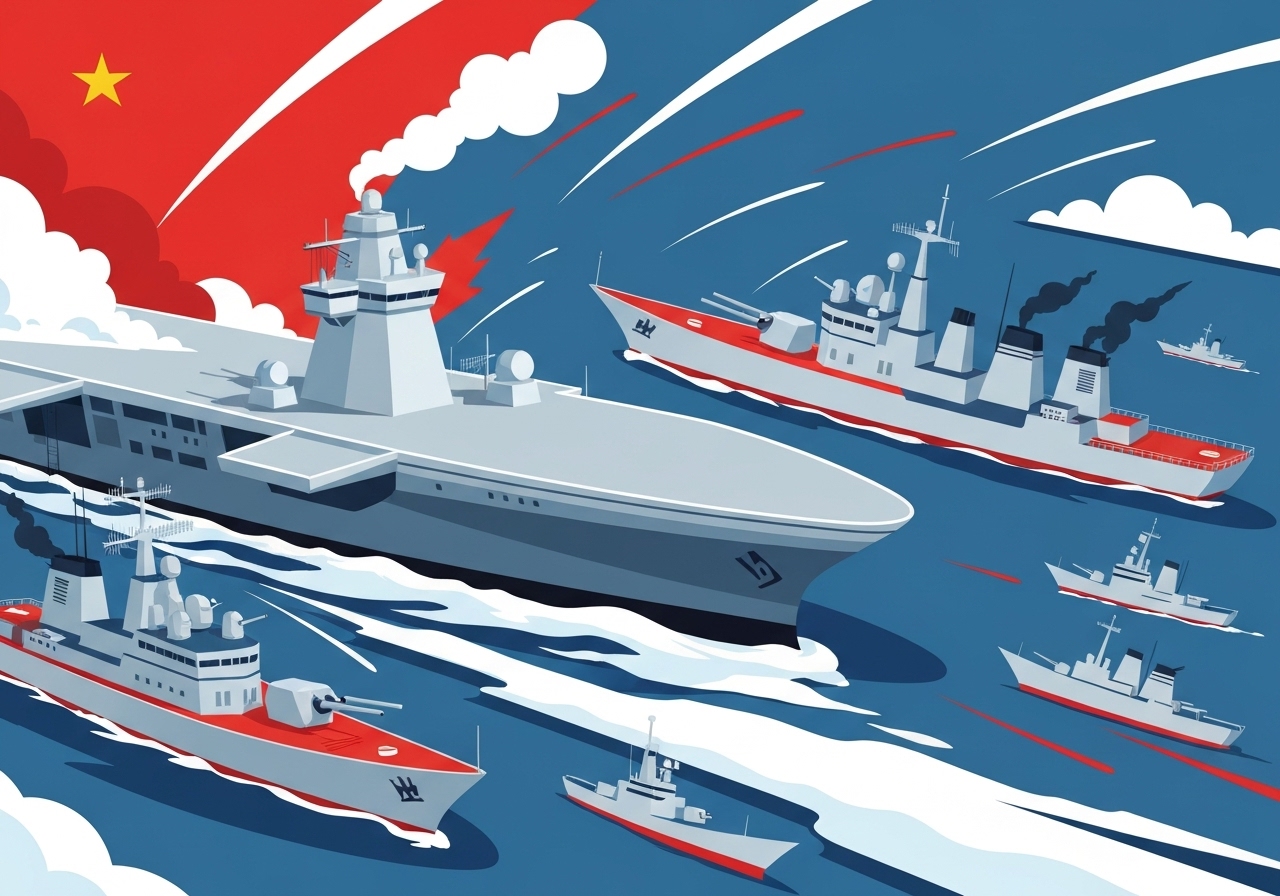
Lead: China commissioned its third and most advanced aircraft carrier, the Fujian, at a naval port in Sanya, Hainan, this week, a ceremony attended by Xi Jinping and reported by state media. The vessel, launched in 2022 and trialed at sea in 2024, is equipped with electromagnetic catapults (EMALS) that allow heavier takeoffs and extended strike range. Beijing presented the commissioning as a milestone in its rapid naval expansion, intensifying strategic competition with the United States. The entry of the Fujian into active service alters regional force posture but leaves operational questions about tempo and sustainment.
Key takeaways
- The Fujian is China’s third carrier and its first to use electromagnetic aircraft launch systems (EMALS), a technology that enables heavier weapon and fuel loads.
- Chinese leader Xi Jinping attended the commissioning at a military port in Sanya, Hainan; the event drew more than 2,000 navy and shipyard personnel and large online attention.
- The ship displaces about 80,000 tons, compared with roughly 97,000 tons for U.S. Nimitz-class carriers.
- Fujian is conventionally powered and requires refueling at port or by tanker; U.S. carriers are nuclear-powered and can remain at sea far longer.
- Only the U.S. Navy’s USS Gerald R. Ford previously fielded EMALS—its system was certified for flight-deck operations in spring 2022.
- Chinese state media showed three catapult positions and carrier-based types including the J-35, J-15T and KJ-600 during the ceremony.
- Analysts note that air‑wing sortie rates and deck configuration could limit Fujian’s operational tempo relative to U.S. carriers; some U.S. veterans estimated possible shortfalls in sortie generation.
Background
Over the last decade China has prioritized naval modernization and shipbuilding capacity, producing large surface combatants, amphibious ships and now multiple carriers. Beijing’s shipyards have increased throughput, producing hulls at a pace that has changed the raw-count balance of surface vessels in the Asia-Pacific. For China’s leadership the navy’s expansion is both a strategic capability program and a domestic political symbol of national rejuvenation under Xi Jinping.
China’s first carrier, Liaoning, was a refit of an older hull and used a ski-jump launch; its second carrier, Shandong, followed a similar STOBAR design. The Fujian departs from that model by adopting EMALS and a flat, catapult-equipped flight deck—an architecture historically associated with U.S.-style carrier aviation. Beijing has signaled plans for further growth: a Type 004 design under development is expected to combine EMALS with nuclear propulsion.
Main event
State broadcaster CCTV reported that Xi attended a commissioning ceremony for the Fujian at a military port in Sanya earlier this week, joined an honor guard and toured the ship, inspecting living and operational spaces. Photographs and state media footage highlighted three EMALS catapult positions on the flight deck and displayed carrier aircraft including the J-35, J-15T and the KJ-600 early warning platform.
China launched Fujian in 2022 and began sea trials in 2024; the official commissioning marks the transition from trials to frontline assignment. CCTV emphasized the scale of the event, noting stands filled with navy and shipyard personnel and heavy engagement on Chinese social platforms where the commissioning trended rapidly. The state narrative framed the ship as evidence of the country’s emergence as a major carrier power.
Operationally, Fujian is conventionally powered and will require refueling stops or at-sea tanking to sustain long deployments, a contrast with U.S. nuclear carriers that are limited mainly by crew provisions. Chinese media and military analysts portrayed the ship as narrowing a technological gap, citing the adoption of EMALS—previously fielded on the U.S. Navy’s newest carrier—as a pivotal advance.
Analysis & implications
The Fujian’s EMALS capability theoretically expands the types of aircraft China can operate from a carrier and increases individual sortie reach by allowing heavier fuel and weapons loads. That change affects tactical reach—aircraft can potentially strike targets at greater distances without relying solely on land-based platforms. For regional states and U.S. planners, the Fujian changes assumptions about China’s ability to project air power from the sea.
However, technology adoption does not automatically translate into parity. Aviation operations depend on deck layout, sortie-generation procedures, pilot experience, and logistics such as aviation fuel, spare parts and at-sea replenishment. Analysts cited in reporting warn that Fujian’s flight-deck configuration and procedural maturity may lower its effective sortie rate compared with long-established U.S. carrier practices.
Strategically, the ship increases Beijing’s flexibility for showing presence in the western Pacific, the South China Sea and beyond, complicating allied planning for deterrence and crisis response. The commissioning is likely to accelerate diplomatic and military consultations among U.S. Pacific partners on carrier task group operations, forward basing, and force posture adjustments.
Economically and industrially, Fujian reflects China’s growing systems-integration capacity—combining catapult technologies, carrier-capable aircraft and carrier support infrastructure. The longer-term balance will depend on sustainment, training tempo and the development of supporting platforms such as tanker and supply ships that enable sustained carrier operations.
Comparison & data
| Ship | Approx. displacement | Propulsion | Catapult | Service status |
|---|---|---|---|---|
| Fujian (China) | ~80,000 tons | Conventional fuel | EMALS | Commissioned 2025 |
| USS Gerald R. Ford (US) | ~97,000 tons (Nimitz/Ford class comparable) | Nuclear | EMALS (certified 2022) | Operational |
The table illustrates the key trade-offs: Fujian narrows capability gaps through EMALS but remains smaller and conventionally powered. Displacement and propulsion affect endurance, while catapult technology affects aircraft payloads and mission radius. These differences shape how each navy can employ carriers in sustained operations.
Reactions & quotes
State media and official channels emphasized national pride and technological achievement during the commissioning ceremony.
“He gave a trial press of the ship’s catapult button,”
CCTV (state broadcaster)
Independent sources and retired U.S. officers were more circumspect about Fujian’s near-term operational performance.
“Air operations may still run at only about 60% the rate of a 50-year-old U.S. carrier,”
Two former U.S. carrier officers (as reported to CNN)
Public reaction inside China was notable on social media platforms, where the commissioning became a top trending topic and a related hashtag drew millions of views in a short span, demonstrating strong domestic resonance.
Unconfirmed
- The precise sustained sortie rate Fujian will achieve in operational deployments remains unproven beyond sea trials and estimates reported by former officers.
- Timelines, specifications and commissioning dates for the planned Type 004 nuclear carrier remain subject to change and official confirmation.
Bottom line
The Fujian’s commissioning is a substantive milestone in China’s naval modernization: it demonstrates new integration of EMALS and carrier-capable aircraft and enhances Beijing’s maritime options. Yet the ship’s conventional propulsion and the practical challenges of building an experienced carrier aviation community mean operational parity with U.S. carrier strike groups is not immediate.
For regional security, Fujian will prompt recalibrations in alliance planning, forward basing, and maritime deterrence posture. Observers should watch sortie-generation data, at-sea replenishment practices, and how quickly carrier aviation training and maintenance ecosystems scale up—those measures will determine the carrier’s long-term strategic impact.