
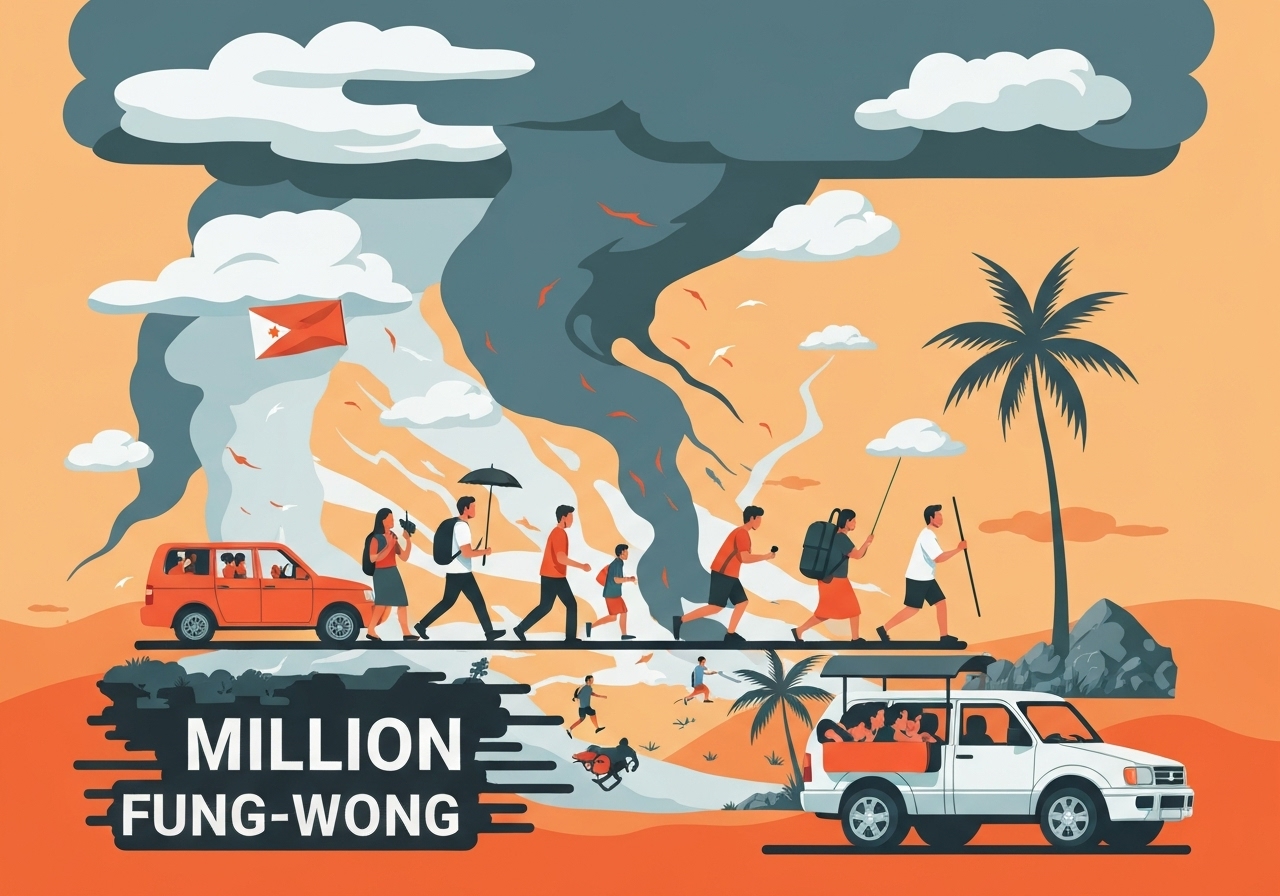
Lead: On Nov. 10, 2025, Super Typhoon Fung-wong struck Luzon, the Philippines’ largest island, forcing mass evacuations and widespread flooding. Authorities said 1.3 million people were moved before landfall in Aurora Province; the storm has so far been linked to two confirmed deaths and damage to roughly 1,000 homes. Coastal communities from Sinbanali to Dipaculao reported storm surges and landslides, while officials continued search-and-rescue and relief operations into Monday morning. Local leaders urged residents to follow emergency protocols as rain and runoff persisted.
Key Takeaways
- 1.3 million people were preemptively evacuated across Luzon ahead of Fung-wong’s landfall on Sunday night, according to government officials.
- Fung-wong is officially classified as a super typhoon by the state weather bureau and made landfall in Aurora Province on Nov. 10, 2025.
- Authorities confirmed two deaths from Fung-wong, far fewer than the more than 200 fatalities attributed to Typhoon Kalmaegi earlier this month.
- About 1,000 homes were reported damaged and 132 villages flooded; some coastal and mountain communities remain isolated by landslides.
- Nearly 1,000 search-and-rescue teams were deployed in anticipation of the storm, and recovery and cleanup began as waters started to recede.
- Residents in evacuation centers described rapid water rise, loud winds and storm surges, prompting urgent local sheltering efforts in Bacoor and elsewhere.
Background
The Philippines is regularly struck by tropical cyclones; Fung-wong is the 21st storm to affect the country in 2025. Repeated hits this season have stressed emergency systems and local coping capacity, especially in coastal and low-lying communities. In the span of weeks, Typhoon Kalmaegi caused severe flooding and more than 200 deaths, elevating public concern and prompting more aggressive preemptive evacuations for Fung-wong.
Government agencies, led by the Office of Civil Defense and the national weather service, coordinated warnings and local evacuations. President Ferdinand Marcos Jr. publicly appealed for compliance with emergency protocols, a decision officials say helped reduce casualties. Many residents, particularly in provinces like Aurora and areas near Manila, have now experienced multiple evacuations this year, eroding economic stability for households dependent on daily wages.
Main Event
Fung-wong intensified as it approached Luzon and made landfall Sunday evening in Aurora Province. High waves swamped seaside villages such as Sinbanali, where residents described hearing winds louder than airplanes and seeing storm surges inundate homes. In Bacoor, near Manila, almost 1,000 villagers sheltered at Bacoor Elementary School after rushing in during the night.
Local accounts detailed rapid water rise that reached waist height inside homes within hours, prompting families to carry small belongings and children to safety. In some communities, village elders and local authorities went door to door to urge evacuation; in others, residents left before formal orders, citing images and memories of Kalmaegi’s destruction. Government teams reported storm surge and landslide incidents across coastal and upland barangays, complicating access for emergency responders.
By Monday, workers were clearing detritus from roads in Dipaculao and teams were assessing damage in Tuguegarao City after river overflow. The Office of Civil Defense deputy administrator, Bernardino Rafaelito Alejandro IV, said cleanup and access restoration would begin immediately where it was safe to do so. Officials also cautioned that residual rains from the adjacent system, Typhoon Uwan, could prolong flooding risks in parts of Luzon.
Analysis & Implications
Public compliance with preemptive evacuation orders appears to have reduced immediate fatalities compared with Kalmaegi, but the economic toll is mounting. Repeated evacuations and home damage undermine livelihoods, particularly for informal workers like drivers, construction laborers and small-scale vendors who lack savings or insurance. Recovery costs for damaged housing and infrastructure will stress local budgets and increase demand for national assistance.
Infrastructure vulnerability is a central issue: storm surges and river overflows repeatedly expose the limits of coastal defenses and drainage systems. Landslides isolating communities highlight persistent risks in upland areas where deforestation and unstable slopes exacerbate hazards. Longer-term adaptation—relocating at-risk settlements, investing in early-warning systems and upgrading drainage—will be politically and financially challenging, but may reduce future casualties and repair costs.
Regionally, the Philippines’ high exposure to tropical cyclones underscores broader climate resilience concerns across Southeast Asia. Increased storm frequency and intensity can disrupt food supply chains, damage crops and strain social services. International aid and bilateral cooperation could be required for major reconstruction if multiple storms continue to strike within a single season.
Comparison & Data
| Storm | Approx. Date | Confirmed Deaths | People Evacuated | Homes Reported Damaged |
|---|---|---|---|---|
| Fung-wong | Nov. 10, 2025 | 2 | 1.3 million | ~1,000 |
| Kalmaegi | Early Nov. 2025 | More than 200 | Not reported in initial dispatch | Not reported |
The table summarizes confirmed figures reported immediately after landfall. Fung-wong’s human toll was far lower than Kalmaegi’s at this stage, likely reflecting stronger precautionary evacuations. Damage tallies and casualty figures remain provisional; authorities continue assessments in isolated areas.
Reactions & Quotes
Local residents, officials and relief workers described a mix of relief at lives saved and concern about long-term impacts.
“We did not want to be swept to sea, so we rushed here. The winds howled, and the rains were nonstop. Like it was the end of the world,”
Ivy Villamor, evacuee in Bacoor
Villamor and her daughter were among those fed by municipal relief provisions at an evacuation center; her account illustrates why many families left before formal orders. Authorities say rapid public response to warnings likely reduced casualties.
“There have been reported storm surges in coastal communities, then a number of landslides,”
Bernardino Rafaelito Alejandro IV, Office of Civil Defense deputy administrator
Alejandro provided operational updates and confirmed the deployment of nearly 1,000 search-and-rescue teams. He also cautioned that some areas remain isolated and that residual rainfall could sustain hazards.
Unconfirmed
- Comprehensive, consolidated tallies of property damage and economic losses from Fung-wong remain incomplete and are expected to change as isolated areas are accessed.
- Reports of missing persons in some mountain barangays have not been independently verified by national authorities at the time of this report.
Bottom Line
Fung-wong’s relatively low confirmed death toll compared with Kalmaegi suggests that preemptive evacuation and coordinated messaging helped avert larger loss of life. Nevertheless, the cumulative impact of repeated storms this season — mounting home damage, lost income and interrupted services — deepens hardship for vulnerable communities. Recovery will require immediate humanitarian assistance and longer-term investments in resilience and infrastructure to reduce the recurring toll of tropical cyclones.
Authorities continue search, rescue and relief operations while monitoring residual rains from nearby systems. For policymakers, the immediate priority is restoring access and basic services in flooded and landslide-affected villages; over the medium term, investments in stronger coastal defenses, drainage and planned relocation where necessary will be critical to limit repeated displacement and losses.