
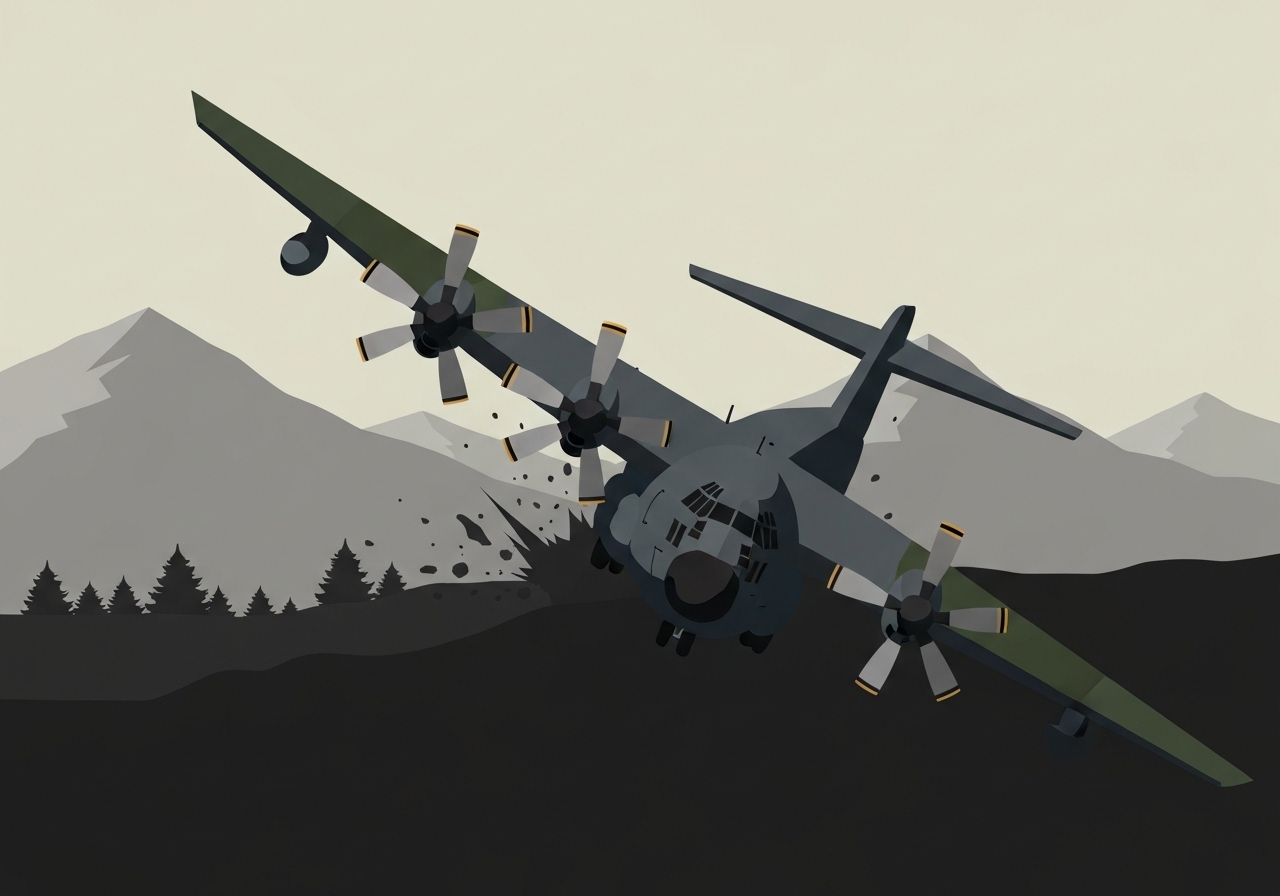
On November 11, 2025, a Turkish C-130 military transport crashed in Sighnaghi municipality in eastern Georgia near the Azerbaijani border, killing all 20 personnel on board. The aircraft was en route from Ganja, Azerbaijan, to Turkey after ferrying troops who had attended Azerbaijan’s Victory Day events. Turkish officials said the flight data recorder was recovered and a joint Turkish–Georgian investigation is ongoing. Recovery teams have so far retrieved 19 bodies and continue efforts to locate the remaining person.
- All 20 people aboard a Turkish C-130 died in the crash on Nov. 11, 2025; 19 remains recovered, one still missing.
- The plane departed Kayseri, Turkey, had flown to Ganja, Azerbaijan, and was bound for Merzifon when it crashed near the Georgia–Azerbaijan border.
- A 46-member Turkish accident investigation team reached the site and is coordinating with Georgian authorities to inspect wreckage.
- Turkey says the aircraft’s flight data recorder has been recovered; forensic and technical inspections are underway.
- Local reports describe debris scattered across farmland and hills in Sighnaghi municipality; Georgian authorities said contact was lost a few minutes after the aircraft entered Georgian airspace.
- Sozcu and Turkish local outlets report the plane belonged to the 12th Air Base Command in Kayseri and was manufactured in 1968, entering Turkish service in 2010.
Background
The soldiers aboard had traveled to Azerbaijan to participate in Victory Day events held on Saturday, commemorating Azerbaijan’s 2020 military gains in the Nagorno-Karabakh conflict. Turkey and Azerbaijan maintain close military and diplomatic ties; joint appearances of troops and mutual training are frequent components of that relationship. The C-130 Hercules is a long-standing tactical airlifter used widely by the Turkish Armed Forces for personnel movement and logistics, often operating on routine cross-border flights in the region.
Georgia lies between Turkey and Azerbaijan and its airspace is regularly traversed for short regional hops. Accidents involving older airframes have prompted scrutiny in many militaries, and investigators typically examine maintenance records, crew actions, air traffic data and environmental conditions. In this case, Turkish authorities dispatched a sizable team to work with Georgian investigators, reflecting the cross-border nature of the accident and the need for coordinated forensic work.
Main event
Turkish officials report the C-130 took off from Kayseri, stopped in Ganja to pick up personnel, and then departed toward Merzifon in northern Turkey. According to Georgian aviation authorities cited by Turkish state media, contact with the aircraft was lost a few minutes after it entered Georgian airspace and no distress signal was issued. Eyewitness and broadcaster NTV reports indicate wreckage was scattered over a wide plain ringed by hills, with debris found at multiple locations.
Defense Minister Yasar Guler posted images of the personnel and described the victims as having been killed in the crash; Turkish authorities said the flight data recorder has been recovered and is undergoing analysis. A 46-member Turkish accident investigation team arrived at the scene to work with Georgian officials inspecting the wreckage and gathering evidence. Search-and-recovery operations located 19 sets of remains; teams continued searching for the final individual at the time of the latest official update.
Local reporting from Sozcu and other outlets identified the aircraft as part of the 12th Air Base Command and noted the airframe’s manufacture in 1968 and accession to Turkish service in 2010. Turkish leaders and regional officials publicly expressed condolences, and several foreign missions conveyed solidarity with Ankara. Officials have not yet announced funeral arrangements or a timeline for repatriation of the remains.
Analysis & implications
Immediately, the crash raises technical and operational questions about maintenance, age and service history of the airframe. An aircraft built in 1968 that entered Turkish service in 2010 will have a long maintenance record; investigators will examine service logs, component lifetimes, and recent repairs to determine whether structural fatigue, mechanical failure or other technical causes played a role. The flight data recorder recovery is a central step toward reconstructing the last minutes of the flight.
Operationally, the loss of 20 military personnel in a single accident is a blow to readiness and will likely prompt internal reviews across Turkish airlift units and may accelerate inspections of similar C-130 fleets. Politically, the incident occurs amid close Turkey–Azerbaijan cooperation showcased at the Victory Day events; Ankara will face pressure to manage both the technical inquiry and public expectations about accountability and safety.
Regionally, the crash may affect short-term cross-border military movements and civil aviation procedures in the Caucasus, as Georgian authorities coordinate airspace and accident response protocols with Turkey. International partners offering condolences may also be asked to assist with technical expertise; multinational participation in the probe could speed analysis but will require sensitive handling of sovereignty and chain-of-custody issues for wreckage and recorder data.
| Item | Detail |
|---|---|
| Date | November 11, 2025 |
| Aircraft | Lockheed C-130 (military cargo) |
| Fatalities | 20 |
| Recovered remains | 19; one missing |
| Manufacture year | 1968 |
| Investigation team | 46-member Turkish team on site |
The table summarizes confirmed details provided by Turkish and Georgian authorities and media reports. Numbers such as casualties and the plane’s manufacture year are being treated as official information; causes remain to be established by technical forensic work.
Reactions & quotes
Turkish Defense Minister Yasar Guler described the victims as fallen comrades and confirmed the recovery of the flight data recorder; his office posted images of the personnel and called for a thorough investigation.
“Our heroic comrades-in-arms were martyred on November 11, 2025, when our C-130 military cargo plane…crashed near the Georgia-Azerbaijan border.”
Defense Ministry (X post)
Azerbaijan’s president offered condolences and described the crash as a shock to the region, reflecting close ties between Baku and Ankara after the Victory Day events in Ganja. Georgian officials coordinated with Turkish investigators at the scene and provided statements on loss of contact shortly after the aircraft entered Georgian airspace.
“We are deeply shocked,”
President Ilham Aliyev (statement cited by Anadolu Agency)
International diplomatic channels also expressed sympathy and support; some partners indicated readiness to assist with technical expertise if requested by Turkish or Georgian authorities. Official expressions focused on condolences and the need for a careful, transparent investigation before conclusions are drawn.
- Unconfirmed: Definitive cause of the crash—investigators have not released findings attributing the accident to mechanical failure, human error or external factors.
- Unconfirmed: Whether the aircraft’s age or a specific maintenance issue directly contributed to the accident; investigators are still reviewing records and components.
- Unconfirmed: Exact timeline for recovery of the final missing person and the schedule for repatriation of remains—authorities have not announced definitive dates.
Bottom line
The Nov. 11, 2025 crash of a Turkish C-130 in Georgia killed all 20 onboard and triggered a cross-border investigation involving Turkish and Georgian authorities. Recovery of the flight data recorder and the deployment of a 46-member Turkish investigative team are key early developments; they mark the start of a technical process that will determine cause and accountability.
In the near term, Turkey will balance investigative transparency with military procedural reviews and public mourning. Longer-term implications could include intensified inspections of similar transport aircraft, adjustments to regional flight protocols, and heightened scrutiny of maintenance regimes for aging military fleets. Readers should watch for formal investigative findings and official technical reports before attributing fault.
Sources
- Associated Press (International news outlet) — primary contemporary reporting and timeline of events.
- Anadolu Agency (Turkish state news agency) — reporting on statements from Georgian aviation authority and Turkish officials.
- NTV (Turkish broadcaster) — on-site reporting about wreckage distribution and local conditions.
- Sozcu (Turkish news outlet) — reporting on unit assignment and aircraft service history.