
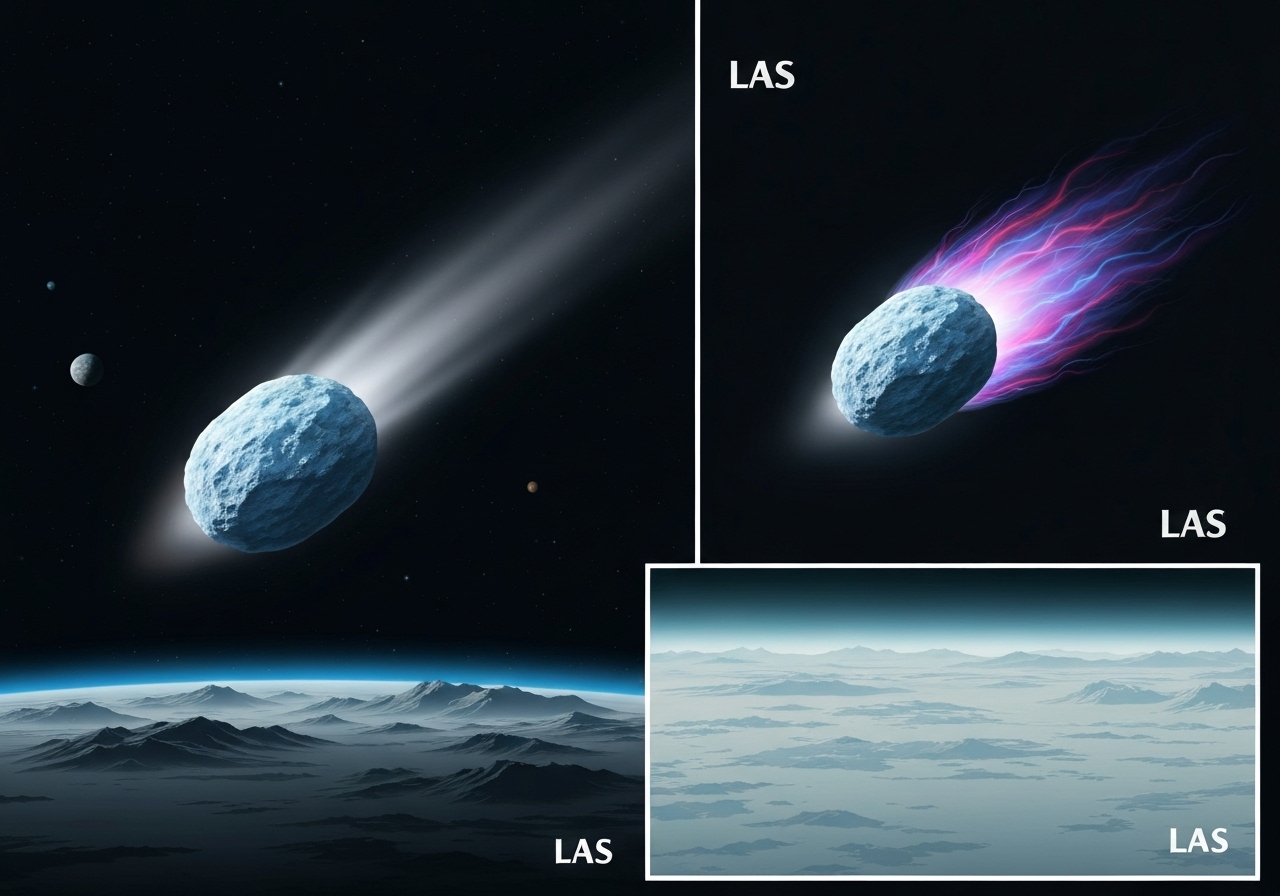
NASA on Nov. 19 released a coordinated set of new observations of interstellar comet 3I/ATLAS gathered by spacecraft scattered across the solar system. The campaign drew data from at least 15 missions — from Mars orbiters and rovers to deep-space probes and flagship telescopes — and confirms that the visitor behaves like a typical comet while originating beyond our planetary neighborhood. Infrared spectroscopy from JWST and SPHEREx shows carbon dioxide and water-ice signatures, while visible-light imaging from Mars assets and distant probes captured the object’s fuzzy coma and developing tail. Together the datasets refine the comet’s trajectory and provide an uncommon window into material formed around another star.
Key Takeaways
- NASA announced new imagery and spectral data on Nov. 19, 2025, collected by 15 confirmed missions observing 3I/ATLAS from multiple vantage points.
- Perseverance’s Mastcam‑Z captured the comet as a faint smudge on Oct. 4 when it was about 18.6 million miles (29.9 million km) from the rover.
- Mars Reconnaissance Orbiter’s HiRISE imaged the object on Oct. 2 at roughly 19 million miles (31 million km) distance.
- Infrared measurements from JWST and SPHEREx detected abundant carbon dioxide and water ice in the coma and nucleus, with CO2 apparently outgassing more strongly than water.
- Psyche and Lucy obtained distant views — Psyche on Sept. 8–9 at ~33 million miles (53 million km), Lucy on Sept. 16 from about 240 million miles — providing backlit and wide-angle perspectives of the coma and tail.
- Composition surprises include an apparently elevated nickel signal relative to iron and a rapid brightening around perihelion on Oct. 29.
- Size remains uncertain; current estimates span from a few thousand feet up to a few miles in diameter because dense dust obscures the nucleus.
Background
Interstellar object 3I/ATLAS is only the third object confirmed to have arrived from outside the solar system, joining 1I/ʻOumuamua (2017) and 2I/Borisov (2019). Such visitors are inherently rare and valuable because they carry material formed in other stellar nurseries, offering comparative samples unavailable from native solar system bodies. Observing campaigns for interstellar objects are logistically complex: targets move quickly across the sky and may reach closest approach when Earth is poorly placed for observation. That made the distributed network of spacecraft — especially assets orbiting or stationed on Mars and probes farther afield — particularly useful for building a complete observational record.
NASA and partner agencies coordinated imaging and spectroscopy across platforms optimized for different wavelengths: visible-light cameras mapped morphology, ultraviolet instruments traced dissociation products, and infrared observatories measured thermal and molecular signatures. Historical precedent shows that combining multiple instruments yields the most robust interpretation of small-body behavior, and the 3I/ATLAS campaign follows that model. Scientists emphasize that while the object behaves like a comet, its interstellar origin means its materials may record formation environments and processes unlike those that produced comets in our own system.
Main Event
The new release centers on imagery and spectra taken between early September and mid‑October 2025. NASA’s Perseverance rover photographed the comet on Oct. 4 with Mastcam‑Z as the object passed about 18.6 million miles (29.9 million km) away, appearing as a faint, diffuse source against the Martian starfield. Two days earlier, the Mars Reconnaissance Orbiter’s HiRISE camera captured a higher-resolution point of view from about 19 million miles (31 million km), showing a prominent coma — the cloud of dust and gas that comets shed when warmed by the Sun.
Farther out, the Psyche spacecraft recorded four broadband frames on Sept. 8–9 while roughly 33 million miles (53 million km) from 3I/ATLAS; those frames helped refine the path and characterize the faint coma. Lucy’s L’LORRI instrument imaged the comet on Sept. 16 from an unusually distant vantage (about 240 million miles), which allowed scientists to see the coma and extended tail against a wide-angle background. Several missions that were on the sunward or far side of Earth — including SOHO and Parker Solar Probe — contributed additional detections as the object tracked through the inner system.
In parallel, JWST and the SPHEREx mission obtained infrared spectra that revealed molecular constituents in the coma and near-surface layers. Investigators report clear signatures of carbon dioxide and water ice; the relative strength of CO2 outgassing compared with water vapor is one of the campaign’s notable findings. Ultraviolet imagery from MAVEN’s Imaging Ultraviolet Spectrograph also traced hydrogen atoms from photodissociated water, corroborating the volatile inventory detected in other bands.
Analysis & Implications
The composition and behavior of 3I/ATLAS have immediate implications for how we understand planetesimal formation around other stars. A CO2-dominated outgassing pattern suggests formation or evolutionary pathways that differ in thermal history or volatile retention from typical solar system comets, which often show stronger water-driven activity near the Sun. If confirmed, such chemical contrasts could point to formation at different radial distances from the host star, unique thermal processing, or different primordial compositions in its parent disk.
Detection of apparent nickel vapor at large heliocentric distances — where thermal conditions usually prevent metallic sublimation — is intriguing and currently unexplained. Nickel and iron are known components of cometary dust, but the asymmetric ratio (more nickel than iron observed) raises questions about fractionation during formation or selective release mechanisms. Resolving this will require laboratory comparisons and more detailed spectral modeling to rule out observational or processing artifacts.
Beyond pure science, the multi‑platform tracking of 3I/ATLAS sharpened trajectory estimates that are useful for refining planetary defense techniques. Observations spanning different lines of sight reduce orbital uncertainty and demonstrate how assets stationed away from Earth can be decisive for target characterization. Finally, JWST’s sensitivity implies it will likely remain capable of detecting the comet after many other instruments lose the target, extending the timeframe for compositional study even as the object departs the inner system.
Comparison & Data
| Mission | Instrument | Date | Distance (miles/km) | Note |
|---|---|---|---|---|
| Perseverance | Mastcam‑Z | Oct. 4, 2025 | 18.6M mi / 29.9M km | Faint smudge; local starfield context |
| MRO | HiRISE | Oct. 2, 2025 | 19M mi / 31M km | Sharply resolved coma |
| Psyche | Multispectral imager | Sept. 8–9, 2025 | 33M mi / 53M km | Multiple broadband frames |
| Lucy | L’LORRI | Sept. 16, 2025 | ≈240M mi | Wide-field coma and tail |
| SOHO | Coronagraph | Oct. 15–16, 2025 | 222M mi / 357M km | Sun‑proximate imaging |
The table highlights representative observations that together sample both close and remote viewpoints. Combining near and far perspectives was essential: probes closer to the comet provided finer morphological detail, while more distant probes — especially those farther from the Sun than the comet — obtained backlit views useful for isolating faint tails and halos. Spectroscopy from JWST/SPHEREx complements these images by revealing molecular abundances that imaging alone cannot. This layered dataset is what makes the 3I/ATLAS campaign richer than any single‑platform study.
Reactions & Quotes
NASA leadership and mission scientists emphasized both the routine cometary behavior and the scientific value of an interstellar sample. Their remarks were concise and aimed at placing the new data in context.
“It looks and behaves like a comet, and all evidence points to it being a comet.”
Amit Kshatriya (NASA Associate Administrator)
Kshatriya’s comment underlined that the object shows canonical comet signatures — a nucleus shedding gas and dust to form a coma — while reiterating the significance of its extrasolar origin. That duality drives the interest: ordinary physics occurring in an extraordinary sample.
“We detected an abundance of carbon dioxide gas in the comet’s coma and in the bright cloud of gas and dust surrounding that comet as it approaches the sun.”
Shawn Domagal‑Goldman (Acting Director, NASA Astrophysics Division)
Domagal‑Goldman framed the detection of CO2 as a key compositional result from infrared observations, noting that molecular inventories help reconstruct formation conditions around the parent star. Such measurements will shape comparative planetesimal science going forward.
“We certainly haven’t seen any technosignatures or anything from it that would lead us to believe it was anything other than a comet.”
Fox (NASA scientist)
That statement responds to internet speculation and reiterates that no evidence points to artificial origin or technology-related anomalies; the object’s signals are consistent with natural cometary processes.
Unconfirmed
- Exact nucleus size is not yet measured; estimates range from a few thousand feet to a few miles because the object is obscured by dust.
- The precise stellar system of origin has not been traced; back‑propagating the trajectory remains uncertain due to galactic motions and past encounters.
- The mechanism producing apparent nickel-rich vapor at large distances is currently unexplained and requires follow-up confirmation and modeling.
Bottom Line
The coordinated imagery and spectroscopy of 3I/ATLAS provide a rare, multi‑angle case study of an extrasolar small body behaving like a classic comet while carrying potentially exotic composition signals. JWST and SPHEREx’s infrared detections of CO2 and water ice — combined with ultraviolet and visible detections of coma structure — give scientists a multifaceted view that will inform models of planetesimal formation around other stars.
Observations across the fleet demonstrate the value of distributed assets for rapid reaction science and trajectory refinement, lessons applicable to future interstellar visitors and planetary defense. In the months ahead, continued analysis of spectral lines, dust properties and dynamical behavior will be needed to resolve open questions about the object’s size, nickel anomaly and birthplace; for now, 3I/ATLAS remains a compelling messenger from beyond our solar system.