
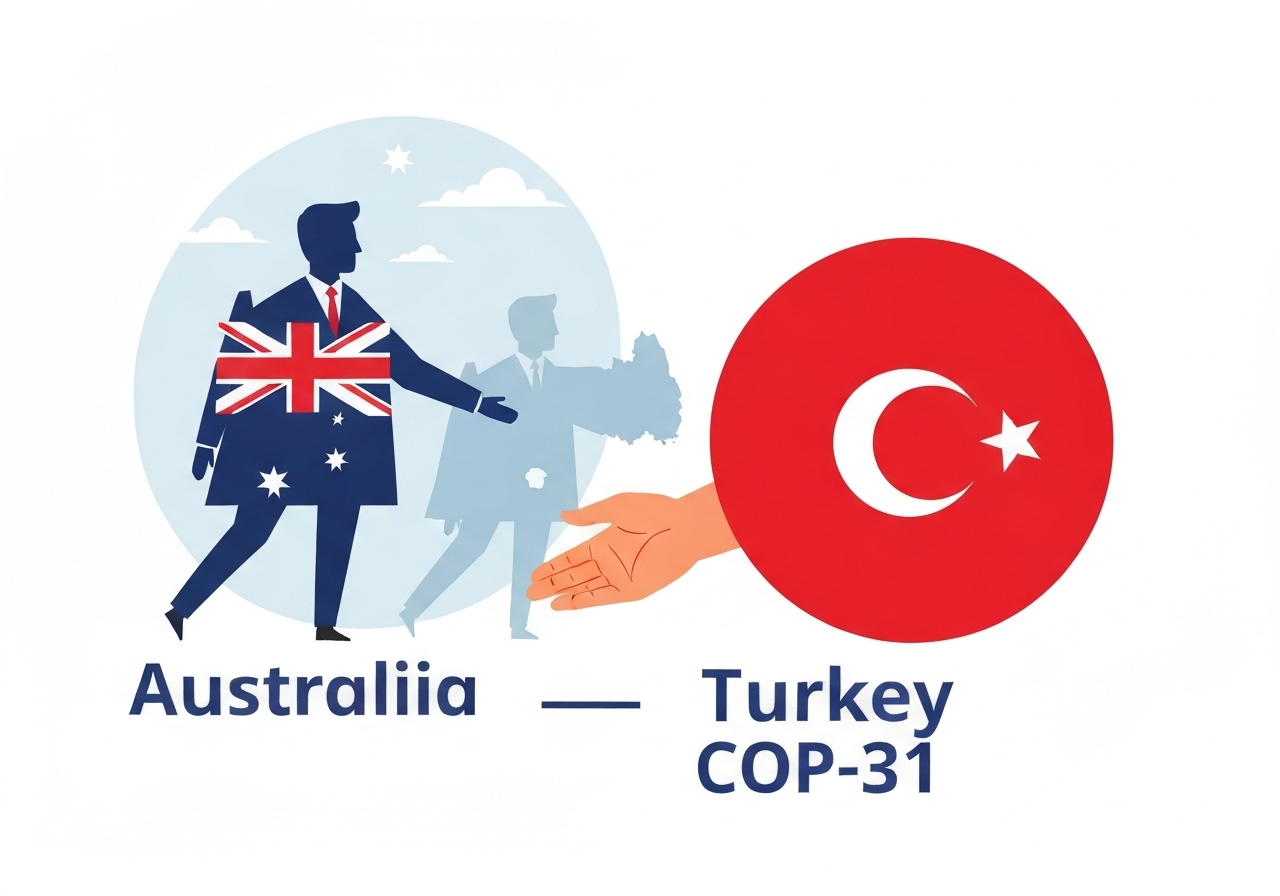
At COP30 in Belém, Brazil, delegates reached a late compromise that clears the way for Turkey to host COP31 in Antalya in 2026 after Australia withdrew its competing bid. Under the deal announced during talks in Belém, Australia will back Turkey’s hosting in exchange for Australia’s climate minister chairing the negotiations as COP president. The package includes a pre‑COP meeting on a Pacific island intended to keep Pacific concerns prominent. The arrangement must still be formalized by the assembled parties, but negotiators said ratification is expected.
Key takeaways
- COP31 is expected to be held in Antalya, Turkey, with the meeting scheduled for 2026 and the decision negotiated at COP30 in Belém, Brazil.
- Australia agreed to support the Turkish bid after securing that its climate minister, Chris Bowen, will serve as COP president responsible for negotiations and draft texts.
- As part of the compromise, a pre‑COP session will be hosted on a Pacific island to ensure Pacific states play a central role in agenda setting.
- Australia had campaigned for Adelaide to host and proposed co‑hosting with Pacific island states seen as highly vulnerable to sea level rise.
- Turkey argued it had precedent to host after standing aside in 2021 to allow the UK to host COP26 in Glasgow.
- If no agreement had been reached, UN rules would have defaulted the 2026 meeting to Bonn, the UN climate secretariat headquarters.
- Pacific leaders including Papua New Guinea and the Solomon Islands expressed disappointment with the outcome, while Australian officials called the compromise an outstanding result.
Background
Selection of COP hosts follows regional rotation and consensus rules within the UNFCCC process, with the Western Europe and Others Group traditionally playing a key role when it is their turn. In recent COP cycles, host nations have used the summit to highlight regional priorities, ranging from mitigation pledges to adaptation finance for vulnerable states. Australia positioned Adelaide as a proposed venue and emphasized co‑hosting modalities to elevate Pacific island concerns, arguing the Pacific should be front and centre of the agenda.
Turkey countered that it had a legitimate claim to host after ceding the 2021 slot to the UK, and proposed Antalya as a venue with international transport links and conference capacity. The impasse between the two candidates became a notable item at COP30 in Belém because failure to agree risked returning the summit to Bonn and leaving the process without a designated president for a year. That prospect pressured delegations to find a negotiated settlement before the end of the meeting.
Main event
Negotiations unfolded during COP30 sessions in Belém where delegations, regional group coordinators and the UNFCCC secretariat sought a consensus. Australia ultimately agreed to withdraw active pursuit of hosting rights in exchange for the right to provide the COP president for the 2026 talks. Delegates described the arrangement as unusual because the COP president is normally from the host country and presides from the venue.
Australian prime minister Anthony Albanese described the agreement as an outstanding result and said he had consulted Pacific leaders in framing the compromise. Meanwhile some Pacific officials made their displeasure public: Papua New Guinea’s foreign minister and the Solomon Islands leader signalled they were disappointed that Australia would not host the main event. Delegates in Belém said the compromise included operational details, with Turkey appointing a venue president to manage logistics and schedules.
Australia’s climate minister Chris Bowen told reporters that as COP president of negotiations he would hold the customary authorities to steer talks, appoint co‑facilitators and prepare draft negotiating text. Turkish officials are expected to manage the venue and on‑site arrangements in Antalya. Formal ratification by the COP body of over 190 parties remains a required procedural step before the deal is final.
Analysis & implications
The agreement sets a notable precedent by separating the negotiation presidency from the physical host, which could reshape expectations about leadership roles at future COPs. If this model is operationally successful, it may provide a tool for resolving future host disputes but it also raises questions about lines of responsibility during tense diplomatic moments. The division of duties will demand tight coordination between the negotiating presidency and the venue management team to avoid procedural confusion.
For Pacific island states the offer of a pre‑COP on a Pacific island is intended to keep their priorities on the formal agenda, yet it may not fully replace the symbolic and logistical weight of hosting the full summit. Many Pacific leaders had pushed for Adelaide in part because proximity would lower travel barriers for small delegations and keep island voices highly visible. Whether a pre‑COP will deliver equivalent influence over final negotiating texts is uncertain and will depend on how co‑facilitation and agenda setting are implemented.
Politically, Australia’s retreat from hosting is an awkward moment for Prime Minister Albanese after a high‑profile campaign among Western Europe and Others group members. Conversely, Turkey gains a diplomatic win and an opportunity to showcase its role in a sensitive global process. Internationally, the compromise averts a potential governance gap that a default to Bonn for 12 months would have created, preserving continuity in UNFCCC leadership during a period of fraught climate diplomacy.
Comparison & data
| Option | Venue | Regional access | Notes |
|---|---|---|---|
| Australia | Adelaide | Close to Pacific island states | Proposed co‑hosting to elevate Pacific priorities |
| Turkey | Antalya | Strong Eurasia and European links | Offered to host after standing aside in 2021 |
| Fallback | Bonn | UNFCCC headquarters | Default location if consensus fails, risks reduced visibility |
The table summarizes the practical tradeoffs: Australia offers geographic proximity to vulnerable Pacific delegations, Turkey offers regional balance and conference infrastructure, and Bonn serves as an administrative fallback. The chosen compromise attempts to harness strengths of both applicants while minimizing the governance disruption that a failed consensus would cause.
Reactions & quotes
Officials and regional leaders responded quickly after the deal emerged in Belém, with a mix of relief and disappointment among different constituencies.
It is an outstanding result and Pacific issues will be front and centre.
Anthony Albanese, Australian Prime Minister (interview with ABC)
Albanese framed the agreement as a diplomatic win that preserved Pacific priorities while acknowledging Australia could not have everything it wanted.
We are all not happy. And disappointed it has ended up like this.
Justin Tkatchenko, Papua New Guinea Foreign Minister (AFP)
Tkatchenko and other Pacific representatives warned that symbolic and practical losses could be significant if the region is not at the core of the main event.
It would be disappointing if Australia did not secure the event.
Jeremiah Manele, Solomon Islands leader (ABC)
Solomon Islands comments underline the political sensitivity inside the Pacific, where hosting carries strategic value beyond logistics.
Unconfirmed
- The precise logistics and legal mechanics of separating the negotiating presidency from the venue presidency have not been published and remain to be agreed.
- The exact Pacific island chosen to host the pre‑COP session and the schedule for that meeting have not been confirmed publicly.
- Details on whether additional concessions were offered to Pacific delegations beyond the pre‑COP and chair role are not yet available.
Bottom line
The negotiated settlement in Belém prevents a procedural gap in UN climate leadership and keeps COP31 on a defined course, but it also establishes an unusual split between where talks are hosted and who leads negotiations. That split may be workable if duties are clearly delineated, yet it raises the risk of operational friction at critical moments of bargaining.
Watch for three near‑term developments: formal ratification by COP parties, publication of the operational roles for the Australian negotiating presidency and the Turkish venue presidency, and the selection and brief for the Pacific pre‑COP. Outcomes on those points will determine whether the compromise strengthens multilateral process or leaves enduring grievances among vulnerable states.
Sources
- BBC News (international news report)
- Agence France‑Presse (AFP) (news agency reporting)
- Australian Broadcasting Corporation (ABC) (national broadcaster)
- UNFCCC (official UNFCCC information)