
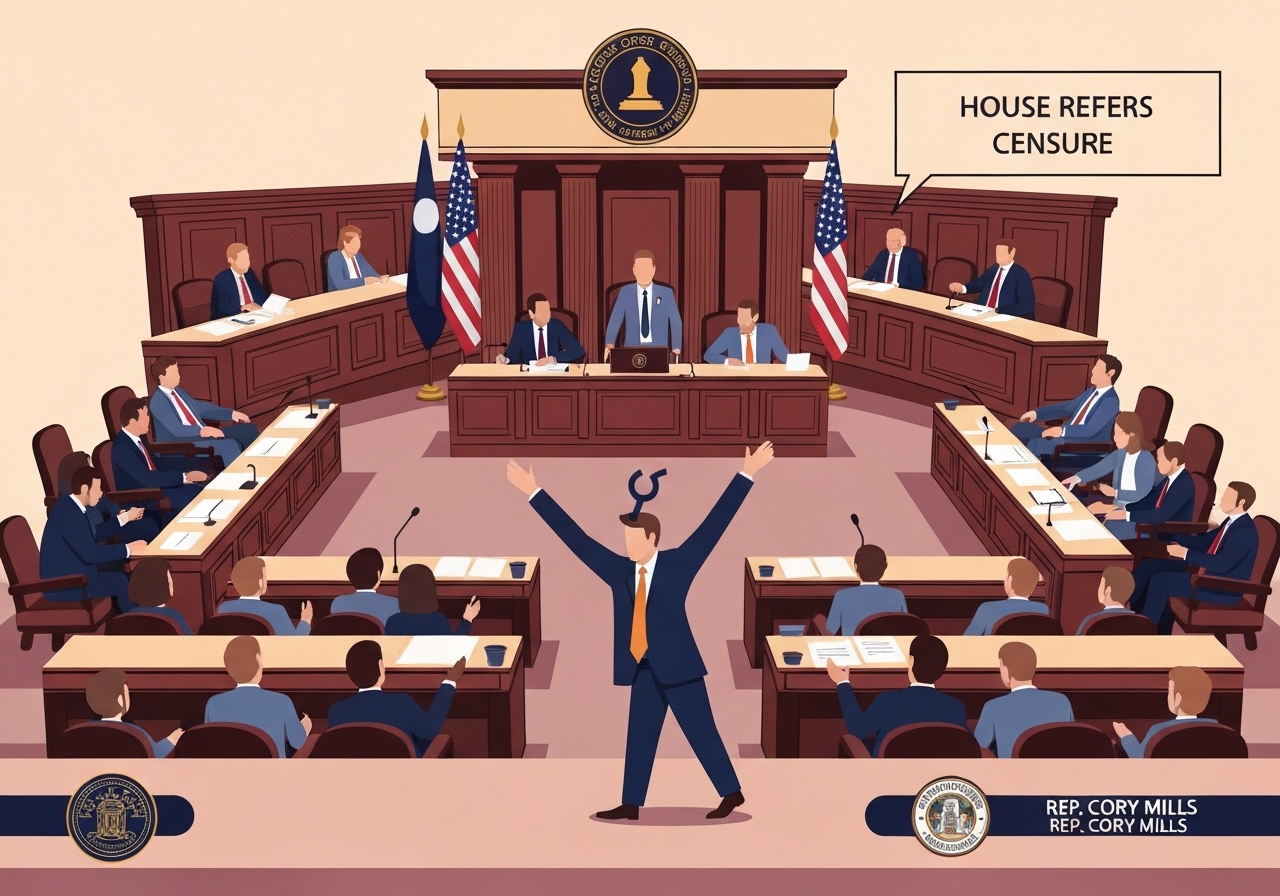
On Nov. 19, 2025, the House voted 310-103 to refer a censure resolution against Florida Republican Rep. Cory Mills to the House Ethics Committee, after an emotionally charged exchange on the floor. The referral prevents a direct House censure vote and sends allegations of campaign finance violations and dating violence to an investigative subcommittee. The move followed a protective order issued in October after a former girlfriend accused Mills of threatening to release intimate videos. The episode produced a tense confrontation between Mills and GOP Rep. Nancy Mace as members debated how to handle the allegations.
Key Takeaways
- The House voted 310-103 on Nov. 19, 2025, to refer Rep. Cory Mills’ censure resolution to the House Ethics Committee rather than vote on censure on the floor.
- The House Ethics Committee voted to form a subcommittee to investigate claims that Mills broke campaign finance law and engaged in sexual misconduct and dating violence.
- A Florida judge issued a protective order in October barring Mills from contacting Lindsey Langston, who was named Miss United States 2024.
- During the censure reading, Rep. Nancy Mace confronted Mills on the floor; several lawmakers, including Democrats, were split and about a dozen voted present.
- Mills has denied the allegations in statements to ABC News, calling them false and politically motivated.
- The judge in the protective order said he did not find Mills’ testimony to be “truthful,” according to court documents obtained by ABC News.
Background
Cory Mills was first elected to represent Florida’s 7th District in 2022 and won reelection in 2024. He sits on the House Armed Services and Intelligence committees, posts that give him an elevated profile on national security and defense matters. The Ethics Committee’s move to form an investigative subcommittee follows an October protective order stemming from allegations by Lindsey Langston, a 2024 Miss United States and a Florida Republican state committeewoman.
Langston alleged in July that Mills threatened to release sexually explicit recordings after their breakup and threatened harm to future partners, details that appear in a report obtained from the Columbia County Sheriff’s Office. Those allegations prompted a judge to issue a court-ordered protective measure in October. Separately, the Ethics Committee is examining whether Mills violated campaign finance rules, adding a financial and regulatory dimension to the allegations.
Main Event
On the House floor the clerk read Rep. Nancy Mace’s censure resolution aloud; Mace stood a few feet from Mills as the measure was read. When the resolution concluded, Mace and Mills exchanged words, and Mace told Mills, “You’re a disgrace,” according to footage and contemporaneous reports. The confrontation underscored the personal and political tensions surrounding the motion.
Rather than permitting a direct censure vote, the House moved to refer the resolution to the Ethics Committee after Mills made a procedural motion to do so once the clerk finished reading the text. The referral vote carried 310-103, effectively preventing the full chamber from issuing a public rebuke at this stage and ensuring formal investigation procedures would be followed instead.
The vote breakdown showed party divisions and a number of present votes; Democrats did not vote uniformly, and roughly a dozen members recorded present votes. House leadership framed the referral as a way to allow the Ethics Committee to pursue a structured fact-finding process while avoiding a politically charged floor rebuke ahead of a formal investigation.
Analysis & Implications
The referral shifts the immediate focus from a symbolic censure to a procedural inquiry with subpoena and investigative powers. An Ethics subcommittee can subpoena witnesses, review documents and hold hearings under committee rules, a process that typically takes longer but can produce a more comprehensive factual record than a single floor vote.
For Mills, referral avoids an immediate public censure but places him under prolonged scrutiny that could affect committee assignments and political standing if the committee finds violations. His roles on Armed Services and Intelligence committees give the investigation heightened attention because of the visibility and sensitivity of those panels.
Politically, the episode exposes fractures within both parties: Republicans faced a choice between protecting a colleague and allowing the Ethics process to proceed, while Democrats’ split votes reflected strategic differences about whether to force an immediate rebuke. The outcome also sets a procedural precedent about when the House opts to defer to ethics structures versus resolving accusations through direct floor discipline.
Legally, the protective order and the judge’s finding about Mills’ testimony introduce a judicial element that the Ethics investigation will likely consider but cannot adjudicate. If committee investigators corroborate elements of the protective order or uncover campaign finance irregularities, those findings could lead to committee sanctions or referrals to law enforcement for potential criminal investigation.
Comparison & Data
| Item | Result / Note |
|---|---|
| House vote to refer | 310-103 (Nov. 19, 2025) |
| Reported present votes | Approximately a dozen members recorded “present” |
| Protective order | Issued in October against Mills; named Lindsey Langston |
This table summarizes the verified counts and formal actions reported publicly. While the referral vote number is definitive, party-level breakdowns and the identities of those who voted present reflect shifting political calculations and are subject to roll-call records for precise attribution.
Reactions & Quotes
“You’re a disgrace.”
Rep. Nancy Mace (GOP)
Mace issued the censure resolution and confronted Mills on the floor; her remark encapsulated the personal intensity of the moment and framed the measure as a moral rebuke.
“These claims are false and misrepresent the nature of my interactions,”
Rep. Cory Mills (statement to ABC News)
Mills has denied the allegations publicly and characterized the accusations as politically motivated, asserting prior opponents have tried to weaponize legal processes.
“[The judge] did not find [Mills’] testimony to be truthful,”
Florida court order (October)
The judge’s language in the protective order became a focal point for critics and for the Ethics Committee’s grounds to investigate; it is a judicial finding about credibility in the protective order proceeding, not a criminal conviction.
Unconfirmed
- Any criminal charges stemming from the allegations have not been filed publicly and remain unconfirmed.
- The full party-line breakdown of the referral vote beyond the overall 310-103 tally and the reported present votes requires consulting the official roll call for individual member positions.
- Additional media reports alleging further misconduct beyond the protective order’s contents have not been formally corroborated in court filings available to ABC News.
Bottom Line
The House’s decision to refer the censure resolution against Rep. Cory Mills to the Ethics Committee turns a volatile, symbolic moment into a formal investigatory process. Referral spares the chamber an immediate public rebuke but initiates a structured probe that can be thorough, slow and consequential if investigators substantiate violations.
For lawmakers and observers, the case illustrates the balance the House must strike between taking swift public disciplinary action and relying on committee mechanisms to build evidentiary records. The Ethics Committee’s findings and any subsequent legal steps will shape Mills’ future in Congress and could influence how the House handles similar allegations going forward.
Sources
- ABC News (national news report)
- House Committee on Ethics (official congressional committee)
- Columbia County Sheriff’s Office (local law enforcement report referenced in public filings)