
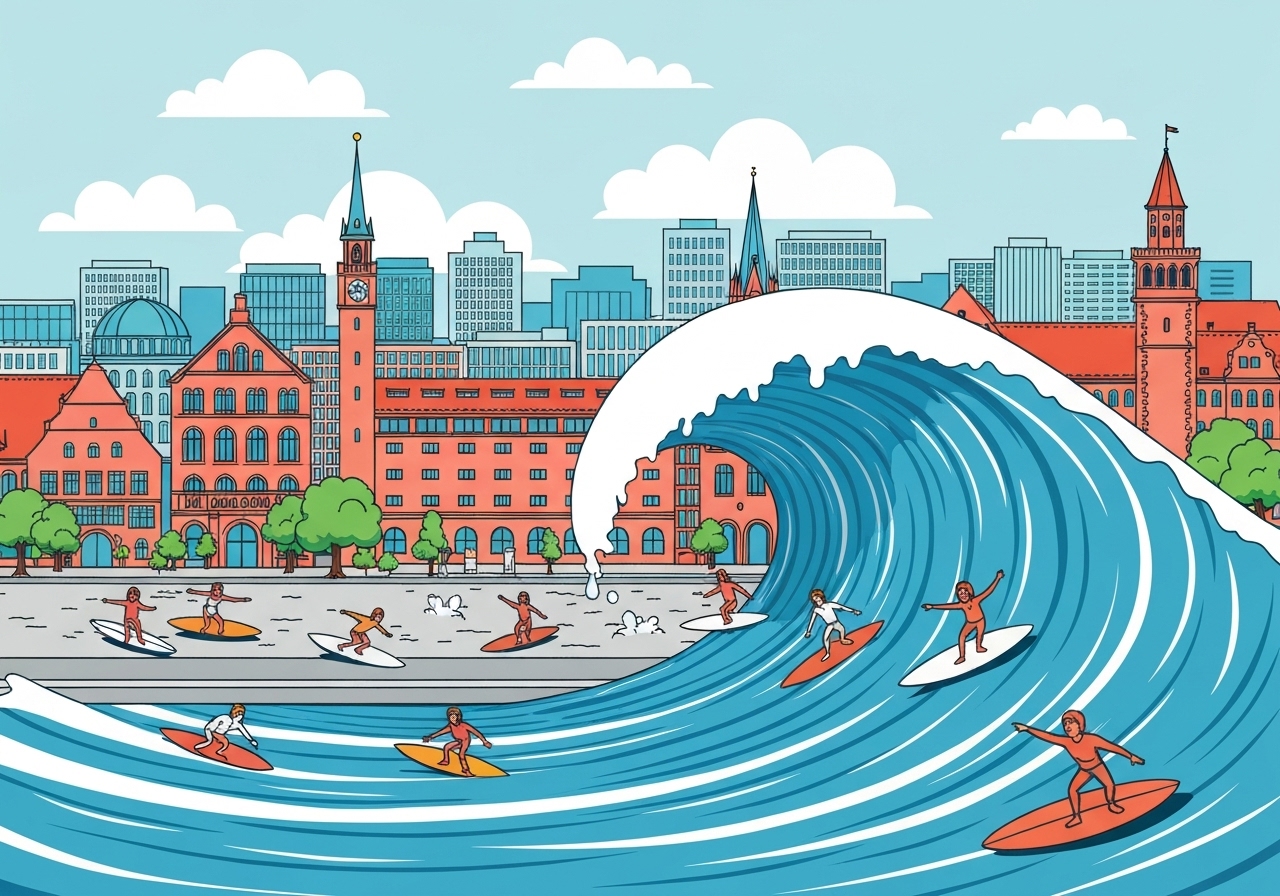
Lead: In early November 2025, municipal engineers finished dredging the Eisbach canal in Munich’s English Garden and reopened the flow, only to find the city’s signature surfable wave—the 1.5-meter Eisbachwelle—had collapsed into a small whitewater bump. Local surfers and officials say the change followed targeted cleaning after a fatality in April 2025, and a specialist team has been hired to diagnose and restore the feature. The disappearance has halted regular river surfing at the E1 break and prompted urgent talks about safety, heritage and technical fixes.
Key takeaways
- The Eisbachwelle historically produced a roughly 1.5-meter (4.9-foot) standing wave across three surfable sections on a 2-kilometer (1.2-mile) canal.
- Engineers completed a dredging operation in early November 2025 and reported the wave had been reduced to a minor whitewater bump on Nov. 4, 2025.
- A drowning on the Eisbachwelle in April 2025 prompted closer inspection of the riverbed and contributed to more extensive sediment removal this year.
- Hydrology experts say the wave depended on a specific flow speed and a submerged sediment ‘bump’ that may have been removed during dredging.
- Munich hired a team from Hamburg to map the riverbed with GPS and sonar and to test flow-discharge scenarios aimed at restoring the wave.
- Surfers briefly re-created the wave with an improvised wooden ramp, but authorities removed it as an illegal structure; formal restoration is underway.
- The site is both a local sports landmark and a tourist asset, and Munich Tourism has publicly urged a speedy return of the wave.
Background
The Eisbach canal runs about 2 kilometers as a side arm of the Isar River through Munich’s English Garden and has hosted the Eisbachwelle for decades. The standing wave — locally called the Eisbachwelle or E1 for its primary break and E2 downstream for a gentler section — became a niche global attraction for river surfers because it forms year-round, even in cold weather. Surfing there was illegal until a 2010 land swap between the city and the state of Bavaria regularized access and allowed local authorities to integrate the spot into official tourism materials.
City engineers have periodically dredged the canal to manage flow and safety. After an April 2025 drowning at the wave, crews carried out a more detailed inspection this year to identify potential entrapment hazards. That additional scrutiny appears to have removed sediment that previously created the underwater geometry necessary for a hydraulic jump and a stable standing wave.
Main event
According to surfers who use the break, engineers finished dredging in early November and opened floodgates to restore normal discharge. When water flow returned, the familiar 1.5-meter peak and distinct three-section profile failed to re-form; instead, the channel produced turbulent, non-surfable whitewater. Witnesses photographed the flattened wave on Nov. 4, 2025, and local media reported immediate concern among the surfing community.
Surfers such as Jakob Netzer and Alexander Neumann, long-time riders of E1 and E2, said dredgers likely removed the shallow sediment ridge that functions as the bed ‘bump’ needed to create a hydraulic jump. Netzer described E1 as ‘dangerous’ but prized for its layered sections; he and others say the altered bed now prevents the predictable transition that made the wave rideable.
Munich officials responded by contracting a team from Hamburg to conduct sonar and GPS mapping of the channel and to run experiments on discharge and bedform manipulation. On the river, engineers tested flows and the team deployed instrumentation, including boogie-board-mounted sonar units, to graph underwater contours. Surfers attempted a temporary fix by submerging a wooden ramp that restored the wave for a day, but authorities removed the structure as unauthorized.
Analysis & implications
Hydrologists explain the Eisbachwelle as a hydraulic-jump phenomenon: fast supercritical flow meets a sudden change in bed elevation, forcing water into a standing wave. Professor Markus Disse of the Technical University of Munich told reporters that the combination of flow velocity and an underwater ‘bump’ is central to forming a surfable crest. If that bump is removed or leveled, the hydraulic jump dissipates and the wave collapses into non-uniform whitewater.
Restoration options fall into two technical pathways: manipulate discharge timing to recreate the hydraulic condition or physically reconstruct a bedform with gravel or engineered structures. Disse suggested staged flow tests first, and gravel placement only if flow manipulation fails. Each option carries trade-offs among ecological regulations, navigational safety, legal liability and cost.
The incident also highlights a governance dilemma: safety-driven interventions meant to reduce drowning risk can unintentionally erase a cultural and tourist asset. Munich tourism officials emphasize the wave’s value to the city’s leisure brand, while safety advocates argue that clearer regulations and better site controls are necessary.
Economically, the immediate impact is modest but visible: river-surfing draws visitors and supports local gear retailers, schools and informal coaching. If the wave remains absent, operators and the city may lose a niche tourism draw and face pressure to fund engineered solutions or mitigation measures to balance safety and cultural preservation.
| Metric | Before dredging | After early Nov. 2025 |
|---|---|---|
| Typical wave height | ~1.5 m (4.9 ft) | Flattened; minor whitewater bump |
| Surfable sections | Three linked zones (E1) | Single irregular whitewater zone |
| Canal length | 2 km (1.2 mi) | 2 km (1.2 mi) |
| Safety action triggering dredge | Regular maintenance | After drowning in April 2025, more extensive dredging |
These figures summarize the measurable changes reported by local surfers and municipal staff. They underline that the canal’s length and basic flow regime are unchanged; the key loss is morphological — the underwater geometry that once concentrated energy into a rideable wave.
Reactions & quotes
‘It’s very sad the wave is not working,’ said Jakob Netzer as he stared at the former crest location, emphasizing local frustration while acknowledging the site’s danger.
Jakob Netzer, local surfer
‘For Munich, the Eisbach wave is a symbol of urban sports and leisure culture,’ Munich Tourism spokesperson Susanne Mühlbauer said, urging swift restoration and calling the site a unique tourist attraction.
Susanne Mühlbauer, Munich Tourism (official statement)
‘They did their job too well,’ said Professor Markus Disse, suggesting the dredging likely removed the bed bump and recommending flow experiments or gravel placement as remedies.
Markus Disse, hydrology professor, Technical University of Munich
Unconfirmed
- Whether the city intentionally removed the exact sediment ridge that created the wave remains unconfirmed; municipal crews say they were targeting hazard zones for safety.
- The full effectiveness of temporary fixes, such as the wooden ramp briefly used by surfers, has not been independently validated and was removed by authorities.
- Timelines for a permanent engineered solution or natural reformation are uncertain; the Hamburg team’s diagnostics have not yet produced public restoration deadlines.
Bottom line
The Eisbachwelle’s disappearance is a technical consequence of bed reshaping during a safety-driven dredging operation, with clear hydrological logic: remove the bump, and the hydraulic jump vanishes. Restoration appears feasible through either managed discharge tests or controlled reconstruction of the bedform, but both choices carry ecological, legal and budgetary implications for the city.
Munich officials, hydrologists and the surfing community are now coordinating measurements and experiments. The immediate next steps are mapping the channel, running discharge trials and evaluating whether gravel placement or an engineered structure can reliably and legally recreate a safe, surfable wave without introducing new hazards.
Sources
- NPR (news report)
- Technical University of Munich (academic institution providing hydrology expertise)
- Munich Tourism (official city tourism board statement)