
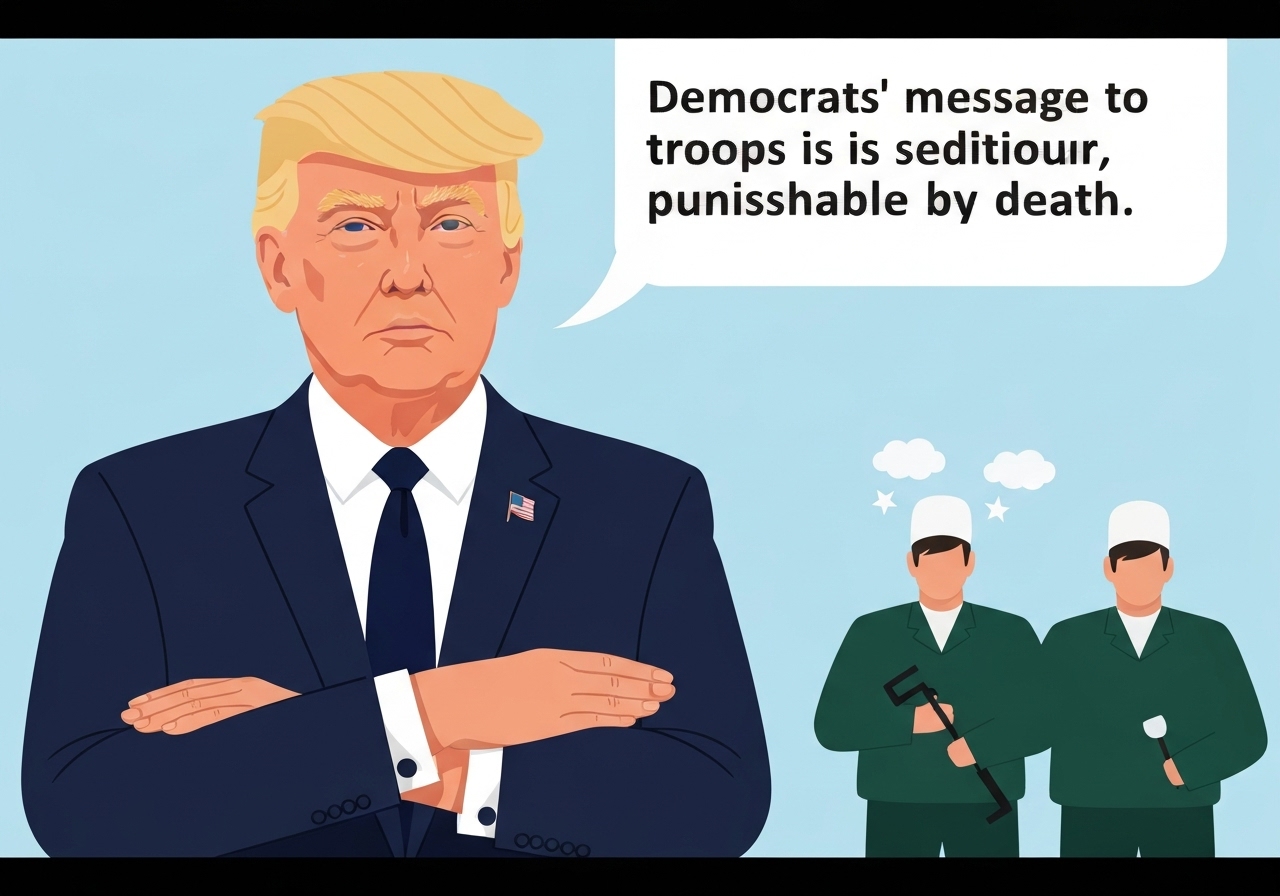
President Donald Trump on Thursday accused six Democratic lawmakers of “seditious behavior, punishable by death” after they circulated a video urging US service members to refuse unlawful orders. The social-media posts, shared on Truth Social, included explicit calls for legal and criminal action and a repost that read “HANG THEM GEORGE WASHINGTON WOULD !!” The six lawmakers — several with military or intelligence backgrounds — called Trump’s language dangerous and said it amounted to threats. Capitol security officials and congressional leaders moved to increase protections for the members targeted as the Justice Department and Pentagon review the matter.
Key Takeaways
- Donald Trump posted multiple statements on Truth Social calling the six Democrats “traitors” and saying their conduct was “punishable by death”; he also reposted an extreme third-party message.
- The video urging troops to refuse unlawful orders was shared by Senator Elissa Slotkin and features Senator Mark Kelly and Representatives Chris DeLuzio, Maggie Goodlander, Chrissy Houlahan and Jason Crow.
- White House press secretary Karoline Leavitt said the president was responding to lawmakers who she said were telling 1.3 million active-duty service members to defy the chain of command.
- House Democratic Leader Hakeem Jeffries condemned Trump’s rhetoric and demanded a recantation; House Speaker Mike Johnson defended Trump and said the DOJ and Pentagon will review the comments.
- Capitol Police and House leadership said they are coordinating protections for the six lawmakers and their families amid heightened threats.
- Public concern about politically motivated violence is high: an October Pew Research Center study found 85% of Americans believe such violence is increasing, a trend reported again by Politico/Public First in November.
Background
Political rhetoric in the United States has grown increasingly heated in recent years, with elected officials on both sides warning about threats to democratic norms. The immediate context here is a short video produced by several Democratic members of Congress and shared by Senator Elissa Slotkin that advises service members they are not required to obey unlawful commands. The lawmakers who appear in the video have military or intelligence experience, which they say informs their appeal to current service personnel.
The exchange follows a series of violent and threatening incidents around US politics in the past year, and a broader public perception that politically motivated violence is rising. Federal and local law-enforcement agencies have been monitoring threats against public officials, and congressional security teams have, at times, increased protections for lawmakers facing targeted online harassment or offline threats. That environment shaped how both Trump’s posts and the lawmakers’ video were received and escalated subsequent security responses.
Main Event
The video at the center of the dispute was shared by Michigan Senator Elissa Slotkin and features Arizona Senator Mark Kelly along with Representatives Chris DeLuzio (PA), Maggie Goodlander (NH), Chrissy Houlahan (PA) and Jason Crow (CO). In it, Sen. Kelly — a Navy veteran and former astronaut — and the other lawmakers tell service members that they may refuse orders that would violate the law or the Constitution. The message frames the present threats to the Constitution as coming from domestic actors rather than foreign adversaries.
Trump reacted on Truth Social with a series of posts early Thursday, calling the lawmakers “traitors” and urging arrest and prosecution. One post read: “SEDITIOUS BEHAVIOR, punishable by DEATH!” He also reposted an inflammatory third-party comment that invoked lynching rhetoric. The tone and content of the president’s posts prompted immediate alarm from the targeted lawmakers and some security officials.
At a White House briefing, press secretary Karoline Leavitt rejected the suggestion that the president was calling for executions, instead arguing that his response was driven by the lawmakers’ message to service members. She told reporters the lawmakers were effectively urging 1.3 million active-duty military personnel to disobey lawful orders and suggested the conduct “perhaps is punishable by law.”
House Democratic Leader Hakeem Jeffries called on the president to retract violent language immediately, warning that such rhetoric could spur violence. House Speaker Mike Johnson defended Trump’s critique as a definition of sedition and said the DOJ and Pentagon were reviewing the matter. Meanwhile, congressional security officials said they were coordinating with Capitol Police to safeguard the members and their families.
Analysis & Implications
The confrontation raises several legal and constitutional questions. U.S. law criminalizes certain forms of seditious conspiracy and incitement to violence, but proving those offenses requires showing intent and a clear nexus to violent action. Statements urging refusal of unlawful orders can be framed as a civic or legal warning by former service members, but when they are portrayed by political opponents as calls for insubordination they become a flashpoint.
For the military, the situation forces a delicate balance between obeying civilian authority and safeguarding the rule of law. The Uniform Code of Military Justice and long-standing military doctrine place a premium on obedience to lawful orders while recognizing that unlawful commands must be disobeyed. Public appeals by former and current officials to service members can create operational and morale challenges if they are perceived as partisan interventions.
Politically, the episode is likely to deepen polarization. Republicans who support Trump framed his posts as a lawful condemnation of what they describe as dangerous messaging; Democrats saw his language as a direct threat. The DOJ and Pentagon reviews will be closely watched for whether they result in formal investigations or policy guidance, and any action — or lack of action — could influence public trust in institutions.
Comparison & Data
| Survey / Event | Finding / Note |
|---|---|
| Pew Research Center (October) | 85% of Americans said politically motivated violence is increasing. |
| Politico / Public First (November) | Reported similar public concern about rising political violence; specific percentages varied by question. |
These figures reflect public anxiety that can amplify the effects of incendiary rhetoric. When leaders use militarized or violent language, communities already on edge may interpret it as justification for action, increasing pressure on law enforcement and public institutions to respond. The DOJ and Pentagon reviews are intended to clarify legal exposure and any necessary security measures.
Reactions & Quotes
“SEDITIOUS BEHAVIOR, punishable by DEATH!”
Donald J. Trump, Truth Social
The president’s short, forceful posts were widely circulated and cited by both critics and supporters as evidence of either a legitimate legal charge or a dangerous escalation in rhetoric.
“No threat, intimidation, or call for violence will deter us from that sacred obligation.”
Six Democratic lawmakers (joint statement)
The lawmakers’ joint statement framed their message as protecting constitutional duties and rejected the characterization of their video as an incitement.
“They are literally saying to 1.3 million active duty service members to defy the chain of command.”
Karoline Leavitt, White House Press Secretary
The White House emphasized the number of active-duty personnel as central to its argument that the lawmakers’ remarks were irresponsible or unlawful.
Unconfirmed
- Whether Trump’s posts will lead to criminal charges or formal DOJ action is under review and not yet determined.
- The provenance and authorship of the extreme reposted comment invoking George Washington and lynching rhetoric have not been independently verified in public records provided with the video.
- Attributions that recent violent incidents were directly caused by either side’s rhetoric remain contested and lack definitive causal proof.
Bottom Line
This episode crystallizes the dangers of heated political rhetoric in an already polarized and threat-sensitive environment. A short legal or moral argument about obedience and unlawful orders quickly escalated into mutual accusations of sedition and death threats, prompting security steps and official reviews.
Watch for the outcomes of the DOJ and Pentagon reviews and any subsequent administrative or legal action; those responses will help determine whether this remains a rhetorical fight or becomes a matter for formal investigation. In the meantime, the incident underlines how appeals to the military or inflammatory language from high office can have immediate operational and security consequences.