
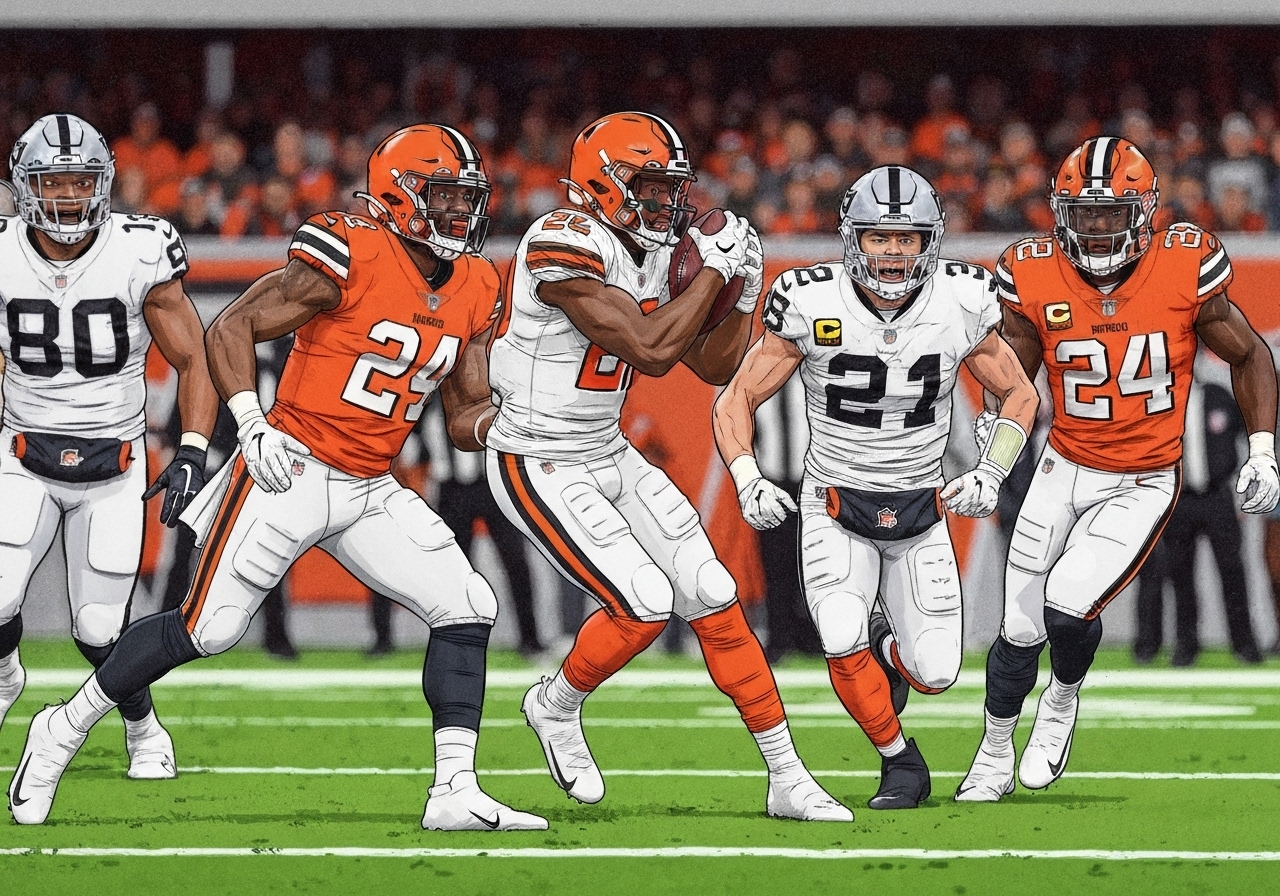
In Las Vegas on Sunday, rookie quarterback Shedeur Sanders delivered a statement performance in his first NFL start, guiding the Cleveland Browns to a 24-10 win over the Raiders. The Browns’ defense dominated, recording 10 sacks and repeatedly disrupting Las Vegas’ offense, while Sanders completed 11 of 20 passes for 209 yards with one touchdown and one interception. The victory snapped Cleveland’s 13-game road losing streak and moved the team to 3-8 overall; the Raiders fell to 2-9. Sanders’ 66-yard touchdown pass to rookie Dylan Sampson provided the game’s signature scoring play and was his first NFL touchdown.
Key takeaways
- Final score: Browns 24, Raiders 10 — Cleveland improved to 3-8 and Las Vegas dropped to 2-9.
- Rookie starter: Shedeur Sanders was 11-for-20 for 209 yards, 1 TD (66 yards), 1 INT, and an 87.3 passer rating in his first NFL start.
- Pass rush: Cleveland recorded 10 sacks on Geno Smith, one shy of the franchise single-game record.
- Myles Garrett: Recorded three sacks in the game, raising his season total to 18 and surpassing his previous team mark of 16.0.
- Explosive play: Sanders’ 52-yard completion to Isaiah Bond was the Browns’ longest play this season and set up a wildcat touchdown by Quinshon Judkins.
- Special teams/clock: Andre Szmyt hit a 53-yard field goal; Daniel Carlson’s 48-yard attempt earlier in the game was missed wide left for the Raiders.
- Depth-chart question: Sanders became the 14th Browns rookie quarterback to start since 1999 and the first rookie starter to win a game for Cleveland since Eric Zeier in 1995.
Background
The Browns entered the game amid an unsettled quarterback picture. Cleveland had started third-round pick Dillon Gabriel for six games (1-5 record) before turning to Sanders, a fifth-round rookie who had previously served mainly on scout team duty and had worked his way up the depth chart after opening training camp as the No. 4 quarterback. The team’s 3-8 mark and an extended road losing streak increased pressure on coaching staff to find momentum down the stretch.
Shedeur Sanders arrived in Cleveland with a high-profile pedigree: son of Hall of Famer Deion Sanders and known for outspoken confidence during the preseason and in recent interviews. The organization brought him along cautiously, emphasizing one-on-one coaching and film study. That deliberate development contrasts with the urgency of the Browns’ record and the broader NFL trend of quicker rookie insertions, creating debate among fans about timing and decision-making.
Main event
The Browns drew first blood after a strong special-teams set and short field position, with Quinshon Judkins taking a direct snap and powering in for a short touchdown to make it 7-0. Sanders’ early possessions were conservative, but he finished the night making several momentum-changing plays. On his fourth drive, a 17-yard strike to tight end Harold Fannin Jr. and a 52-yard rollout bomb to rookie Isaiah Bond flipped field position and led to a second Judkins wildcat touchdown.
Sanders’ lone touchdown pass came late in the fourth quarter when he hit rookie running back Dylan Sampson on a short swing that turned into a 66-yard sprint to the goal line, giving Cleveland a 24-3 advantage. The Raiders managed a 5-yard touchdown to Ashton Jeanty with 5:16 remaining, but the Browns’ defense limited further comeback opportunities. Sanders did toss an interception in the second quarter—picked off by Charles Snowden—which resulted in a 41-yard field goal, but the defense held Vegas to three points on the sequence.
Defensively, Cleveland’s front and linebackers consistently pressured Geno Smith, collecting 10 sacks and forcing multiple third-and-long situations. Myles Garrett paced the pass rush with three sacks, a performance that both contributed to the win and pushed his season sack total to an individual team record. The Browns’ ability to convert pressure into defensive stops and short fields was decisive.
Analysis & implications
Sunday’s outcome has immediate roster and strategic implications. Offensively, Sanders’ combination of touch on intermediate throws, willingness to extend plays, and demonstrated rapport with select receivers gives the coaching staff an alternative to continue evaluating rather than revert to previous starter Dillon Gabriel. While one start is not definitive, the Browns’ offense showed more consistent energy and explosive potential than it had for most of the season.
Defensively, Cleveland reinforced that its front is a season-long strength capable of compensating when the offense is inconsistent. Ten sacks in a single game underline a pass rush that can alter opponents’ gameplans and create field-position advantages. That kind of defensive production reduces pressure on any young quarterback tasked with learning on the fly.
Longer term, Sanders’ debut raises questions about development timelines for late-round quarterbacks. The Browns’ patient approach—extensive film study and targeted reps—appears to have paid an early dividend, but sustained success will depend on game-planning, offensive line play, and how opposing defenses adjust. For the roster, a clear short-term effect is a likely continued look for Sanders next week; the coaching staff publicly declined to name a definitive starter while praising the performance.
Comparison & data
| Metric | Game | Season/Record |
|---|---|---|
| Team sacks vs Raiders | 10 | One shy of franchise single-game record (11) |
| Myles Garrett sacks (game / season) | 3 / 18 | Surpassed his prior team-high mark of 16.0 |
| Shedeur Sanders (comp/att / yards / TD / INT) | 11/20 / 209 / 1 TD / 1 INT | 87.3 passer rating in start |
The table highlights how balanced contributions—explosive passing plays, wildcat scoring by Judkins, and overwhelming pass rush—combined to produce a decisive win. That multi-faceted performance contrasts with earlier games this season where the Browns have lacked either offensive explosiveness or defensive consistency. The data suggest Cleveland’s best path to more wins is maintaining the defensive pressure while the offense refines game-management and reduces turnovers.
Reactions & quotes
“I’m proud of him and proud of this offense,” said coach Kevin Stefanski, declining to name a long-term starter immediately while praising the team’s effort.
Kevin Stefanski — Browns head coach (postgame comments)
“You start thinking as a dad,” Deion Sanders said of deciding to attend, describing a parental impulse to support his son on a short trip.
Deion Sanders — former NFL defensive back and Shedeur’s father (postgame)
After a strip-and-three-and-out sequence, veteran defensive players emphasized the unit’s identity: consistent pressure and situational tackling turned turnovers and short fields into points.
Team defensive leaders (postgame remarks)
Unconfirmed
- Whether Shedeur Sanders will be named the permanent starter beyond next week remains undecided; the coaching staff did not make a definitive commitment after the game.
- Any long-term projection about Sanders’ trajectory as an NFL starter is speculative based on a single start and needs more starts and filmwork to confirm.
Bottom line
Sunday’s result was a meaningful early test and one the Browns passed as a collective unit: a high-impact defensive showing paired with an encouraging offensive debut by Shedeur Sanders. The win snapped a lengthy road losing streak and injected immediate optimism into a 3-8 season, but it does not by itself resolve the Browns’ longer-term quarterback or roster questions.
What matters next is follow-through. The Browns face the San Francisco 49ers at Huntington Bank Field next Sunday, and how Cleveland balances evaluation and short-term competitiveness will shape decisions about the quarterback position and offensive identity. For now, Sanders has earned an extended look and the defense has reasserted itself as the team’s engine for wins.
Sources
- Cleveland.com game report (news)
- Cleveland Browns — game notes & team release (official team site)
- NFL — game statistics and box score (league/official)