
Lead
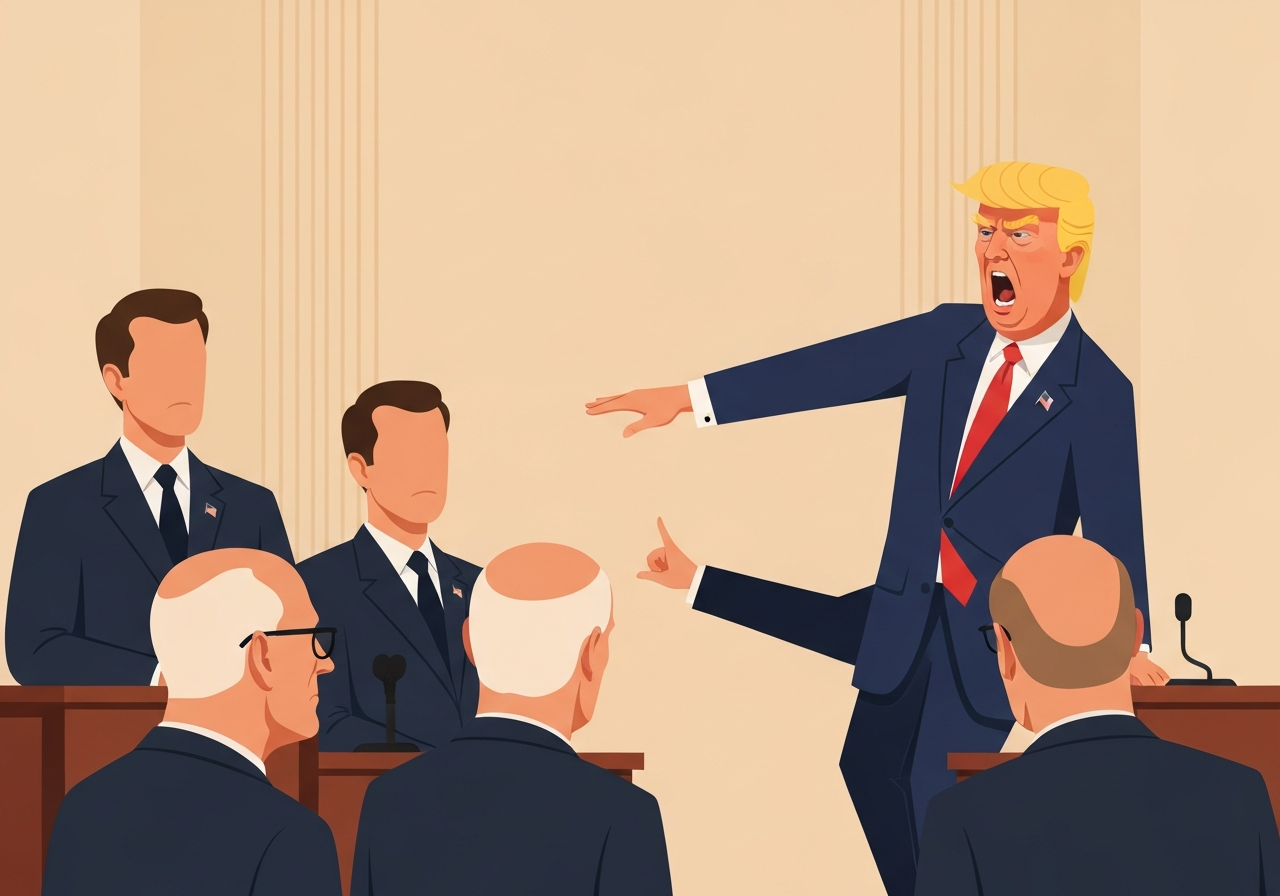
On June 24, 2026, inside a closed-door Republican luncheon at the U.S. Capitol, President Donald Trump confronted Senate Republicans face to face over Tuesday’s vote approving a war powers resolution linked to the Iran conflict. The encounter came after Trump scrapped a planned public signing of an overwhelmingly passed housing bill, saying he would not sign until lawmakers moved his SAVE America proof-of-citizenship measure. The exchange highlighted widening friction between the president and his Senate allies and interrupted the chamber’s ability to focus on an election-year affordability agenda. Several GOP senators who joined Democrats on the war powers measure were singled out by Trump and have since defended their votes.
Key Takeaways
- On June 24, 2026, President Trump chastised Senate Republicans at a private Capitol luncheon after the Senate adopted a war powers resolution regarding the Iran war.
- Four Republican senators voted with Democrats on the resolution: Lisa Murkowski, Susan Collins, Rand Paul and Bill Cassidy, prompting public criticism from Trump.
- Trump canceled a ceremonial signing of a housing bill that had cleared both chambers, demanding the SAVE America Act in return for his signature.
- The Senate currently has a 53-47 Republican majority, but leaders say they lack the votes to end the filibuster and pass the voting measure as written.
- Sen. Bill Cassidy, who lost a primary after a Trump endorsement of his opponent, defended his vote and said he pressed for a briefing on the Iran campaign before supporting war powers.
- Senate leaders and some House Republicans are exploring alternative steps, including reconciliation or a federal grants approach, but options are politically and procedurally fraught.
Background
Tension between President Trump and Senate Republicans has been building for weeks over several issues, including confirmation delays for administration nominees, funding questions tied to discretionary projects, and strategic disagreements about the U.S. approach to Iran. The dispute intensified after the House passed its own version of a war powers resolution earlier in June, and the Senate took up a largely symbolic measure to rebuke the administration’s military actions. The White House has pushed for a more aggressive posture, while many senators have expressed unease about the campaign’s scope and endgame.
At the same time, Republicans have been trying to marshal legislative wins they can present to voters ahead of the November midterm elections, with a housing bill aimed at lowering costs being a primary example. Trump abruptly announced he would not sign that bill publicly unless the Senate advanced the SAVE America Act, his proof-of-citizenship proposal for federal elections, which Democrats uniformly oppose and which faces a high bar because of the 60-vote filibuster threshold. The resulting standoff has left leaders scrambling for alternatives while public attention turns to intra-party conflict rather than policy accomplishments.
Main Event
The president accepted an invitation from Sen. Rick Scott to attend the closed-door GOP luncheon on June 24, 2026, and arrived intent on pressing senators to back his voting bill. Instead, much of the meeting focused on the previous day’s Senate adoption of the war powers resolution relating to U.S. military action in Iran. According to participants, Trump singled out the four Republican defectors and raised his objections in a heated, at times loud, exchange with lawmakers.
Sen. Bill Cassidy rose to defend his decision to support the war powers measure, telling reporters after the meeting that he challenged officials on the conflict’s objectives and timeline. Cassidy said he told the president that the campaign had been expected to run about four weeks but had stretched to four months without clear achievement of original aims, and that he would continue to press for classified briefings before shifting his stance. A person familiar with the private session said Trump repeatedly told Cassidy to sit down and at one point called the senator a ‘lunatic,’ a characterization relayed by attendees.
Most senators remained publicly restrained after the meeting, but several acknowledged the rift. Senate Majority Leader John Thune described the luncheon as dominated by the president’s messaging, and others, including Sen. Thom Tillis, expressed frustration that the housing bill had been effectively put on hold. House Speaker Mike Johnson has discussed alternate paths for the SAVE America proposals, including pairing elements with budget reconciliation or federal grants, but those ideas face complex procedural and political hurdles.
Senate Republicans face internal pressure from members like Sen. Mike Lee, who has publicly urged abandoning the filibuster to pass the voting measure, while leaders warn that such a move is unrealistic given current votes and intense Democratic opposition. The meeting did not resolve those divisions and instead underscored the limits of party discipline ahead of the midterms.
Analysis & Implications
The public rebuke and the aborted signing ceremony signal a broad strategic tension: Trump is using leverage over ceremonial and legislative moments to force priority items onto an embattled Senate agenda. By tying the housing bill to the SAVE America Act, the president elevated a partisan voting reform proposal into a bargaining chip that risks alienating voters focused on affordability. Republican leaders worry that voters will see indifference to cost-of-living concerns if high-profile bills remain unsigned or uncelebrated.
Procedurally, the SAVE America Act faces near-insurmountable obstacles: it would either require scrapping or circumventing the filibuster or an alternative path through reconciliation that many in the party regard as impractical for this subject matter. Democrats uniformly oppose the bill, and even some Republicans who sympathize with its goals have warned that eliminating the filibuster would set a consequential precedent. Those realities make the president’s demand a long-shot but a potent intra-party rallying cry for his base.
On national security, the Senate’s adoption of a war powers resolution marks a rare congressional rebuke of executive military action, even if mostly symbolic. The split among Republicans—four joining Democrats—highlights reservations about strategy, authority, and oversight. If more senators press for briefings or constraints, the administration may face growing difficulty in sustaining a broad bipartisan rationale for military efforts, which could shape funding, authorizations and public messaging in coming months.
Comparison & Data
| Item | Detail |
|---|---|
| Republican defectors | 4 senators: Lisa Murkowski, Susan Collins, Rand Paul, Bill Cassidy |
| Senate composition | 53 Republicans, 47 Democrats |
| Housing bill | Passed both chambers overwhelmingly; public signing canceled June 24, 2026 |
| SAVE America Act | Proof-of-citizenship voting bill, opposed by Democrats; would face a 60-vote filibuster hurdle |
The table above summarizes the immediate facts that shaped the June 24 meeting: a small group of Republican defections, a narrow Senate majority, and competing legislative priorities that exposed fissures in GOP unity. While the war powers vote is largely symbolic, it carries political weight as a formal expression of congressional concern about the administration’s Iran policy. Meanwhile, the housing bill’s stalled ceremonial signing illustrates how executive theater can be used as leverage in internal party disputes.
Reactions & Quotes
Sen. Bill Cassidy defended his actions and described a direct confrontation with the president but said he sought to de-escalate after asserting the need for clearer objectives.
I stood and said, ‘You have not told the American people what’s going on. This was supposed to last four weeks, it’s lasted four months.’
Sen. Bill Cassidy
Senate leaders conveyed frustration that the luncheon did not accomplish the hoped-for thaw in relations and that the president’s insistence on the voting bill complicated efforts to present legislative wins to voters.
It was kind of a one-sided conversation.
Sen. John Thune
Publicly, the president offered a more conciliatory line on departing the meeting while acknowledging differences with some attendees, underscoring the contrast between private intensity and public messaging.
We like everyone in the room. I don’t like a few people, but that’s OK.
President Donald Trump
Unconfirmed
- Whether President Trump will ultimately veto the housing bill remains unresolved; the president’s refusal to hold a public signing does not equal a formal veto threat.
- Reports that the president explicitly used the word ‘lunatic’ to describe a senator come from a person familiar with the meeting and have not been confirmed by a White House transcript.
- Plans to attach SAVE Act provisions to a reconciliation package are under discussion but lack a detailed, agreed procedural path and are therefore speculative.
Bottom Line
The June 24 confrontation illustrated a widening gap between President Trump and key Senate Republicans over both foreign policy oversight and domestic legislative priorities. By linking a widely supported housing bill to the contentious SAVE America Act, the president escalated leverage tactics that may undermine Republican efforts to campaign on affordability ahead of the midterms. The short-term effect is political distraction; the medium-term consequence could be a reordering of Senate priorities if defections or leadership decisions reduce the chamber’s ability to pass signature GOP agenda items.
For observers, the episode signals that intra-party discipline cannot be assumed even with a Senate majority, and that presidential pressure alone may not translate into policy outcomes when procedural constraints and electoral calculations collide. Watch for further developments on classified briefings about the Iran campaign, the administration’s public posture on the housing bill, and any concrete procedural moves to advance or repurpose the SAVE America provisions.
Sources
- Associated Press — news report on the June 24, 2026 meeting and related developments