
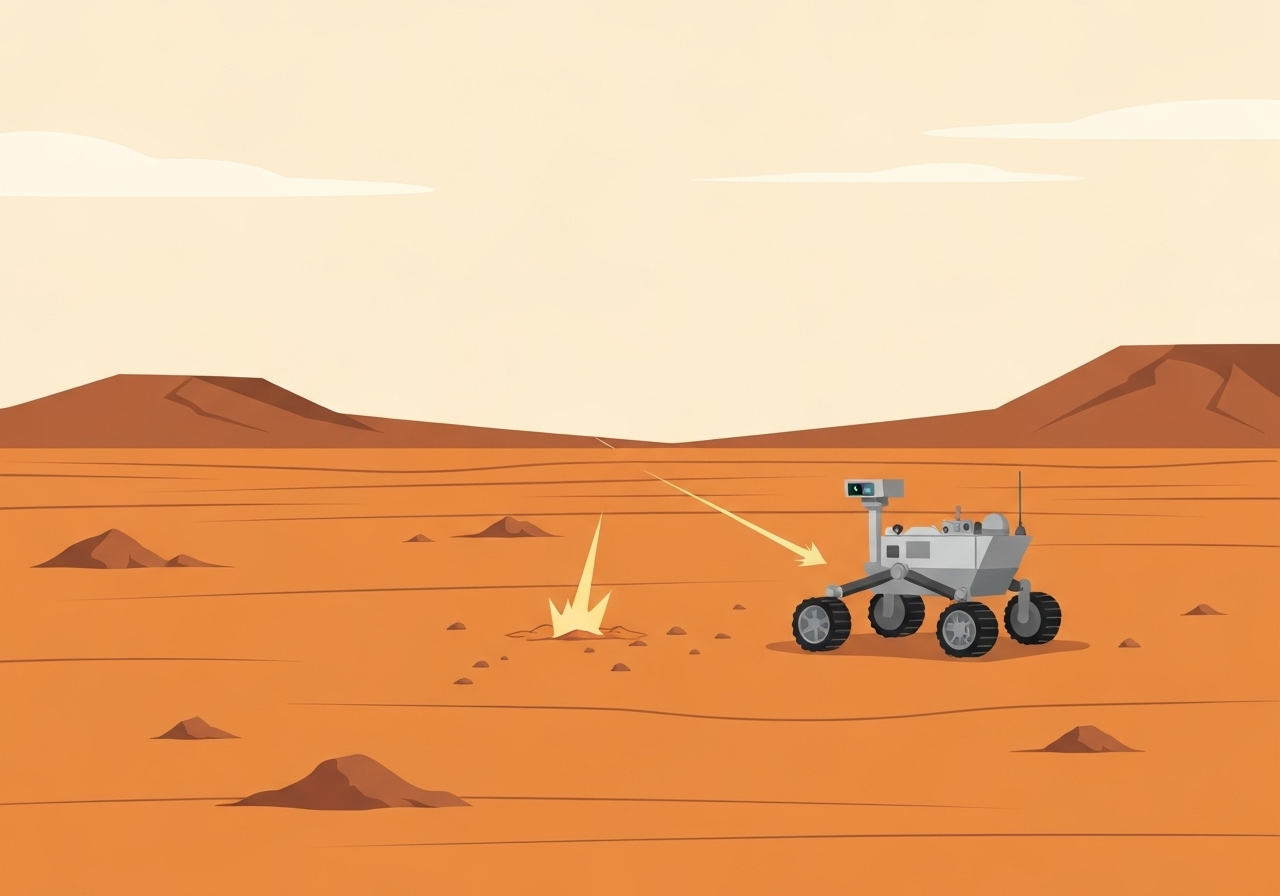
NASA’s Perseverance rover has provided the clearest evidence yet that tiny electrical discharges—dubbed “mini-lightning”—occur on Mars. Over two Martian years (1,374 Earth days) scientists analysed 28 hours of audio recorded by Perseverance’s SuperCam microphone and identified 55 short events linked to dust devils and storm fronts. These signals began as brief electromagnetic disturbances in the microphone electronics followed milliseconds later by faint acoustic pulses, consistent with centimetre-scale triboelectric sparks inside moving dust. While not the dramatic lightning bolts familiar on Earth, the observations point to active electrostatic processes in Mars’s dusty atmosphere.
Key Takeaways
- Perseverance has been on Mars since 2021 and its SuperCam microphone captured 28 hours of usable audio across two Martian years (1,374 Earth days).
- Researchers detected 55 discrete events where an electronic disturbance preceded a faint sound, interpreted as dust-driven electrical discharges.
- Most discharges were centimetre-scale and associated with dust devils or storm fronts; one strong event was estimated about 6 feet (≈1.8 m) from the rover, others occurred within inches.
- The phenomenon is consistent with triboelectric charging—fast-moving grains exchanging charge when they collide or rub together in Martian winds.
- Recordings provide persuasive evidence but remain indirect: the events were heard (acoustic) and detected electrically (microphone circuitry), not visually imaged.
- Scientists caution that tiny sparks are unlikely to threaten short-term human safety but could pose long-term risks to electronics and spacesuits through cumulative damage.
- Teams recommend future missions include dedicated high-speed cameras and specialized electromagnetic sensors to confirm and characterise these discharges.
Background
Mars is a windy, dusty world where frequent dust devils and episodic planet-spanning storms loft fine particles into the atmosphere. For decades scientists have debated whether that moving dust can generate sufficient charge separation to produce electrical discharges. On Earth, lightning arises from large-scale charge separation in clouds; on Mars the thin atmosphere, lower pressure and different particle properties make Earth-like lightning unlikely but allow smaller-scale triboelectric effects.
Past laboratory experiments and modelling have shown that colliding dust and sand grains can build up static charge, and some remote measurements from orbit and landers hinted at electrostatic activity. Until now, however, no mission had recorded a convincing, time-resolved signature linking electrical and acoustic signals on the surface. The new analysis, published as “Detection of triboelectric discharges during dust events on Mars,” synthesises microphone data with environmental context to make the case for real, localised discharges.
Main Event
The discovery emerged not from an imaging instrument but from Perseverance’s SuperCam microphone, which was performing unrelated observations when short disturbances were recorded. Each anomalous event began with an abrupt electronic perturbation registered in the microphone’s circuitry; milliseconds later a faint acoustic pulse arrived. Researchers used the delay between the two signatures to estimate distances to the source in several cases.
Of 55 events flagged by the study team, many clustered during active dust activity—either when dust devils passed over or when sharp storm fronts moved through. In one well-documented occurrence, an intense dust devil crossed the rover’s location; the audio-electrical sequence implied a discharge roughly 6 feet from the lander and may have involved the rover itself building and then releasing charge to the ground.
Lead investigator Dr. Baptiste Chide and colleagues interpreted the signals as centimetre-scale triboelectric sparks—short-lived, localised zaps produced when charged grains collide and discharge. These are orders of magnitude smaller than terrestrial cloud-to-ground lightning but deliver a clear, measurable signature in both the electromagnetic and acoustic domains.
Analysis & Implications
The finding changes the baseline understanding of Martian atmospheric electricity by showing that charging and discharge actually occur at the surface under natural dust conditions. Even though the energetic scale is small compared with Earth lightning, such discharges confirm active electrostatic processes that can influence dust lifting, particle adhesion, and near-surface chemistry.
For robotic hardware and future crewed missions, the practical implication is notable: repeated tiny discharges can produce cumulative wear on electronics, connectors, and suit materials. Devices that rely on sensitive electronics or uncompensated surfaces could see degraded performance without mitigation—grounding, shielding, or electrostatic discharge protections may be needed in design cycles.
Scientifically, confirming triboelectric discharges opens new observational windows into Martian meteorology and surface-atmosphere coupling. Discharge occurrence, frequency and energy depend on grain size distributions, wind speed, atmospheric conductivity and local terrain—so systematic measurements could reveal subsurface properties and dust transport processes.
Finally, because the current evidence is indirect (audio + circuitry perturbation), the result motivates instrument suites that combine high-speed optical imaging, calibrated electromagnetic sensors and microphones to unambiguously link visual sparks with electric and acoustic signatures on future missions.
Comparison & Data
| Parameter | Terrestrial lightning | Martian mini-discharges |
|---|---|---|
| Typical scale | Kilometres | Centimetres |
| Energy | 10^9–10^12 J (cloud lightning) | Many orders of magnitude lower (tiny sparks) |
| Detection | Optical, radio, acoustic | Electromagnetic perturbation + faint acoustic pulse |
The table highlights the contrast in scale and detectability. While Martian discharges are minuscule in energy compared with Earth lightning, their detection by Perseverance’s audio system demonstrates that even low-energy events produce measurable electromagnetic and acoustic footprints under the right conditions. Contextual environmental data (wind speed, dust loading and pressure) will be key to mapping when and where these discharges occur.
Reactions & Quotes
Researchers emphasise that the recordings provide compelling but not yet definitive proof until corroborated by visual or dedicated electromagnetic imaging.
“What we are seeing are tiny sparks — but on Mars, even tiny sparks can tell us a lot about the atmosphere.”
Dr. Baptiste Chide, lead author (research team)
Dr. Chide framed the events as small-scale but scientifically valuable signatures of Martian atmospheric processes, and noted that measuring the timing between electronic and acoustic signals allowed the team to estimate spark distances from the rover.
“The recordings provide persuasive evidence of dust-induced discharges, but some doubt will inevitably remain until we see them visually.”
Dr. Daniel Pritchard, particle physicist (commentary)
Independent commentators urged caution: the combined electronic and acoustic detections are strong indicators but visual confirmation—high-speed imaging of a spark—would remove remaining ambiguity.
Unconfirmed
- Direct optical observation of the sparks: no high-speed camera captured a visual flash concurrent with the electrical/acoustic signals.
- Whether rover materials contributed to some discharges: in at least one strong event the rover may have accumulated charge that then discharged to the ground, but this attribution is not fully confirmed.
- Exact energy and frequency distribution across Mars: the current dataset is limited (55 events, 28 hours) and not yet representative of global rates.
Bottom Line
Perseverance’s microphones have provided the strongest evidence to date that Mars experiences tiny, dust-driven electrical discharges—”mini-lightning”—during dust devils and storm fronts. The phenomenon is small-scale but scientifically important, confirming active electrostatic processes in the Martian environment and opening new questions about dust dynamics and near-surface chemistry.
For mission planners, the takeaway is practical as well as scientific: designers should consider electrostatic discharge resilience for long-duration equipment and suits. To move from persuasive evidence to conclusive understanding, future missions should carry instruments designed to image, electrically characterise and timestamp discharges simultaneously.
Sources
- The Times of India — news report summarising the study and reactions (media).
- NASA Mars 2020 / Perseverance — official mission pages with instrumentation and mission timeline (official).
- Nature — academic publisher of the study titled “Detection of triboelectric discharges during dust events on Mars” (academic journal).