
Lead
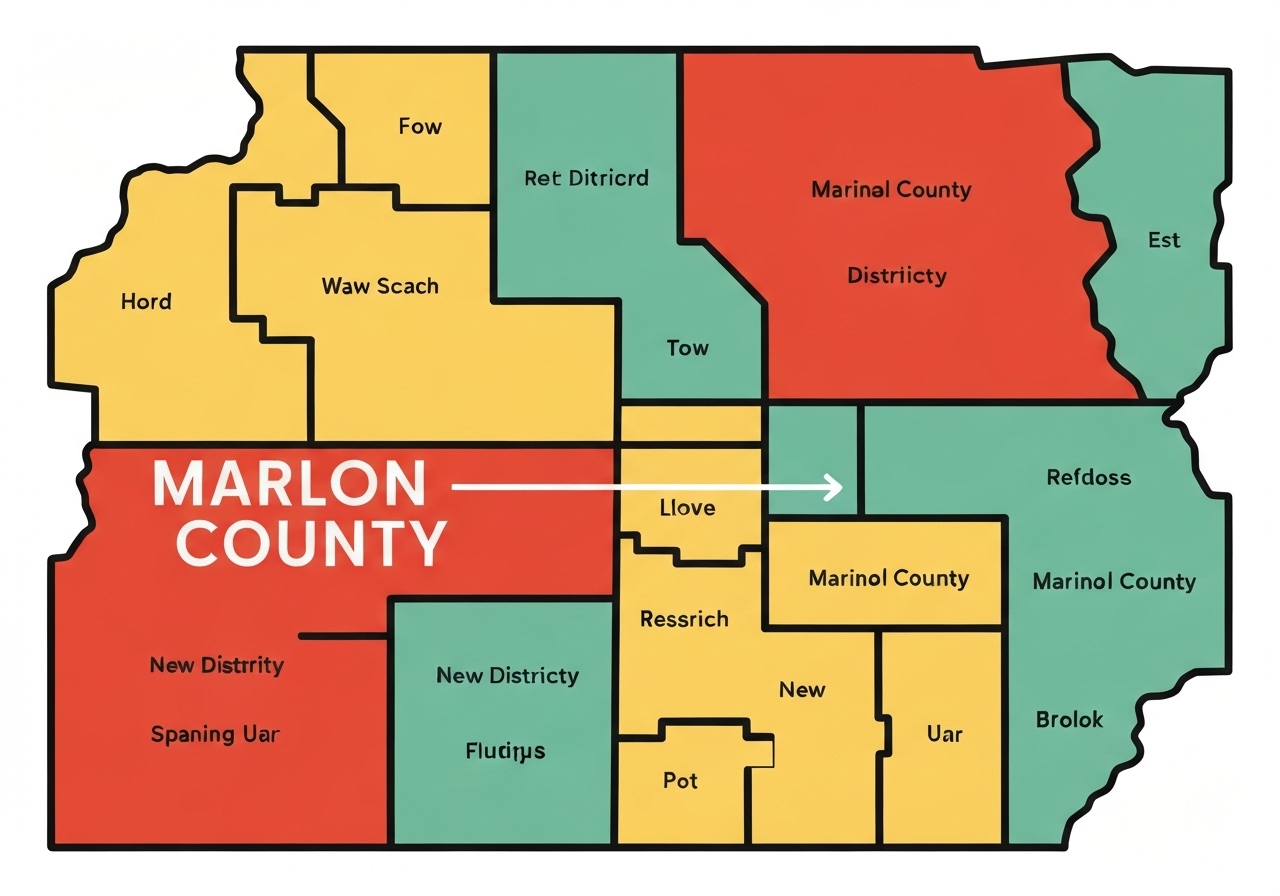
Indiana House Republicans on Monday unveiled a proposed congressional map that would divide Marion County — home to Indianapolis and the state’s 7th District — into four separate districts. The draft is designed to weaken the two remaining Democratic-held U.S. House seats in Indiana; Republicans currently hold seven of nine seats. The proposal prompted large protests at the statehouse and sharp criticism from Democrats, who say the plan dilutes the voting strength of racial minorities and urban voters. The bill includes language intended to limit court delays and now moves to committee for further consideration.
Key Takeaways
- Republicans currently hold 7 of Indiana’s 9 U.S. House seats; Democrats hold the 1st (Rep. Frank Mrvan) and 7th (Rep. André Carson) districts.
- The House Republican draft would split Marion County into four districts, a change leaders say would make the 7th District less favorable to Democrats.
- The bill contains provisions aimed at preventing temporary restraining orders, an apparent response to litigation in other states and pending Texas litigation before the U.S. Supreme Court.
- Speaker Todd Huston (R-Fishers) said conversations with national GOP leaders, including reported contact with Speaker Mike Johnson, influenced the push for new maps.
- Hundreds of protesters demonstrated at the statehouse; several lawmakers reported anonymous threats and swatting attempts, though motives remain unconfirmed.
- Political scientists identify racial gerrymandering as the strongest legal vulnerability for the proposal.
- House leaders expect the bill to move through committee this week and reach a floor vote within days.
Background
Indiana’s congressional delegation is currently weighted toward Republicans, who hold seven out of nine seats in the U.S. House. The remaining Democratic seats are the 1st District in northwest Indiana, represented by Rep. Frank Mrvan, and the 7th District centered in Marion County and represented by Rep. André Carson. Redistricting battles have intensified nationwide as both parties seek maps that improve their chances ahead of upcoming federal elections.
The national context includes pressure from federal and national party actors to reshape maps for partisan advantage. The story references months of pressure attributed to the Trump administration for map changes and reports that U.S. House Speaker Mike Johnson spoke with Indiana Republicans before the state session. Indiana GOP leaders pointed to actions in other states — notably California, Virginia and Missouri — as part of a broader Republican redistricting push.
Main Event
At the statehouse on Monday, House Republican leadership presented a draft congressional map that slices Marion County into four districts. House leaders said the change reflects political realities and follows practices in other states; Speaker Todd Huston told reporters the move was inspired by maps passed elsewhere and that conversations with national Republican figures were “robust.” The proposal’s immediate effect would be to disperse concentrated Democratic and racially diverse voters from a single urban district into multiple districts.
Democrats argued the session itself violated House rules by reconvening and rushed through debate; during floor discussion Rep. Cherrish Pryor (D-Indianapolis) criticized the process and invoked constitutional oaths. Rep. Edward Delaney (D-Indianapolis) described Dec. 1 as among the lowest moments of his congressional career, saying the maps appeared designed to reduce political influence for racial minorities in Marion County.
The bill also includes statutory language intended to limit state-court or federal-court delays by preempting temporary restraining orders against the new districts. House leaders described this as a mechanism to accelerate the legal resolution of possible challenges, pointing to ongoing litigation elsewhere as motivation for speed. The plan now heads to committee, with Huston predicting action could take place over the remainder of the week and consideration in the state Senate to follow.
Analysis & Implications
Politically, the draft map is aimed at flipping the two Democratic seats in Indiana and consolidating Republican control of the state’s congressional delegation. If the changes succeed as intended, Republican representation could increase from seven seats and reduce the number of competitive urban districts. That would likely lower electoral competition in affected areas and reshape campaign strategies for both parties across future cycles.
Legally, experts say political gerrymandering claims have been difficult to win in federal courts, but race-based claims retain stronger judicial scrutiny. Political science professor Dr. Laura Merrifield Wilson highlighted that challenges alleging racial gerrymandering may be the most viable route to contest the map, because courts have been more receptive to race-based constitutional claims than broad political gerrymandering arguments.
Beyond courtroom fights, the proposed map could have broader civic consequences. Academic observers warn that diluted urban and minority voting strength tends to depress turnout and reduce policy responsiveness from representatives who no longer face competitive districts. University of Indianapolis professor Gregory Shufeldt said the draft would harm democratic competition and could depress engagement among both minority and general voters.
Comparison & Data
| Metric | Current | Proposed Impact |
|---|---|---|
| U.S. House seats (Indiana) | 7 R / 2 D | Draft aims to reduce Democratic-held districts by splitting urban Marion County |
| 7th District (Marion County) | Held by Rep. André Carson (D) | Would be divided into four districts, dispersing concentrated Democratic voters |
| Legal vulnerability | Political gerrymandering—difficult to win | Race-based gerrymandering challenges—stronger judicial prospects |
The table summarizes the current partisan baseline and the principal projected effect of the GOP draft: dilution of concentrated Democratic and racially diverse voters in Marion County. While the exact partisan outcome depends on final lines and voter behavior, the structural change is clear — the city would no longer be contained within a single cohesive congressional district.
Reactions & Quotes
Protests and vocal criticism accompanied the legislative session, with hundreds of Hoosiers chanting outside and inside the chamber. Several lawmakers and residents described the plan as an outside-directed effort that ignores local communities’ needs.
“Splicing our state’s largest city — and its biggest economic driver — into four parts is ridiculous.”
Rep. André Carson (D–7th District)
Carson framed the proposal as an externally imposed map that would harm the community’s political voice. He and other Democrats said the move appears to be driven by national partisan strategy rather than local input.
“Hoosier values matter more than DC threats and bullying.”
Rep. André Carson
Speaker Todd Huston defended the committee timeline and said the state is responding to nationwide redistricting activity. Huston told reporters the mapmaking follows patterns observed in other states and emphasized the leadership’s desire to resolve anticipated legal disputes quickly.
“This is taking place all across the country.”
Speaker Todd Huston (R–Fishers)
Observers noted that statements from national leaders, and reported conversations with the U.S. House Speaker, signal coordination between state and federal Republican operatives, raising the political stakes for the coming weeks.
Unconfirmed
- Reports that the draft map would result in a 9–0 Republican delegation are projections; final legal and electoral outcomes depend on court rulings and future revisions.
- Several lawmakers reported anonymous threats and swatting attempts; investigations are ongoing and the motives behind those incidents are not yet confirmed.
Bottom Line
The draft congressional map proposed by House Republicans would significantly reshape Indiana’s political map by fragmenting Marion County and targeting the state’s two Democratic-held seats. Strategically, the plan seeks to entrench Republican advantage by dispersing Democratic and racially diverse voters across multiple districts rather than allowing a single urban district to aggregate them.
Legally, the most promising route for challengers will likely be race-based litigation; politically, the proposal has already energized protests and national attention. The bill’s rapid path through committee and the inclusion of provisions to limit court delays mean that any legal and political battles over these lines could unfold quickly.
Sources
- WFYI (local public media, reporting)