
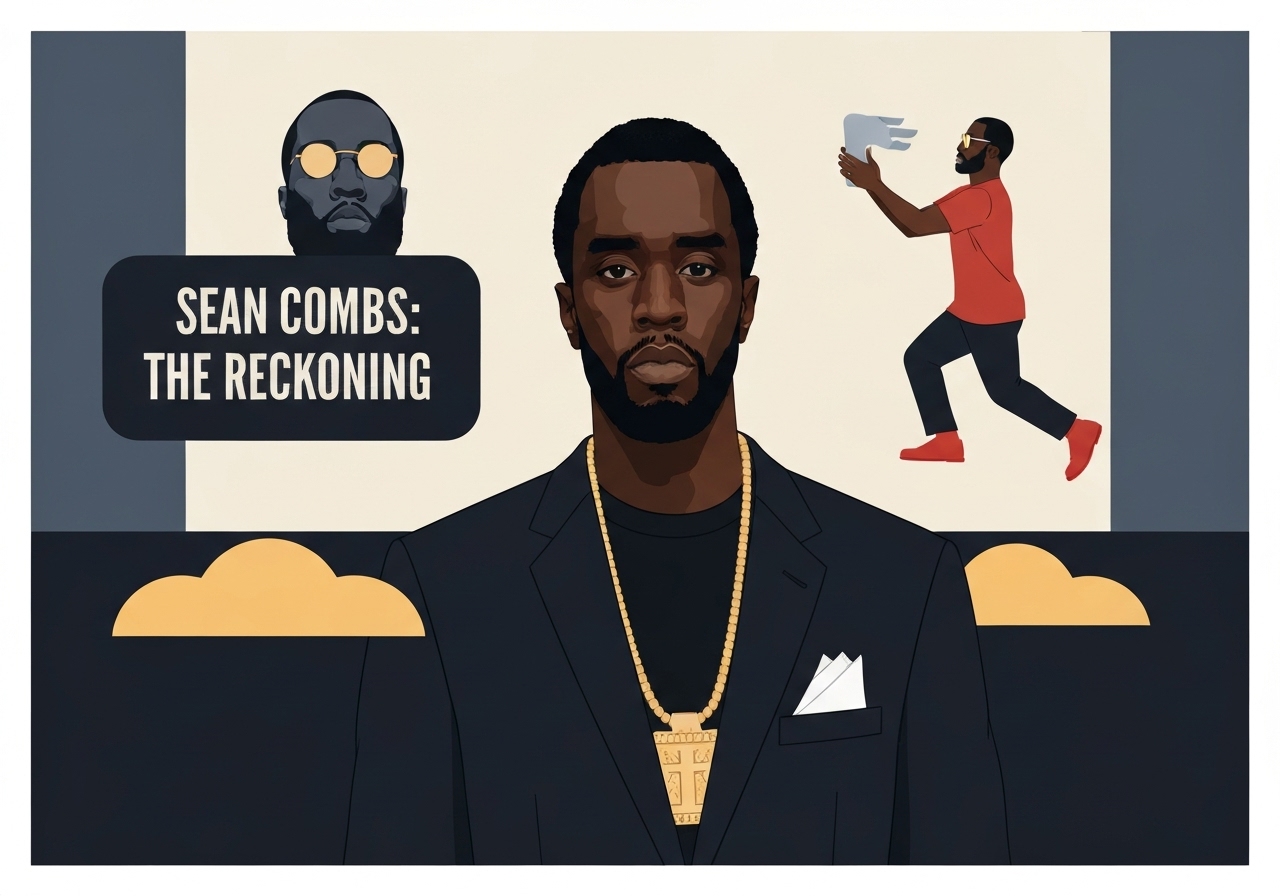
Lead: Netflix’s four-part series Sean Combs: The Reckoning, produced by Curtis “50 Cent” Jackson and directed by Alex Stapleton, revisits the rise and fall of Sean “Diddy” Combs as he faces the legal and reputational fallout following his 2024 arrest and a 50-month prison sentence this year. The series assembles new footage, interviews with accusers and allies, and—unusually—two jurors from Combs’s federal trial to trace three decades of influence, alleged abuses, and unresolved questions. It expands past recent criminal allegations to examine how power, rivalry and industry dynamics shaped events from the 1990s to the present. Combs has denied the allegations and his lawyers have sought removal of the series from Netflix.
Key Takeaways
- The Reckoning is a four-part Netflix series produced by 50 Cent and directed by Alex Stapleton, released shortly after Combs received a 50-month prison sentence in 2024.
- Filmmakers obtained new footage filmed by Combs himself in the days before his arrest; that material is now the subject of a legal takedown notice from Combs’s attorneys.
- Episode two revisits the 1990s East Coast–West Coast rap feud and presents testimony implicating Combs in actions that intensified gang alignments around the murders of Tupac Shakur and The Notorious B.I.G. in 1996–97.
- The series includes interviews with accusers, former collaborators, a childhood friend, and, for the first time on camera, two jurors who say portions of the prosecution’s case did not meet legal elements required for conviction.
- Jurors described certain testimony—such as Capricorn Clark’s account—as emotionally powerful but inconsistent with other evidence, complicating the panel’s view of criminal liability.
- Former singer Aubrey O’Day recounts a 2005 episode she says she does not remember and describes alleged career retaliation after rejecting sexual advances in 2008.
- Despite the acquittal on federal racketeering counts, civil suits and public allegations continue; Combs maintains they lack merit and denies wrongdoing.
Background
Sean Combs rose from Mount Vernon to build Bad Boy Records into a dominant force in hip-hop across the 1990s and 2000s, cultivating artists, branding and a public persona that expanded into fashion and entertainment. His influence—artist development, marketing savvy and deep industry ties—made him a singular figure in music business narratives and in popular culture.
The last year brought a steep legal reckoning. In 2024 Combs was arrested on a federal indictment alleging racketeering and sex-trafficking-related conduct; prosecutors characterized parts of his business network as instrumental to coercing partners. A jury in 2024 acquitted him on the federal counts, and he was later sentenced to 50 months in prison following related proceedings. Parallel civil litigation has proliferated, keeping allegations in public view.
Documentary coverage of Combs has already appeared in multiple recent projects focused on his alleged abuse of collaborators and associates. What sets The Reckoning apart, its producers say, is a three-decade perspective that threads personal history, industry power structures and new material—some of it filmed by Combs—into a single narrative aiming to let viewers weigh competing accounts.
Main Event
The Reckoning premiered on Netflix weeks after Combs’s sentencing, and its release was framed by the involvement of his outspoken rival Curtis “50 Cent” Jackson, who served as a top producer. Jackson publicly mocked Combs during the eight-week trial, and his name attached to the series amplified attention and debate over objectivity even as the filmmakers interviewed a wide range of sources.
Newly surfaced footage—clips Combs reportedly shot while sequestered in a Manhattan hotel—shows moments of anger, anxiety and self-reflection that contrast with the public mogul persona. In one excerpt Combs speaks to his legal team by phone, urging coordination and warning that their approach was failing, an exchange now central to disputes over editorial control and privacy.
Episode two reexamines the mid-1990s escalation between East and West Coast rap, arguing the rivalry’s commercialization spilled into violent gang alignments. The series features on-camera recollections by Duane “Keffe D” Davis, who asserts involvement in Tupac Shakur’s 1996 killing and makes additional claims about offers tied to both Shakur and Suge Knight—allegations that are presented as participant testimony but remain contested.
The filmmakers secured interviews rarely seen before on camera, including two jurors from Combs’s federal trial who explain why certain graphic testimony did not translate into convictions under U.S. criminal statutes. Jurors cited legal thresholds, inconsistencies in witness accounts and the complexity of intimate relationships when describing their deliberations.
The series also spotlights former collaborators who say Combs used career leverage to punish resistance; Aubrey O’Day recounts an episode she has no memory of and describes being pushed out of Danity Kane after rebuffing advances, while former partner Kirk Burrowes characterizes envy and control dynamics within the label.
Analysis & Implications
The Reckoning operates at the intersection of cultural history and courtroom consequence. By combining industry context with personal testimony, the series reframes Combs’s public ascent as a product of both entrepreneurial skill and systemic tolerance for predatory behavior within elite entertainment circles. That framing prompts questions about how power is policed—or not—when commercial success and celebrity can insulate influential figures.
Legally, the documentary underscores the gap between public perception and the elements prosecutors must prove in federal racketeering and sex-trafficking cases. Jurors’ explanations in the film highlight how vivid allegations—domestic incidents, surveillance video, emotional testimony—may still fall short of statutory definitions or conclusive corroboration required for criminal conviction.
For the music business, the series may deepen demands for accountability and contractual protections for artists and staff. If audiences accept the pattern the film outlines—promotion mixed with intimidation and career retaliation—labels, managers and corporate partners could face increased scrutiny, both legally and commercially, and calls for structural reforms in talent oversight.
Internationally, the show contributes to a broader media trend: adversarial documentary projects produced by industry rivals can shape narratives as effectively as traditional investigative reporting. Viewers and commentators will need to parse motive and evidence carefully; the program’s reach on Netflix ensures its claims will influence public debate and potential civil litigation trajectories.
Comparison & Data
| Item | Focus/Date |
|---|---|
| Combs: The Reckoning | Netflix, 4 episodes, 2024–2025 (post-arrest release) |
| Federal trial | Eight-week trial, 2024; subsequent sentencing to 50 months |
| Biggie/Tupac murders | 1996 (Tupac), 1997 (Biggie); 1990s East–West feud context |
The table places the new series alongside the criminal case timeline and the historical episodes it revisits. That juxtaposition clarifies the film’s intent: to connect long-term industry conduct with discrete legal outcomes. While the documentary introduces fresh testimony and footage, some claims reach back decades and intersect with unresolved investigations and ongoing civil suits.
Reactions & Quotes
Producers and participants framed the project as careful, layered reporting rather than a simple hit piece, while Combs’s legal team contested the series’ fairness and sought its removal.
“There was a lot of care and craft that went into making these four hours of story,”
Alex Stapleton, director (as quoted in The Hollywood Reporter)
Stapleton told journalists the film aimed to assemble muted voices and leave final judgment to viewers. That positioning responds directly to concerns about bias due to 50 Cent’s producer credit and the charged, recent legal backdrop.
“It’s going to No. 1,”
Curtis “50 Cent” Jackson (on the series’ Netflix ranking)
Jackson publicly predicted broad viewership and used social platforms to amplify the series. His involvement has complicated assessments of motive even as it guaranteed heightened attention.
“Listen to me … Y’all are not working together the right way. We’re losing,”
Sean Combs (excerpt of phone footage shown in the series)
The Combs-shot clip that appears in the docuseries is central to legal debate: attorneys describe the broadcast as an illegal invasion of privacy, while filmmakers and distributors argue in favor of newsworthiness and public interest.
Unconfirmed
- Duane “Keffe D” Davis’s on-camera recounting of involvement and offers tied to the murders of Tupac Shakur and The Notorious B.I.G. remains an allegation and has not produced a criminal conviction in those cases.
- The provenance and chain of custody for the Combs-shot hotel footage shown in the series have not been publicly verified; details of how filmmakers acquired it remain contested.
- Claims that Combs promised payment for murders, as presented in the film, are testimonial and have not been independently corroborated to the standards of a criminal conviction.
Bottom Line
The Reckoning is consequential not only for its revelations but for how it frames a high-profile figure’s trajectory through power, commerce and alleged abuse. By combining new footage, seldom-heard interviews and juror testimony, the series complicates clean narratives of guilt or innocence and foregrounds structural questions about accountability in entertainment.
Viewers and policymakers should note the documentary’s dual status as both a cultural artifact and a potential influencer of ongoing legal and civil processes. While the series supplies additional context and testimonies, many claims remain contested; independent verification and due process continue to matter for any lasting legal or reputational outcome.
Sources
- The Hollywood Reporter — Entertainment journalism report summarizing the docuseries and interviews (media)
- Netflix — Streaming platform listing for Sean Combs: The Reckoning (platform)
- U.S. Attorney’s Office, Eastern District of New York — Federal prosecutor office (official source for related filings and press releases)