
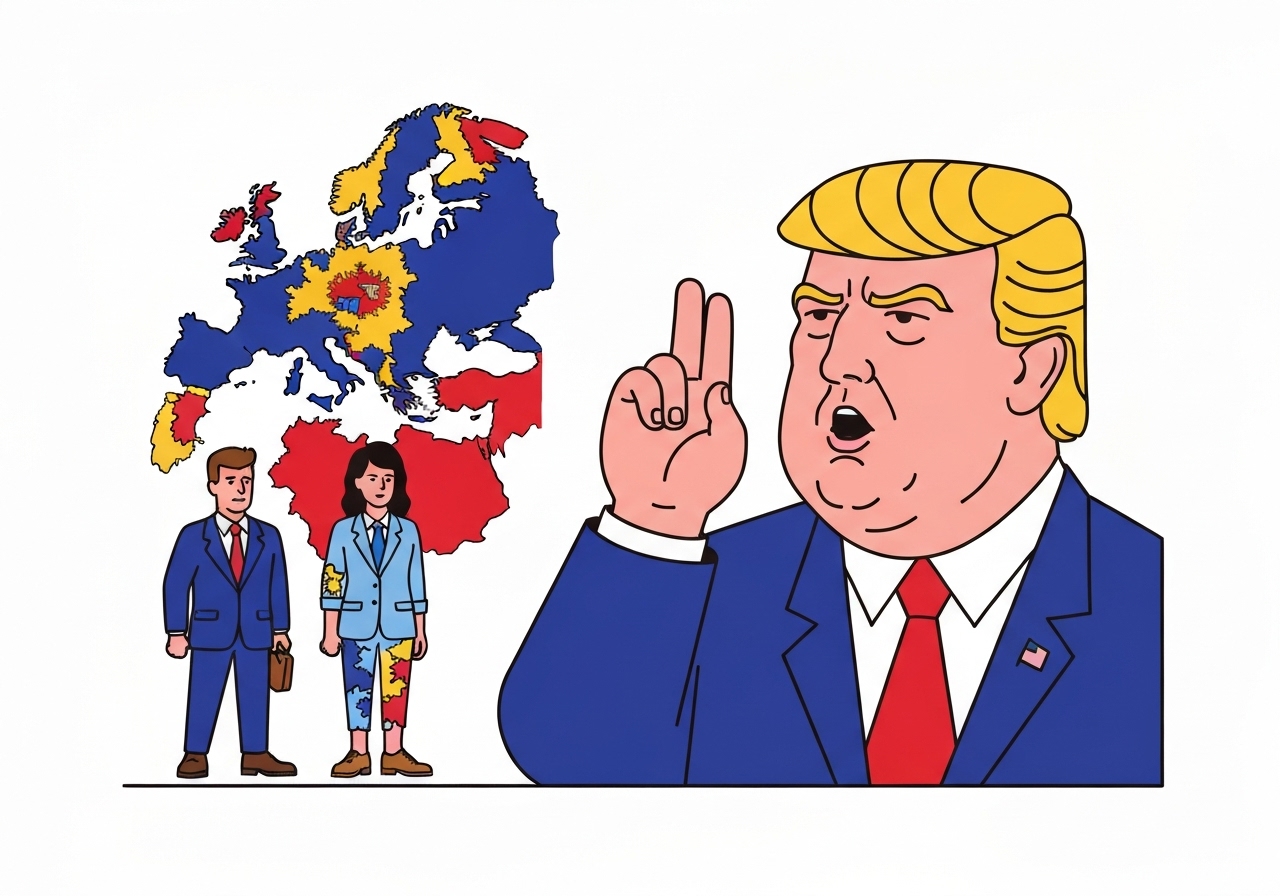
On Dec. 9, 2025, President Donald Trump used a Politico interview to assail U.S. allies in Europe as “weak” and “decaying,” while the administration simultaneously signaled major policy reversals on China chip exports, trade with Mexico, offshore wind and election-law battles in U.S. courts. In the same period Ukraine’s president, Volodymyr Zelensky, said Kyiv expected to finish a revised peace proposal by Tuesday evening after a weekend meeting between Ukrainian negotiators and Trump representatives. The White House also announced a relaxation of limits on sales of Nvidia’s H200 A.I. chip to China even as Congress and the courts test major components of the administration’s agenda. Several developments — from a Supreme Court challenge to campaign-finance rules to a federal judge halting a wind-farm moratorium — together create fresh political and geopolitical uncertainty.
Key takeaways
- On Dec. 9, 2025, President Trump told Politico that European allies are “weak” and “decaying,” reflecting a national security posture that asks Europe to shoulder more of its defense burden.
- Ukraine’s government said a revised peace proposal would be finalized and shared with U.S. officials by Tuesday evening after a weekend meeting with representatives linked to the president.
- The Supreme Court will hear National Republican Senatorial Committee v. FEC, a case that could be decided by July and permit party-coordinated spending, potentially shifting advertising-cost advantages in future elections.
- Mr. Trump threatened an additional 5% tariff on Mexican goods over a water-dispute shortfall, demanding Mexico deliver 200,000 acre-feet by Dec. 31 and noting a broader claimed shortfall of over 800,000 acre-feet under the 1944 treaty.
- A federal judge in Massachusetts found the administration’s January executive order halting offshore wind approvals on federal lands and waters “arbitrary and capricious,” reopening legal paths for projects in the Atlantic and elsewhere.
- The Commerce Department signaled approval for limited sales of Nvidia’s H200 chips to vetted Chinese commercial customers, while maintaining restrictions on the newer Blackwell chips.
- Congressional leaders inserted language into the defense policy bill to force the Pentagon to provide EXORDs (execute orders) and unedited strike videos related to recent maritime boat strikes, citing transparency concerns.
- Republican senators proposed a two-year, scaled-back extension of Affordable Care Act premium tax credits as Democrats press for a three-year extension ahead of a likely floor vote this week.
Background
President Trump’s comments on Europe come amid a formal national security strategy that urges European states to assume “primary responsibility” for their own defense. That strategic shift echoes long-standing debates inside NATO about burden-sharing and the U.S. role overseas, but it is sharper in tone and rhetoric than recent administrations’ statements. Tensions over allied commitments have particular force now because of the ongoing Russia-Ukraine war and U.S. debates over the political and material support provided to Kyiv.
Campaign-finance rules in the United States were substantially reshaped by the Supreme Court’s 2010 Citizens United decision and earlier precedents, including a 2001 ruling that upheld coordinated-spending limits. The case now before the justices challenges those remaining restrictions and, depending on scope, could allow national party committees to coordinate spending with candidates and thus access legally lower broadcasting rates — a change with fast, concrete implications for midterm campaigning.
On trade and energy, the administration’s hard line has included tariff threats and a concerted push against wind energy. The 1944 water treaty between the U.S. and Mexico governs cross-border river allocations, but drought and changing hydrology have complicated compliance. At the same time, federal permitting and export-policy choices — from offshore wind leasing to semiconductor controls — have become high-stakes levers of economic and strategic competition with allies and rivals alike.
Main event
In a wide-ranging Politico interview published Dec. 9, Mr. Trump criticized European governments for political correctness and weakness, saying they are “decaying” and implying the United States should reduce its security guarantees. The comments followed the release of the administration’s national security paper urging European self-reliance. Officials framed the change as a rebalancing of responsibilities; critics said the rhetoric risks straining transatlantic ties and complicating U.S. leadership in NATO.
Meanwhile, Mr. Trump assessed the Ukraine war as favoring Russia, telling the outlet that Russia held a stronger negotiating position and suggesting President Zelensky should “get on the ball” and accept parts of a U.S.-backed peace plan. Ukrainian officials responded that a revised proposal — shaped in part by a weekend meeting between Ukrainian negotiators and representatives for Mr. Trump — would be completed and shared with the United States by Tuesday evening, signaling active diplomacy but not resolution.
On the domestic legal front, the Supreme Court agreed to hear National Republican Senatorial Committee v. FEC, a challenge brought on Nov. 4, 2022, by national Republican leaders and two Ohio candidates. The plaintiffs argue that limits on party spending coordinated with candidates violate the First Amendment. If the court relaxes those limits, party committees could place coordinated ads at the lower rates legally afforded to candidates, altering the financial calculus of midterm campaigns.
In trade policy, Mr. Trump warned Mexico in a social-media post that Washington would impose an additional 5% tariff unless Mexico transfers 200,000 acre-feet of water by Dec. 31 and addresses a claimed shortfall of over 800,000 acre-feet tied to the 1944 treaty. Mexico’s president, Claudia Sheinbaum, acknowledged drought-related delivery problems earlier in the year and courted compromise in spring, but domestic political pressure and farmers’ protests have complicated options for greater concessions.
On energy and regulatory policy, Judge Patti B. Saris of the U.S. District Court for Massachusetts ruled the presidential halt on offshore and federal-land wind approvals unlawful under the Administrative Procedure Act, concluding agencies failed to provide a reasoned explanation beyond following presidential direction. That decision restores the judicial path for some projects but does not automatically compel federal agencies to approve new leases or permits; developers may still face a difficult permitting environment.
The administration also authorized limited commercial sales of Nvidia’s H200 chip to vetted Chinese customers, reversing elements of earlier export curbs while leaving the most advanced Blackwell chips restricted. The move followed lobbying by Nvidia’s CEO and other industry figures and has sparked bipartisan concern in Congress about national-security risks and calls to curb sales more tightly.
Finally, lawmakers inserted provisions into the roughly $900 billion defense policy bill to require the Pentagon to submit the execute orders (EXORDs) and unedited video for maritime boat strikes to the congressional Armed Services Committees. The measure reflects bipartisan frustration over classified briefings and the department’s failure to meet statutory disclosure timelines after at least 21 strikes that the administration says target narco-terrorists at sea.
Analysis & implications
The president’s rhetoric toward Europe could have immediate diplomatic costs. Labeling NATO partners “weak” risks eroding trust and diminishes U.S. leverage when pressing allies to increase defense spending or to coordinate sanctions and military support for Ukraine. If European capitals perceive the United States as retreating rhetorically, they may accelerate independent defense initiatives or seek new security arrangements, changing the alliance’s dynamics.
In Ukraine’s case, Trump’s public assessment that Russia is negotiating from strength and that Kyiv is “losing” may influence bargaining positions and domestic politics in Kyiv. Even if a revised Ukrainian proposal is produced, the credibility of any U.S.-brokered compromise depends on concrete American assurances and allied unity—both of which are complicated by the administration’s broader posture toward Europe and by partisan divisions at home.
A Supreme Court ruling loosening coordinated-spending restrictions would quickly reshape campaign strategy and the flow of money in federal races. Party committees able to place ads at candidate rates could translate large-donor contributions into cheaper, high-impact media buys. That shift would likely advantage national party machines — and, given current bank balances, could produce short-term financial benefits for Republicans, who control larger cash reserves at present.
Relaxing chip export controls for select H200 sales to China reflects a trade-off between commercial competitiveness and national-security caution. Allowing vetted sales could preserve U.S. suppliers’ market share and support high-tech jobs, but it also risks transferring capability that, over time, may assist foreign AI development. Policymakers must weigh near-term industry gains against longer-term strategic competition and legal constraints on revenue-sharing proposals.
Comparison & data
| Item | Value / 2021-22 |
|---|---|
| NRSC coordinated expenditures (2021-22) | $15.5 million |
| NRCC coordinated expenditures (2021-22) | $8.3 million |
| RNC cash on hand (recent) | ~$91 million |
| DNC cash on hand (recent) | ~$18 million (after $15M loan) |
| Individual donor limit to candidate (per cycle) | $3,500 |
| Party committee general fund limit (annual) | Up to $44,300 |
The table highlights disparities at the nexus of campaign finance rules and fundraising capacity: party committees can legally accept much larger gifts than candidates, and coordinated-spending limits have historically constrained the direct use of those funds on behalf of candidates. If the Supreme Court removes those constraints, the practical effect would be to allow party committees to convert large contributions into lower-cost advertising buys, narrowing the functional advantage that candidates have under current rules.
Reactions & quotes
Officials, experts and advocates offered immediate responses that framed the stakes differently.
“I think they’re weak, but I also think that they want to be so politically correct…They’re decaying.”
President Donald J. Trump, Politico interview (Dec. 9, 2025)
Mr. Trump’s line was highlighted by allies and critics alike as emblematic of a new U.S. posture; diplomats in Brussels and capitals across Europe privately expressed concern about damage to alliance cohesion.
“As we look to build the electric grid that will power America’s future, wind energy is a key component.”
Marguerite Wells, Executive Director, Alliance for Clean Energy New York
The comment accompanied praise for the Massachusetts court ruling and reflected industry relief at a decision that may allow projects to move forward after months of regulatory uncertainty.
“It’s going to be one of the most important votes we take.”
Senator Chuck Schumer, Democratic Leader, on the ACA subsidy extension vote
Senate leaders said the subsidy debate will be a central political test, with competing Republican proposals likely to struggle to reach the 60-vote threshold needed to overcome a filibuster.
Unconfirmed
- Whether Moscow’s negotiating position is actually stronger in battlefield terms than Kyiv’s assertions — battlefield assessments vary and are politically contested.
- The practicality and legality of the president’s suggestion that 25% of chip-sales revenue be paid to the U.S. government remains unresolved and could conflict with existing export-license rules.
- Exactly which Chinese commercial customers will receive H200 chips, and whether Beijing will permit widespread procurement, has not been publicly confirmed.
- Full, unedited footage and complete EXORDs for all boat strikes have not been released; Congress has seen some classified materials but not the complete record.
Bottom line
This cluster of developments marks a consequential week in which the administration combined blunt rhetoric about allies with concrete policy shifts on trade, technology and energy. The cumulative effect is to accelerate both domestic political battles — about campaign finance, health subsidies and oversight of military operations — and international friction over alliances, trade and strategic tech controls.
Key near-term things to watch: whether Kyiv’s revised peace proposal changes negotiations; the Supreme Court’s ruling timeline (a decision expected by July) and its consequences for campaign spending; whether Mexico meets the Dec. 31 water demand or whether tariffs escalate; and congressional responses to the H200 decision and demands for Pentagon transparency. Each outcome will reshape political leverage at home and America’s posture abroad.