
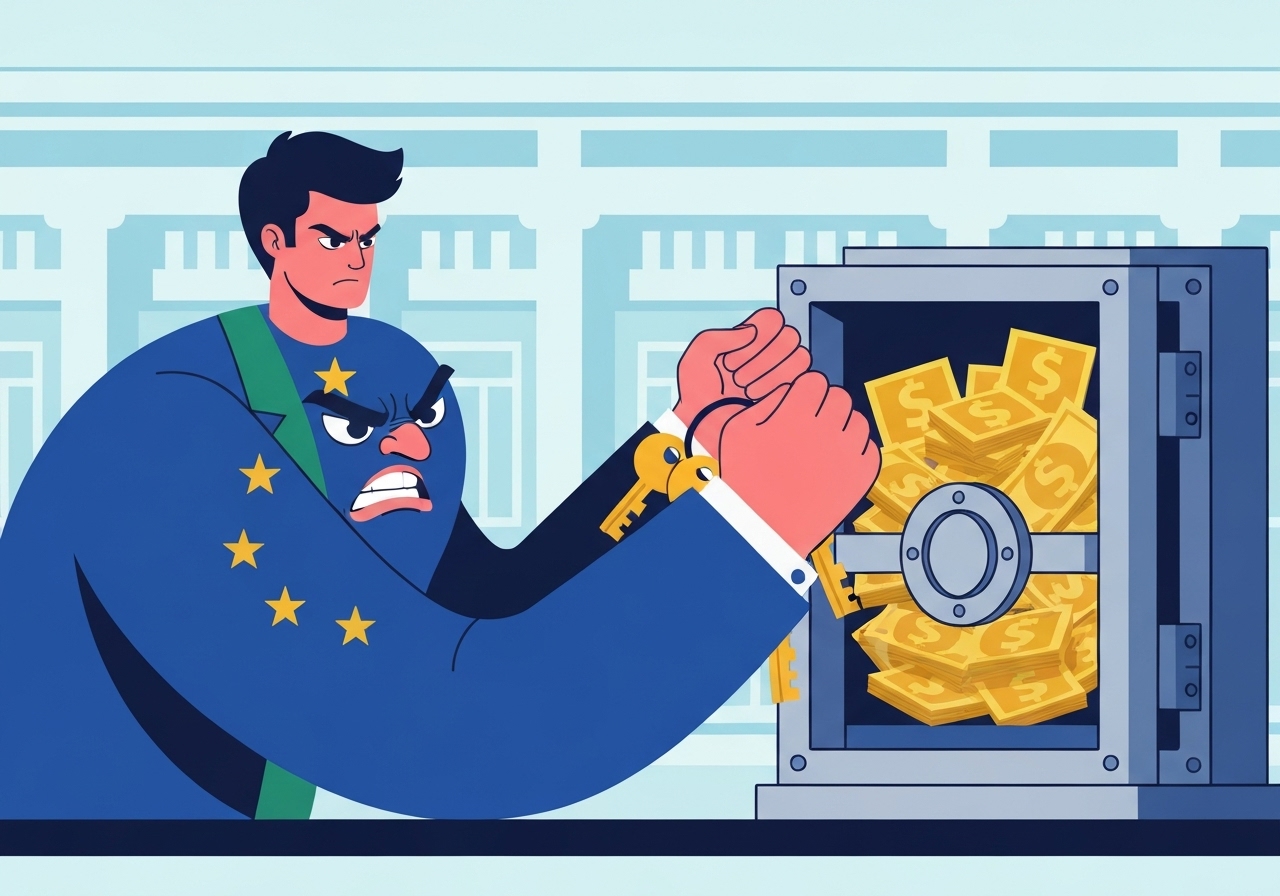
Lead: This week the European Union took an unusually forceful step by invoking an emergency treaty provision to indefinitely immobilise €210 billion held by the Russian Central Bank across the bloc. The decision, announced on Thursday, prevents any member state from returning those funds while Moscow wages its war against Ukraine and sets a new legal threshold for unfreezing them. EU leaders framed the move as both a strategic lever against Kremlin finance and a reassurance to Kyiv that European support will not be undermined by internal vetoes. The declaration followed months of fraught renewals under the six‑monthly sanctions system that exposed the bloc’s vulnerability to single‑country holds.
Key Takeaways
- The EU has frozen €210 billion of Russian Central Bank assets held in the bloc, of which €185 billion is at Euroclear and €25 billion sits in banks across five member states.
- The European Commission relied on Article 122 of the treaties to immobilise the funds indefinitely, shifting the decision to a qualified‑majority procedure and bypassing the European Parliament.
- Previously, sanctions renewals required unanimous six‑monthly votes; Hungary had threatened vetoes this year, creating repeated political crises.
- The Commission had earlier proposed channeling the funds into a zero‑interest reparations loan for Ukraine, raising questions about legal protections and financial stability for Euroclear and the eurozone.
- Article 31.2 (the ‘passerelle’ clause) was considered and rejected because any member could block the switch by citing national policy, so the Commission opted for Article 122 instead.
- Hungary’s prime minister, Viktor Orbán, denounced the move and signalled possible legal challenge, while most other capitals welcomed the reduced risk of single‑state blackmail.
- The EU will require a new qualified majority vote to release the sovereign assets, conditioned on an end to aggression, agreement to reparations, and the removal of threats to the European economy.
Background
Since Russia launched its full‑scale invasion of Ukraine in February 2022, the EU has built an array of financial sanctions that include freezing central‑bank reserves held inside its jurisdiction. Those freezes have become a major lever of pressure, but their renewal has depended on the routine six‑monthly extension mechanism that requires unanimity among member states. The unanimity rule exposed a strategic weakness when Hungary threatened to block extensions this year, forcing last‑minute diplomacy to preserve the measures.
In the months after those threats, the Commission began exploring ways to make the asset freeze more durable and to protect a possible reparations mechanism. Officials also had to weigh financial stability risks: freeing €210 billion suddenly could strain Euroclear, the Brussels‑based central securities depository that holds the lion’s share of the pot, and ripple through euro‑area markets.
The legal pathway was contested from the outset. The Commission first looked at Article 31.2 to move some decisions to qualified majority voting, but that option was abandoned because any member could invoke national policy to block it. Article 122 — traditionally used for economic emergencies such as the COVID‑19 pandemic and the 2022 energy crisis — offered a different route, with a qualified‑majority threshold and fewer parliamentary hurdles.
Main Event
On Thursday the Commission and a broad majority of member states agreed to invoke Article 122 to declare an EU‑wide economic emergency tied to Russia’s war and to enshrine a prohibition on returning the €210 billion to the Russian Central Bank. The formal measure bars member states from taking steps to release the funds while the conditions set by the Council remain unmet.
Commission President Ursula von der Leyen framed the move as a clear deterrent to Moscow and a demonstration of solidarity with Ukraine, noting that the measure keeps financial pressure in place so long as the war continues. The bloc also linked the asset freeze to a future requirement that Russia cease its military aggression and accept reparations before any funds could be considered for release.
Officials emphasised the technical safeguards: the assets will remain immobilised in their current custodial structures, with the largest share at Euroclear and the remainder distributed across accounts in five member states. That arrangement aims to avoid sudden market shocks, maintain custody continuity and keep the eurozone’s financial plumbing intact.
Political reactions split predictably. Several capitals hailed the decision as a necessary step to avoid repeated vetoes and to preserve leverage. Hungary’s leader immediately criticised the move and signalled potential legal action; Budapest’s objections underscore the continuing challenge of building consensus in a heterogeneous union.
Analysis & Implications
The legal use of Article 122 in this context marks a significant reinterpretation of treaty language. Originally framed for economic emergencies, the provision’s application to a geopolitical war relies on a Commission argument that the invasion has produced quantifiable economic damage across the bloc — from supply disruptions and higher risk premia to increased uncertainty that depresses investment and consumption.
If upheld, this precedent could make it easier for the EU to act by qualified majority on measures previously blocked by unanimity, reducing the risk that a single member can paralyse collective foreign‑policy tools. That shift may strengthen the bloc’s deterrence posture and allow faster responses to hybrid threats such as sabotage and disinformation campaigns.
However, the strategy carries legal and political hazards. Critics argue the Commission’s reading stretches treaty language and could invite litigation that courts might take years to resolve, potentially muddying the legal certainty of EU action. Politically, hardened opposition from a veto‑prone member risks deepening East‑West cleavages inside the union and feeding narratives of democratic overreach.
Economically, immobilising assets indefinitely reduces the risk of a destabilising release, but it also leaves open thorny questions about the eventual use of the funds. A reparations loan or other temporary deployment would need robust safeguards to prevent moral‑hazard problems and to secure buy‑in from member states and financial markets.
Comparison & Data
| Mechanism | Voting Rule | Parliament Role | Typical Uses |
|---|---|---|---|
| Six‑monthly sanctions renewal | Unanimity | Limited | Sanctions extension |
| Article 31.2 (passerelle) | Qualified majority but vetoable by national policy | Varies | Streamlining decision‑making (rare) |
| Article 122 | Qualified majority | Bypassed for some measures | Economic emergencies (COVID, energy crisis) |
The table shows the practical differences between unanimous and qualified‑majority routes. By using Article 122, the Commission removed one of the most important levers that allowed single states to delay or block sanctions extensions. Past uses of Article 122 include the €150 billion defence instrument invoked in March to respond to an ‘unprecedented security threat’, a decision that already prompted parliamentary and legal scrutiny.
Reactions & Quotes
Official and diplomatic reactions were swift and pointed in different directions. Supporters highlighted the step as necessary to secure leverage and policy continuity, while detractors framed it as an overreach of executive power.
‘We are sending a strong signal to Russia that as long as this brutal war of aggression continues, Russia’s costs will continue to rise.’
Ursula von der Leyen, European Commission President
Von der Leyen’s comment was presented as both a deterrent to Moscow and a reassurance to Ukraine that European backing would not be undermined by internal disputes.
‘We are confident the justification of economic damages to trigger this provision of the treaty has been met above and beyond what is required.’
Valdis Dombrovskis, European Commissioner for the Economy
Dombrovskis defended the legal reasoning before member capitals and in interviews, arguing that the pandemic and energy responses show precedent for Article 122’s flexible use in pressing circumstances.
‘This is a Brusselian dictatorship and we will do everything to restore lawful order.’
Viktor Orbán, Prime Minister of Hungary
Orbán’s statement signalled an intent to challenge the decision legally and illustrated the domestic political constraints that still shape EU policymaking.
Unconfirmed
- Details of a leaked 28‑point plan that reportedly proposed splitting assets for joint US‑Russia commercial vehicles remain based on leaks and have not been officially confirmed by the White House or the Kremlin.
- Any timeline or concrete mechanism for converting immobilised reserves into a reparations loan for Ukraine has not been finalised and remains subject to further legal and political review.
- The outcome and timing of any legal challenge by Hungary or other parties are unknown and could take months or years to resolve in EU courts.
Bottom Line
The Commission’s decision to immobilise €210 billion of Russian reserves by invoking Article 122 represents a major tactical shift: it reduces the chance that a single member can repeatedly hold up sanctions and it preserves the EU’s leverage over Moscow while the war continues. The move also signals that Brussels is willing to reinterpret treaty provisions to respond to prolonged geopolitical shocks.
Yet this approach is not risk‑free. Legal challenges are likely, political fractures within the EU could deepen, and long‑term choices about the use of the funds will demand careful design to avoid destabilising markets or splintering member‑state consensus. For now, the assets are practically frozen, and the decision reshapes how Europe can project collective power in the face of external aggression.
Sources
- Euronews (news report)
- Euroclear (central securities depository — official site)
- European Commission Press Corner (official press releases)