
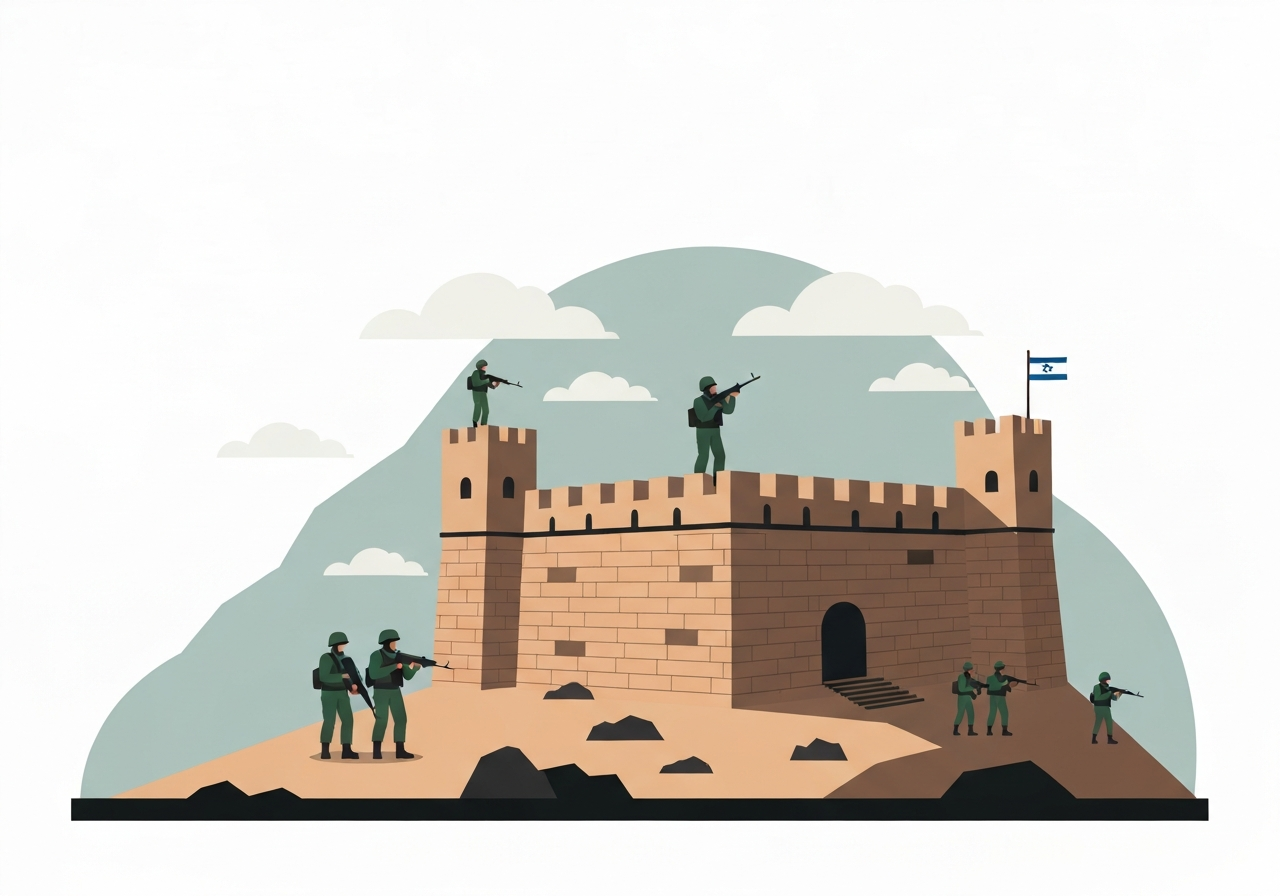
The Israeli military captured Beaufort Castle in south Lebanon on Sunday, raising an Israeli flag over the hilltop stronghold for the first time in 26 years as air and ground operations expanded. Witnesses and local officials described white phosphorus smoke and advancing troops, while Israeli authorities released footage of soldiers entering an undefended castle and nearby empty villages. The move came amid a renewed phase of fighting after a lull since a supposed ceasefire on 17 April and coincided with intensified airstrikes across southern Lebanon, including on the city of Tyre. Residents fled once-settled areas as warnings and orders to evacuate preceded the ground advance.
- Beaufort Castle was taken on Sunday; an Israeli flag was raised there for the first time since 2000, marking 26 years since its last occupation.
- White phosphorus was reported as creating a smoke screen during the assault, enabling Israeli troops to approach the fortification.
- Since a supposed ceasefire on 17 April, the conflict saw a renewed surge last week with Israeli warplanes reportedly killing at least a dozen people per day in southern Lebanon.
- Arnoun and surrounding villages were largely emptied ahead of the advance after repeated airstrikes and evacuation orders; Israeli forces entered largely undefended areas.
- Tyre suffered heavy bombing on Sunday; the city’s civil defence evacuated at Israeli direction and reestablished a base on Monday in a part of the city not yet hit.
- Israel’s defence minister said the military would resume strikes on Beirut on Monday, expanding the campaign beyond the south.
Background
Beaufort Castle sits on a strategic hill above the Litani River and south Lebanon, a site contested for centuries and long valued for observation and symbolic presence. Crusaders captured it roughly a millennium ago; more recently, the site featured in Lebanon’s modern conflicts—used by the Palestine Liberation Organisation in the 1980s and later affected by Israeli operations during the 1982–2000 occupation. For many south Lebanese communities the castle is a marker of resistance and local identity, and its occupation in past decades left lasting scars on collective memory. The 26-year interval since Israel’s withdrawal in 2000 made the sight of an Israeli flag there particularly fraught.
Politically, the capture takes place amid a six-week war that ground into a deadlock before an apparent pause on 17 April. Domestic pressures in Israel, including political rivalries and public expectations of military progress, shaped messaging around the operation. Lebanon’s government and Hezbollah condemned the incursion, but state institutions have limited capacity to halt a cross-border advance backed by heavy aerial and artillery fire. Civilians in southern towns and suburbs have repeatedly faced evacuation orders and the destruction of homes, producing cycles of displacement and return that exacerbate humanitarian risk.
Main Event
On Sunday Israeli ground troops entered the fort after manoeuvres that local witnesses say were masked by dense white phosphorus smoke. Footage released by the Israeli military showed soldiers ascending the castle steps; the military also broadcast the scene set to a recorded song by Fairuz whose chorus includes the line “Where are they?”—a choice commentators read as psychological signaling. Local guides and residents described an empty Arnoun and other villages, saying evacuations preceded the arrival of soldiers. Municipal leaders say they received warnings and orders; mayor Fouad Fatimi said he had been told to clear residents before the incursion.
As soldiers patrolled the castle, the wider military campaign accelerated. Israeli warplanes struck targets across southern Lebanon, and Tyre sustained heavy bombardment that left large craters in residential districts. The city’s civil defence team said Israeli commanders had called them to order an evacuation before the strikes; they later reestablished operations from a neighbourhood the team described as not yet targeted. The combined air-and-ground push erased any immediate ability for local actors to hold territory gained by earlier returns.
Officials in Israel framed the advance as reasserting control and applying pressure on Hezbollah and its allies. Prime Ministerial statements and Defence Ministry briefings stressed tactical gains; at the same time, Lebanese officials emphasized the psychological harm of seeing a long-symbolic site under foreign military control. Residents and guides who had once shown tourists the panoramic views from Beaufort spoke of the capture as a blow to local morale, recalling the decades of occupation and subsequent withdrawal in 2000.
Analysis & Implications
Symbolic sites often carry outsize weight in protracted conflicts: even in an era of drones and advanced surveillance, hilltop fortresses function as icons that shape narratives of control and legitimacy. Taking Beaufort Castle provides a visible sign of tactical reach for Israeli forces and may be intended to influence domestic political audiences as much as battlefield opponents. The psychological messaging—amplified by released footage and soundtrack choices—aims to convey permanence and dominance, even if the military value of the position is limited by modern sensors and stand-off weapons.
Operationally, the ground advance combined with stepped-up airstrikes risks entrenching cycles of retaliation and widening the geographic scope of fighting. The stated intention to resume strikes on Beirut signals a potential escalation beyond the south, raising the stakes for civilian populations across Lebanon’s urban centres. Humanitarian needs are likely to rise: repeated displacements undermine recovery and increase pressure on already strained civil defence and aid services, complicating any mediation or ceasefire prospects.
Regionally, the capture may affect calculations in neighbouring countries and among international mediators. If the Israeli government presents the incursion as momentum, opponents may respond with intensified asymmetric attacks or mobilization of political support for resistance groups. Diplomatic actors will face renewed urgency to prevent a broader conflagration; yet the immediate military signals and domestic politics on both sides make rapid de-escalation politically difficult.
| Period | Status | Notes |
|---|---|---|
| ~11th century | Crusader capture | Castle used as medieval stronghold and observation point. |
| 1982–2000 | Israeli occupation | Area saw military use and operations; withdrawal in 2000 ended occupation. |
| 1 June 2026 (Sunday) | Captured by Israeli forces | Flag raised after ground advance amid air campaign; first time in 26 years. |
The table highlights continuity between historic strategic value and modern symbolic significance. While the medieval function of the castle was control of terrain, its contemporary importance leans more on narrative and visibility than on commanding firepower in the age of precision weapons.
Reactions & Quotes
Local figures framed the capture in personal and communal terms, describing shock and painful historical echoes.
“The raising of the Israeli flag above the castle caused a shock to me and to all southerners and Lebanese people.”
Hussain Alawieh, tour guide, south Lebanon
Municipal officials underlined the sequence of warnings and evacuations that preceded the entry.
“Residents were told to leave; soldiers arrived to largely empty villages and an undefended castle.”
Fouad Fatimi, mayor of Arnoun
Hezbollah and other political actors framed the development as part of an ongoing struggle and stressed efforts to contest any lasting control.
“[The resistance] has never claimed to prevent invasion or occupation of territory… it will work to prevent the Israeli military from consolidating control.”
Hassan Fadlallah, Hezbollah MP
Unconfirmed
- Independent verification of the reported use of white phosphorus is pending; available accounts come from local witnesses and imagery released by parties to the conflict.
- Exact daily casualty counts in southern Lebanon vary by source; reports of “at least a dozen deaths per day” reflect preliminary tallies during the renewed surge and may change as more information emerges.
- The long-term intent behind the public presentation (music choice, footage release) is interpreted as psychological messaging but cannot be proven without official doctrinal statements.
Bottom Line
The capture of Beaufort Castle is tactically modest in an era of aerial surveillance, but symbolically potent: it provides Israel with a visible sign of advance and is likely intended to influence public sentiment inside Israel and Lebanon. For Lebanese communities the image of the flag atop a once-defended local landmark rekindles memories of past occupation and amplifies the humanitarian strain caused by renewed air and ground operations.
Near-term prospects point to continued volatility. With expanded strikes and statements about renewed operations around Beirut, the conflict risks broader geographic escalation. International and regional mediators face a narrowing window to broker de-escalation while humanitarian responders prepare for further displacement and damage in southern Lebanon.
- The Guardian — news report and eyewitness accounts