
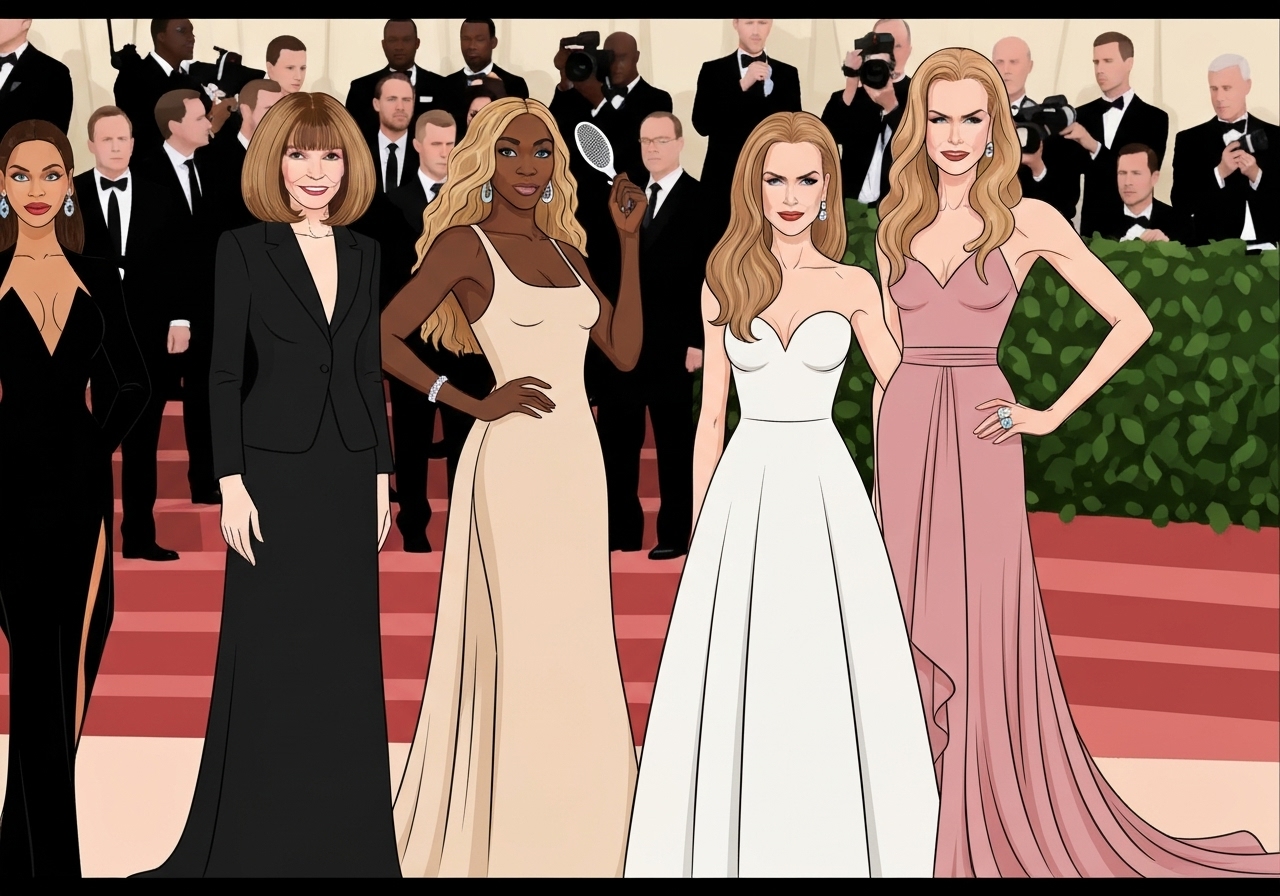
On Monday of the first week in May 2026, New York’s Metropolitan Museum of Art will host its annual Met Gala with four co-chairs announced for the event: Beyoncé, Venus Williams, Nicole Kidman and long-time host Anna Wintour. The title event will introduce the Costume Institute’s spring 2026 exhibition, which opens to the public on 10 May and pairs works from the Met’s collection with roughly 200 historical and contemporary garments. Beyoncé’s return marks her first appearance at the Gala since 2016, when she attended the Manus x Machina themed event in Givenchy. Organizers and sponsors announced the lineup amid advance attention to the exhibition’s provocative focus on the body and fresh scrutiny of the Gala’s backers.
Key Takeaways
- Four co-chairs named for the 2026 Met Gala: Beyoncé, Venus Williams, Nicole Kidman and Anna Wintour, who continues her long-running leadership role.
- The Gala will align with the Costume Institute’s spring 2026 exhibition, which opens to the public on 10 May and features about 200 garments juxtaposed with paintings and sculptures.
- The exhibition is organised into thematic body types — including the naked, anatomical, ageing and pregnant body — curated by Andrew Bolton.
- The Costume Institute’s show will be the inaugural display in the Met’s new Condé Nast Galleries, a nearly 10,000 sq ft permanent space named for the company’s late founder.
- Jeff Bezos and Lauren Sánchez Bezos were announced as the main sponsors for the 2026 event, prompting public debate over sponsorship and influence.
- Anthony Vaccarello and actress Zoë Kravitz will co-chair the Gala host committee; additional committee members include Doja Cat, Sabrina Carpenter, Gwendoline Christie, Lena Dunham and Chloe Malle.
Background
The Met Gala is held each year on the first Monday in May and serves as a fundraiser and public spectacle that launches that season’s Costume Institute exhibition. Over decades the event has become commerce and culture’s convergence point: designers, celebrities and sponsors converge around a museum-curated theme that often generates headline-making fashion. The co-chair role has evolved from a ceremonial title to hands-on direction of interior design, catering, the guest list and the evening’s programming, and it now commonly includes high-profile celebrity co-chairs who influence creative direction and media attention.
Past co-chairs have ranged across industries—film, fashion, music and theatre—reflecting the Gala’s interdisciplinary appeal. Celebrities frequently use the event to interpret the exhibition theme, sometimes producing memorable or controversial looks that amplify the museum’s curatorial goals. The Costume Institute’s themes have historically prompted both celebration and critique, and the 2026 focus on the body ties the museum’s garment collections to centuries of artistic representations of flesh and form.
Main Event
The 2026 exhibition will pair about 200 garments with paintings, sculptures and other objects from the Met’s holdings to explore how bodies have been depicted and dressed across time. Curator Andrew Bolton has framed the show as an inquiry into “the dressed body,” arranging works into thematic categories such as the naked body and the anatomical body to create dialogues between art and fashion. Examples cited in the planning include a 16th-century Adam and Eve by Albrecht Dürer alongside a Walter Van Beirendonck ensemble, and a photograph titled La Poupée displayed next to a Rei Kawakubo creation for Comme des Garçons.
Co-chairs are expected to work with the Met and stylists to produce evening looks that resonate with the exhibition’s themes; historically, that interplay between clothes and theme has produced high-visibility moments. Beyoncé’s role as co-chair almost certainly guarantees intense media scrutiny because this will be her first Met appearance since 2016, a year when her dress—Givenchy at the Manus x Machina Gala—drew wide attention. Venus Williams and Nicole Kidman bring profiles from sports and film respectively, broadening the Gala’s cross-sector appeal.
The Met also confirmed that Anthony Vaccarello and Zoë Kravitz will lead the host committee, alongside named members from music, fashion and film. Meanwhile, Jeff Bezos and Lauren Sánchez Bezos were identified as the event’s primary sponsors for 2026, a development that organisers framed as part of a deeper investment by private backers in fashion programming; the sponsorship announcement has already generated debate online about donor influence and cultural stewardship.
Analysis & Implications
The pairing of a body-focused exhibition with high-profile co-chairs reflects the Gala’s dual role as both cultural programming and mass media event. For the museum, the show offers an opportunity to foreground the Costume Institute’s new permanent galleries and to attract visitors with a provocative curatorial thesis. The public-facing Gala amplifies that reach: celebrity interpretations of the theme will function as an extension of the museum’s narrative, reaching audiences who may not otherwise engage with the exhibition.
For designers and brands, the Gala remains a rare marketing moment with global visibility. Stylists will likely pursue literal and conceptual translations of the “Costume Art” theme—ranging from literal “naked dressing” to sculptural or mannequin-inspired silhouettes—so the event may shape commercial trends for the season. The presence of Beyoncé, in particular, creates an elevated platform for designers associated with her looks, while co-chairs from sport and film may prompt cross-sector collaborations that shift the Gala’s tone toward broader mainstream interest.
The announcement of Jeff Bezos and Lauren Sánchez Bezos as lead sponsors complicates the Gala’s optics. Large private sponsorships fund exhibitions and programming, yet they also invite scrutiny over corporate influence in cultural institutions. The Met’s acceptance of high-profile tech money follows a broader pattern in which major museums rely increasingly on wealthy donors, raising ongoing questions about governance, donor visibility and curatorial independence.
Comparison & Data
| Item | 2026 Exhibition |
|---|---|
| Public opening | 10 May 2026 |
| Garments displayed | About 200 historical and contemporary pieces |
| Galleries | New Condé Nast Galleries, nearly 10,000 sq ft |
The table above summarises core logistical details that will shape the visitor experience and the Gala’s programming. The combination of a large, permanent gallery footprint and a 200-piece ensemble provides curators with scale to build multiple thematic groupings and to stage the kinds of juxtapositions—between fine art and fashion—that the show promises.
Reactions & Quotes
“I wanted to focus on the centrality of the dressed body within the museum, connecting artistic representations of the body with fashion as an embodied artform.”
Andrew Bolton, Curator, Costume Institute (Met)
“The role of the co-chairs is to oversee everything from interior design to catering to guest list,”
The Guardian (news report)
“The new, nearly 10,000 sq ft Condé Nast Galleries have been named for the company’s late founder.”
The Guardian (news report)
Unconfirmed
- Whether any of the co-chairs will perform or present a staged moment during the Gala remains unannounced and should not be assumed.
- Final guest list and specific outfits for the co-chairs and major celebrities have not been released and will be confirmed closer to the event.
- The precise terms and conditions of the Bezos sponsorship—such as donor naming rights beyond the Gala or influence on curatorial decisions—have not been published publicly.
Bottom Line
The Met’s announcement of Beyoncé, Venus Williams, Nicole Kidman and Anna Wintour as co-chairs frames the 2026 Gala as both a high-profile cultural moment and a strategic launch for an ambitious Costume Institute exhibition. The show’s focus on varied body types, coupled with the opening of the new Condé Nast Galleries, positions the Met to generate renewed public interest and media coverage through both scholarship and spectacle.
At the same time, the prominence of private sponsorship and the global reach of celebrity interpretations mean the Gala will be scrutinised for what it reveals about donor influence, institutional priorities and how museums negotiate popular culture. For visitors and observers, the event will be instructive both for the exhibition it launches and for the conversations it provokes about art, fashion and public stewardship.
Sources
- The Guardian — news report summarising Met announcement and related details