
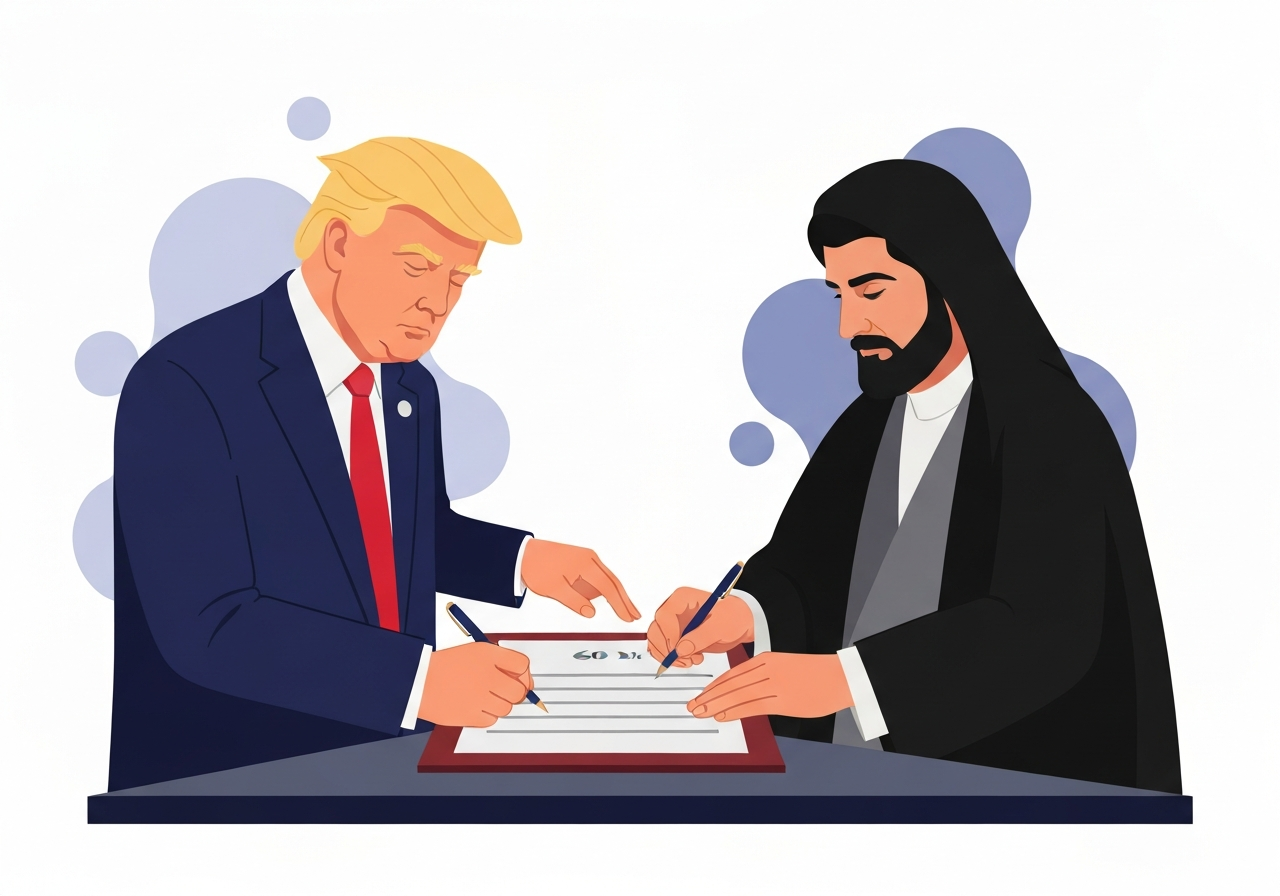
The United States and Iran agreed a 14-point Memorandum of Understanding (MOU) that was signed late Wednesday by President Donald Trump and Iran’s Masoud Pezeshkian, extending a ceasefire and pausing hostilities for an initial 60-day period. The agreement, struck during the G7 summit in France and witnessed by mediators including Pakistan and Qatar, aims to reopen the Strait of Hormuz to commercial traffic and lift immediate barriers to Iranian oil exports while the parties negotiate a final settlement. Key operational deadlines include a 30-day removal of the US naval blockade and a 60-day window for safe, toll-free transit through the strait. Significant technical and political questions — above all credible nuclear verification, oversight of a proposed $300 billion reconstruction fund, and regional security guarantees — remain unresolved.
Key takeaways
- The MOU is a 14-point framework signed by Trump and Iran’s President Masoud Pezeshkian; it triggers a 60-day negotiating window for a final deal, extendable by mutual consent.
- The agreement calls for immediate and permanent termination of military operations on all fronts, explicitly including Lebanon, and a US pledge to begin ending its naval blockade within 30 days.
- Iran has recommitted not to procure or develop nuclear weapons; the text also references down‑blending of 440 kg of uranium enriched to roughly 60% but leaves many nuclear details for technical talks.
- The US agreed to issue waivers to allow Iranian crude and petroleum exports while a proposed USD 300 billion reconstruction/development fund is discussed with regional partners.
- Oil reacted quickly: Brent traded from about $86.80 at the start of the week to roughly $77.90 on the morning after the signing, a fall of roughly 10% from early‑week levels.
- The IAEA says it is prepared to help devise “concrete steps” for technical verification, but chief negotiators face a compressed timetable compared with the 2015 JCPOA negotiations.
Background
The MOU arrives after months of escalation that saw attacks on shipping through the Gulf and concerted military pressure by the US and allied forces. Tehran employed the Strait of Hormuz as a lever during the conflict, intermittently attacking vessels and signaling it could disrupt global oil flows — a cheap and effective pressure point compared with other forms of military coercion. The 2015 JCPOA, which President Trump abandoned during his earlier presidency, previously set a lengthy diplomatic timeline; negotiators now face a far shorter window to resolve detailed nuclear safeguards and monitoring arrangements.
Regional stakes are high. Gulf Arab states want assurance that commercial traffic and energy exports will not be subject to renewed disruption or quasi‑state levies, and they will insist reconstruction funds do not underwrite Iran’s ballistic missile or drone programmes. Israel, which was not a party to these talks, views any settlement that limits its freedom of action in Lebanon or appears to strengthen Tehran with deep suspicion. The United States has committed to securing a final, binding agreement within a provisional 60 days, though the MOU allows that deadline to be extended by mutual consent.
Main event
The signing took place late on Wednesday at the Palace of Versailles after G7 meetings in France. President Trump put his signature on a hard copy of the 14‑point framework; Iran’s president, Masoud Pezeshkian, signed on behalf of Tehran. Pakistani Prime Minister Shehbaz Sharif is recorded as a mediator and also signed documents shared publicly by state accounts. A previously planned in‑person Swiss meeting of implementation teams was scheduled for Friday; both Tehran and Washington indicated diplomatic channels and mediation would continue as the text goes into force.
The MOU’s core operational measures include: the immediate and permanent cessation of military operations on all fronts (explicitly covering Lebanon), US removal of a naval blockade within 30 days, and arrangements by Iran to facilitate safe passage through the Strait of Hormuz for 60 days without charging fees. The US also agreed to issue waivers allowing Iran to export crude and petroleum products pending a final deal, and both sides agreed to begin negotiating outstanding matters during the 60‑day window.
Financial and technical provisions are among the most contested. The framework refers to a USD 300 billion reconstruction and development fund to be developed “with regional partners” — not directly from the US — and an executive mechanism to monitor implementation. Iran reconfirmed it will not seek nuclear weapons; however, the MOU defers detailed arrangements for enrichment limits, inspections and chain‑of‑custody for existing enriched uranium to the technical phase of talks.
Despite the signing, violence persisted in some places. Lebanese media reported Israeli strikes in the south of the country after the MOU took effect, and the Israeli military reported casualties in border incidents. Israeli officials have expressed reservations and indicated they are still negotiating with Washington over conditions related to Lebanon and security guarantees.
Analysis & implications
The nuclear verification challenge is the single most consequential technical hurdle. The MOU’s 60‑day timetable is sharply compressed compared with the protracted effort that produced the 2015 JCPOA, which negotiators have said took roughly ten times longer. Crafting a robust inspection and monitoring regime — including access to enrichment sites and credible mechanisms for handling the 440 kg of roughly 60% enriched uranium referenced in the framework — typically requires months of detailed IAEA technical work and legal agreement on safeguards.
Regional politics complicate the economics. Gulf Arab states that were targeted during the conflict are simultaneously being asked to participate in financing reconstruction for Iran; they will want enforceable safeguards that prevent diverted funding to the Islamic Revolutionary Guard Corps (IRGC) or to ballistic missile and drone programs. The MOU’s language about a regional financing mechanism seeks to spread both the cost and the scrutiny, but operational controls and auditing will be essential to build confidence.
Strategically, reopening the Strait of Hormuz and removing the blockade reduce the immediate risk of global supply shocks and appear to have eased oil markets in the short term. But the agreement also codifies a political trade: Iran gains rapid economic relief and access to markets, while the US and partners get a pause and a window to press for hard verification. If verification proves weak, the MOU could bolster Tehran’s regional posture without removing long‑term proliferation risks.
The Israel‑US relationship may face strain. Jerusalem’s public silence and a number of Israeli leaders’ critical comments reflect anxiety that the MOU constrains Israel’s freedom to act in Lebanon and weakens leverage over Iran. If Israel conducts operations that Tehran and Washington view as a breach of the MOU, the ceasefire could unravel quickly; conversely, coordinated diplomacy that addresses Israeli security concerns could shore up the agreement.
Comparison & data
| Item | Value / target |
|---|---|
| Initial negotiating window | 60 days (extendable) |
| Timeframe cited for 2015 JCPOA negotiations | ~600 days (approximately 10× longer) |
| Blockade removal | Begin immediately; fully end within 30 days |
| Safe commercial transit in Hormuz | 60 days without charge |
| Enriched uranium referenced | 440 kg at ~60% enrichment (down‑blending discussed) |
| Proposed reconstruction fund | USD 300 billion (to be developed with regional partners) |
| Brent crude price (week) | From ~$86.80 to ~$77.90 after signing |
The table highlights the compressed negotiating timeline and the main numeric tradeoffs that negotiators must translate into verifiable mechanisms. The contrast with the 2015 JCPOA’s duration underlines how much technical detail still needs to be resolved in a much shorter period; verification of uranium stocks, chain‑of‑custody procedures, and on‑site access are among the most time‑consuming elements.
Reactions & quotes
Domestic and international actors reacted within hours. In the United States, some Republican politicians criticized the deal as too lenient on Iran, while others welcomed the potential for regional stability. In Tehran, officials hailed the framework but stressed lingering distrust. Public and political responses show the agreement’s fragility unless technical and oversight questions are resolved.
“These fools, who think I haven’t been tough enough on Iran… are either jealous, bad people, or stupid,”
President Donald Trump (social media post)
Trump’s message framed the deal as a political success at home, linking economic indicators and oil prices to his judgment. Supporters point to immediate relief for markets; critics challenge the depth of constraints on Iran.
“It does smack of the kind of appeasement that our administration rejected in the Obama‑Iran nuclear deal,”
Former Vice‑President Mike Pence (public comment)
Some conservative US voices singled out the speed and the absence of immediate, binding dismantlement requirements on sensitive nuclear infrastructure as major shortcomings. Others within the US political spectrum argued the MOU buys time to build a firmer verification regime.
“We are ready to discuss concrete steps to address the nuclear programme,”
Rafael Grossi, IAEA Director General (briefing)
The IAEA signaled willingness to engage technically but cautioned against premature assumptions about access and procedures, emphasizing that detailed negotiations must precede formal technical implementation.
Unconfirmed
- Whether the USD 300 billion reconstruction fund will be fully mobilised, who will contribute what amounts, and under what safeguards remains unclear.
- Exact technical arrangements for monitoring and verifying the 440 kg of ~60% enriched uranium — including IAEA access, sampling protocols and timelines — have not been published.
- It is not yet confirmed whether Israel will fully accept the security restrictions implied by an immediate cessation of operations in Lebanon or continue independent operations that could be construed as breaches.
- Reports of Israeli strikes in southern Lebanon on the morning after the signing are being reported by local media; full, independently verified incident reports are pending.
Bottom line
The MOU signed by the US and Iran buys a pause and creates breathing space for diplomacy: a 60‑day window to negotiate a final, binding settlement and immediate operational steps to reopen shipping lanes and ease oil market pressures. It achieves fast, concrete changes — blockade removal, waivers for oil exports and a framework for reconstruction funding — that materially reduce immediate tensions and economic risk.
But the agreement is provisional and fragile. The most consequential work remains: translating broad political commitments into legally enforceable verification, establishing transparent financial controls for reconstruction resources, and securing regional buy‑in — particularly from Israel and Gulf partners. If the technical phase fails to deliver credible inspection and enforcement mechanisms, the MOU risks becoming a temporary respite rather than a durable settlement.