
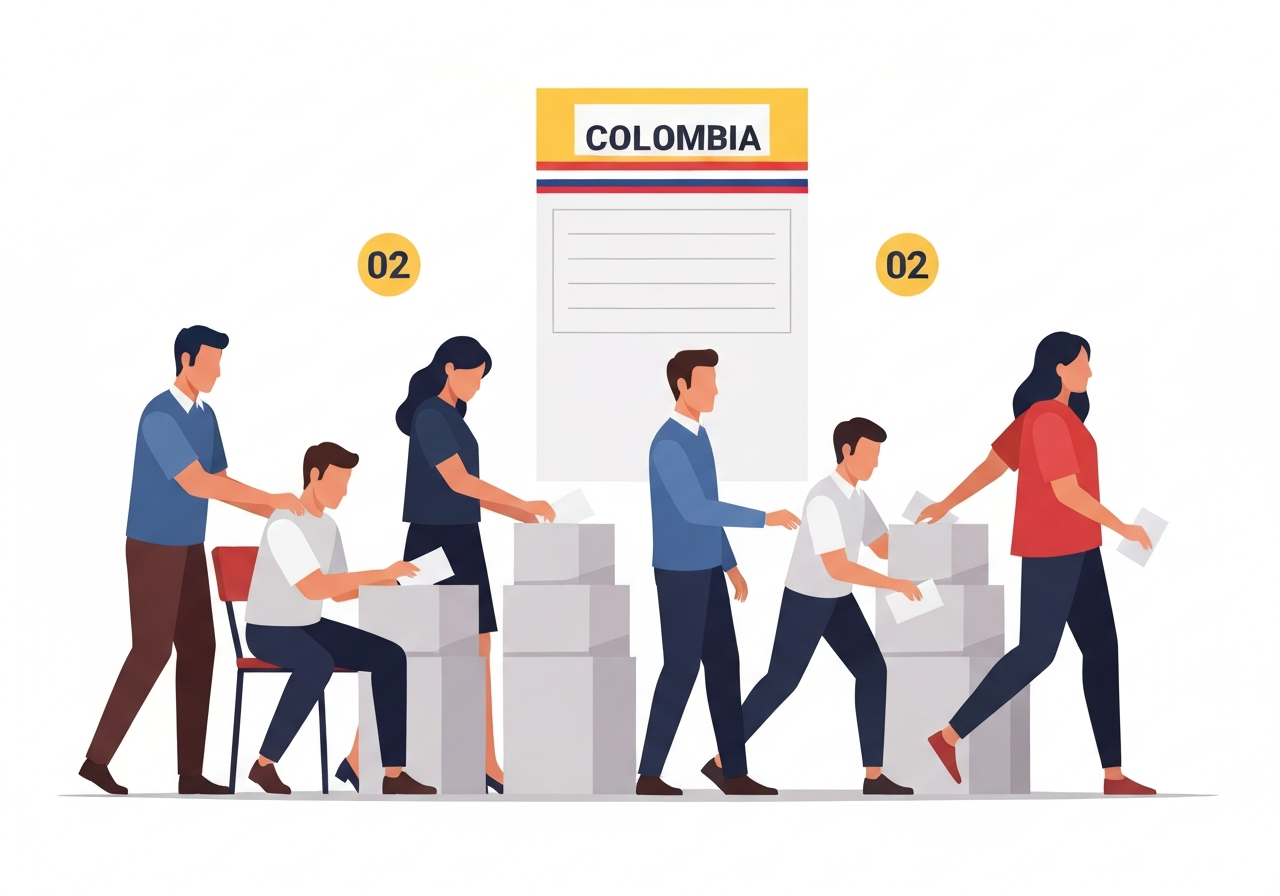
Lead: Colombia held a high-stakes presidential runoff on Sunday in a contest that matched conservative outsider Abelardo de la Espriella against progressive lawmaker Iván Cepeda. The two finalists emerged after a May 31 first round in which Cepeda won 41% and de la Espriella 44% of the vote, according to official tallies. Both candidates framed their campaigns around preventing a return to the waves of car bombs, kidnappings and mass displacements that marked earlier decades. More than 41 million people were eligible to vote in an election shaped by security fears, economic strains and allegations of irregularities.
Key Takeaways
- Iván Cepeda and Abelardo de la Espriella advanced from the May 31 first round with 41% and 44% respectively, setting the June runoff between a progressive and an outsider.
- Over 41 million Colombians were registered to vote in the runoff, with polling places open until the afternoon on election day.
- Security remains central: authorities recorded 14,780 homicides last year and reported 13,417 extortion cases in 2025, more than double counts from 2015.
- Colombia’s illegal armed groups number more than 27,000 members; one small group of roughly 100 fighters began a disarmament and resettlement process the week before the runoff.
- De la Espriella, nicknamed “The Tiger,” proposed a tough-on-crime agenda including 10 mega-prisons and has received an endorsement from former U.S. President Donald Trump.
- Cepeda pledges to continue outgoing President Gustavo Petro’s “total peace” outreach to guerrillas and criminal gangs, a strategy with limited success so far.
- The runoff was contested amid accusations of fraud, vote-buying and intimidation; Cepeda filed complaints with Colombia’s Attorney General and the International Criminal Court.
Background
Ten years after the 2016 peace accord with the FARC, Colombia’s hopes for a decisive break with armed conflict have been challenged by a renewed wave of violence. Many former guerrilla factions and new criminal networks shifted from ideological struggle to trafficking and extortion, eroding security gains from the earlier agreement. The spike in homicides and a sharp rise in extortion have heightened public anxiety, especially in rural areas where illegal groups contest state authority.
Gustavo Petro, Colombia’s first leftist president, pursued a negotiated path to reduce violence beginning in 2022 with a policy he labeled “total peace.” The approach sought talks with a range of armed groups but has produced uneven results and faced criticism for slow implementation and limited concrete surrenders. Meanwhile, economic pressures—strained public finances, an overburdened health system and persistent corruption—have left many voters searching for a clear and immediate fix.
Main Event
The runoff pitted two sharply different proposals for Colombia’s immediate future. Abelardo de la Espriella, a business owner and lawyer known as “The Tiger,” ran as a law-and-order outsider promising an aggressive campaign against criminal networks and the construction of 10 mega-prisons modeled on tough measures in Central America. His campaign attracted high-profile international attention, including an endorsement from former U.S. President Donald Trump.
Iván Cepeda, a congressman and figure linked to the political movement of outgoing President Petro, argued voters should continue negotiations and reintegration efforts aimed at reducing the armed groups’ incentives for violence. Cepeda framed his bid as an extension of Petro’s agenda to prioritize dialogue and institutional reform while also tackling economic and social inequities.
The runoff unfolded amid heightened political rancor. Petro publicly questioned parts of the electoral environment, saying officials should protect the vote and signaling concerns about foreign funding through unspecified channels. Campaigns traded accusations: Cepeda filed formal complaints with Colombia’s Attorney General and the International Criminal Court alleging de la Espriella had links to paramilitary actors, charges the challenger denied.
On the ground, voters expressed palpable unease. Some, like Yolanda Hernández, who voted early, said they switched from supporting Petro in 2022 to backing de la Espriella because they felt economic promises had not been delivered. Others cited worry that a confrontational security strategy could produce short-term gains at the cost of rights and long-term stability.
Analysis & Implications
Security policy will be the defining axis of the next administration. A hardline approach promising incarceration and large-scale military operations could reduce visible crime metrics in the near term, as seen in other countries, but risks human rights scrutiny and potential abuses that could provoke domestic and international backlash. Mega-prisons and aggressive policing have precedent but come with legal and budgetary trade-offs.
The negotiation route championed by Cepeda and Petro faces fragmentation among armed actors. With more than 27,000 members across numerous groups, negotiating comprehensive disarmament is complex and slow; the recent surrender of a roughly 100-member group shows progress but underlines how piecemeal reintegration has been. Success will require sustained investment, credible guarantees and coordination across national and local institutions.
Economically, either administration will confront rising public debt and an overtaxed health system. Fiscal space for large security projects—prisons, expanded forces or reintegration programs—will be constrained without revenue reforms or international financing. Corruption and congressional opposition could blunt both candidates’ agendas, making coalition-building in Congress a decisive factor regardless of who wins.
Finally, political polarization and public distrust of institutions increase the risk that contested results or post-election disputes will erode confidence. International observers, foreign governments and human rights bodies are likely to scrutinize both the voting process and subsequent security measures closely.
Comparison & Data
| Indicator | Most recent official figure | Context |
|---|---|---|
| Homicides (most recent year) | 14,780 | Highest annual total since at least 2015, per authorities |
| Extortion cases (2025) | 13,417 | More than double the count reported for 2015 |
| Estimated members of illegal groups | 27,000+ | Wide fragmentation among multiple organizations |
These indicators have driven the debate: voters weighing immediate security gains against the rule-of-law implications of heavy-handed measures, and the feasibility of negotiating peace with numerous, financially motivated armed groups. Budget implications and institutional capacity also inform how realistic large-scale proposals, like building several mega-prisons, would be in practice.
Reactions & Quotes
Officials, voters and analysts reacted sharply in the run-up to and during voting. The outgoing president publicly urged vigilance about the integrity of the vote, reflecting persistent fears of interference and foreign money in politics.
“We must protect the vote, undoubtedly.”
Gustavo Petro (outgoing president, statement)
At street level, many voters expressed a combination of resignation and hope—resignation about persistent violence and hope that a new leader could break the cycle. Legal professionals and ordinary citizens cautioned against escalating polarization.
“Right now, what worries me is the polarization that exists between us: there are two very extreme sides, and the violence is concerning.”
John Manrique (Bogotá lawyer)
For some low-income voters, economic frustrations drove their choice more than ideology. These personal stories illustrate how security, cost of living and unmet promises shaped individual ballots.
“We want change in Colombia because it’s always the same violence, always the same thing.”
Yolanda Hernández (early voter)
Unconfirmed
- Claims by outgoing President Petro about detailed foreign funding networks affecting the vote remain unproven and are the subject of his party’s statements.
- Allegations that Abelardo de la Espriella has operational ties to paramilitary groups have been formally lodged but not independently verified in court by the time of the runoff.
- Wide-scale, systematic vote-buying or intimidation has been alleged in pockets; comprehensive, verified evidence has not yet been made public and investigations are ongoing.
Bottom Line
The runoff crystallized a choice between an assertive, security-first approach and a negotiated, continuity-oriented path tied to the outgoing administration. Both routes carry risks: a confrontational security policy could bring rapid improvements in some crime metrics while sparking rights concerns; continued negotiation faces an uphill battle against fragmented, profit-driven criminal groups.
What matters next is not only who takes the presidential sash but how institutions—Congress, the judiciary, electoral authorities and international observers—shape and check policy. Watch for post-election legal challenges, early signs of policy prioritization (prison construction, reintegration budgets), and whether international actors press for human-rights safeguards as security measures are implemented.
Sources
- AP News (news report)
- Office of the Attorney General of Colombia (official/prosecutorial authority)
- International Criminal Court (international judicial institution)
- Registraduría Nacional del Estado Civil (Colombian electoral authority)