
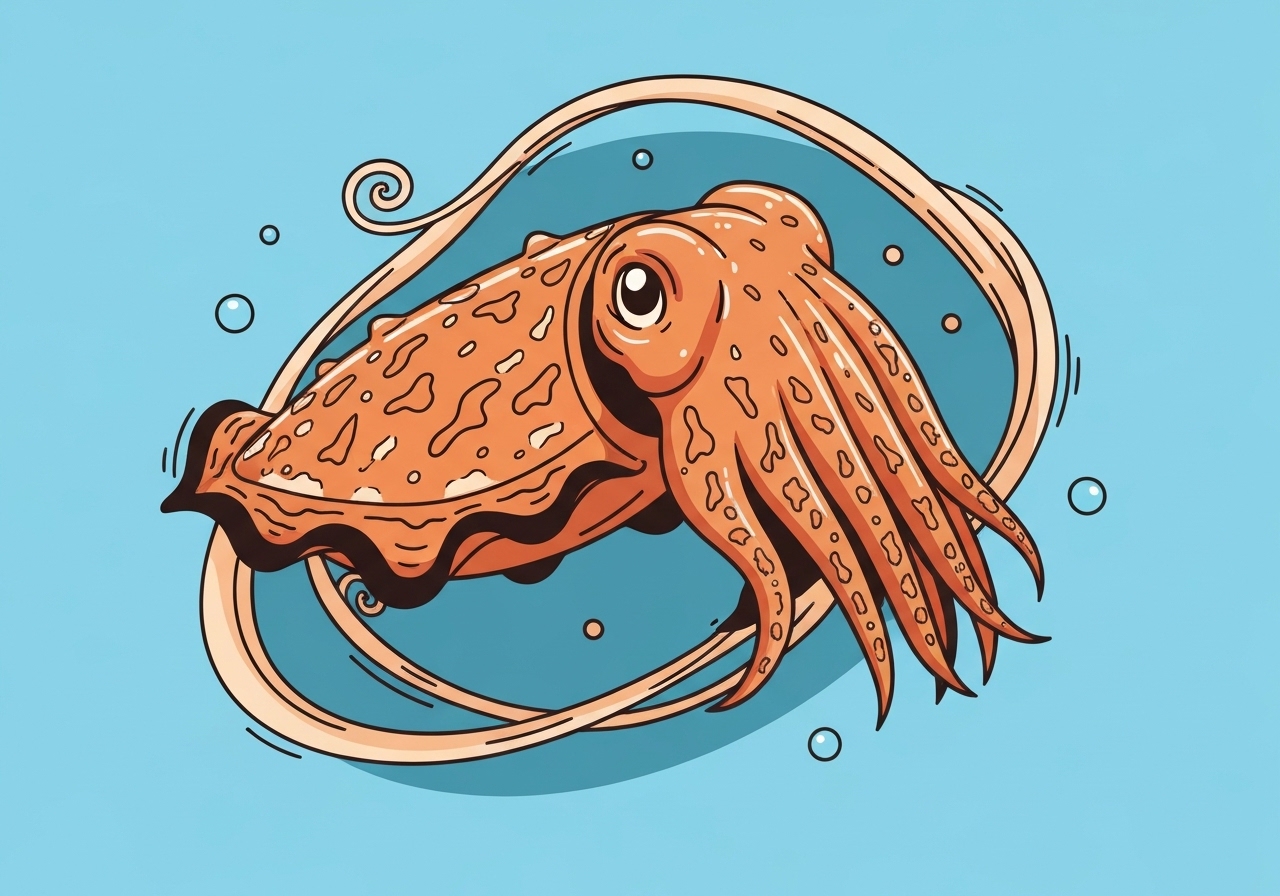
Researchers reported on Jan. 26, 2026, that cuttlefish produce skin patterns that encode the orientation of light waves—polarization—that are invisible to human eyes but visible to polarization-sensitive animals. The finding, published Monday in the Proceedings of the National Academy of Sciences, was led in part by Arata Nakayama of National Taiwan Normal University and documented using a camera fitted with a polarized sensor. Observations were made during courtship contexts, and the team interprets the patterns as a potential sexual signal that enhances contrast for intended viewers. The work suggests that an entire channel of visual communication may have gone largely undetected by human observers and traditional cameras.
Key Takeaways
- The study published in PNAS on Jan. 26, 2026, provides the first direct images of polarization-based skin patterns displayed by cuttlefish during courtship.
- Researchers captured the polarization patterns using a camera equipped with a polarized sensor; those patterns are not visible to the unaided human eye.
- Arata Nakayama (National Taiwan Normal University) is an author and emphasized the difficulty of knowing what polarized light looks like to animals that perceive it.
- Polarization vision—ability to detect the orientation of light waves—is known in some fish, insects, and cephalopods and likely adds contrast or texture to scenes.
- The authors conclude that polarized-light signals in mating displays may be more common than previously recognized across aquatic and terrestrial taxa.
Background
Light waves have orientation; when those orientations are preferentially filtered or aligned, light is described as polarized. Humans and most mammals lack reliable sensitivity to polarization orientation, so patterns that rely on it are effectively hidden from us. By contrast, a range of animals—from some fish and insects to cephalopods—have sensory systems that register polarization and can thus access an extra dimension of visual information.
Cephalopods are celebrated for rapid, complex changes in skin color and texture used for camouflage, threat displays and courtship. Those dynamic skin states are produced by specialized cells and structures that modulate reflected light. Until now, studies of cephalopod signaling focused primarily on color, luminance and pattern visible to human observers or conventional cameras, leaving open the possibility that additional signal components target viewers with different sensory capabilities.
Main Event
The research team deployed imaging equipment capable of recording the orientation of polarized light reflected from cuttlefish skin and documented distinct polarization patterns produced during courtship. Those patterns were present at moments when males displayed toward females, suggesting a role in mate attraction or assessment. Because the patterns are based on the orientation of light waves rather than hue or brightness, conventional cameras and human vision fail to detect them.
Nakayama and colleagues note that polarization contrasts can make features stand out against backgrounds in ways that ordinary color contrast cannot. In the observed courtship sequences, polarization patches appeared to create local texture differences that would be salient to a polarization-sensitive receiver. The authors therefore interpret the displays as private or low-noise signals aimed at prospective partners while remaining less obvious to predators or competitors lacking polarization vision.
Methodologically, the study relied on specialized polarization-imaging sensors rather than post-processing tricks to infer orientation information. That allowed the researchers to capture real-time changes in the polarization pattern as social interactions unfolded. The images were then analyzed to correlate display timing with courtship behavior and to assess the spatial structure of the polarization signals.
Analysis & Implications
If polarization-based displays function as sexual signals, they expand our understanding of communication channels in evolution. Sexual selection favors signals that reliably convey information to intended receivers while minimizing costs; polarization patterns could achieve that by increasing signal contrast to mates without dramatically increasing conspicuousness to predators that lack polarization sensitivity. This would represent an efficient signaling solution in visually complex aquatic environments.
The discovery also alters field and laboratory methodology: researchers who rely solely on standard color and luminance imaging may miss behaviorally relevant displays. Incorporating polarization-sensitive equipment will likely reveal previously overlooked signaling strategies across species, especially in aquatic and crepuscular settings where polarization cues are strong. Future behavioral tests will need to demonstrate receiver responses to confirm function definitively.
On an ecological scale, recognizing polarization signaling could change interpretations of mate choice, species recognition and even predator–prey dynamics. If many species use polarization channels, ecological models that ignore this dimension may underestimate the complexity of visual interactions and the selective pressures shaping sensory systems. Conservation and monitoring programs should account for sensory diversity when assessing animal behavior in situ.
Comparison & Data
| Viewer | Detects Polarization? | Perceives the Display? |
|---|---|---|
| Human (unaided) | No | No |
| Polarization-sensitive animal (e.g., cuttlefish) | Yes | Yes |
| Conventional camera | No | No |
| Polarization-imaging camera | Yes | Yes |
The table summarizes visibility: polarization signals are effectively invisible to humans and standard cameras but are accessible to animals with polarization vision and to specialized imaging devices. This simple comparison underscores why such displays could have evolved as targeted signals and why they have been under-detected by researchers who lacked polarization-sensitive tools.
Reactions & Quotes
Researchers emphasized methodological and conceptual shifts prompted by the finding: recording polarization directly provides a new window onto animal communication, and the study invites broader surveys across taxa.
“It’s really difficult to know exactly what polarized light looks like to an animal that can see it,”
Arata Nakayama, research fellow, National Taiwan Normal University
Nakayama framed the discovery as both a technical and interpretive challenge: without the right sensors, whole signal channels remain hidden. The research team adds that polarization signals can add contrast or texture, making objects stand out more clearly to receivers that detect orientation of light waves.
“The use of polarized light during courtship may be more prevalent than previously thought,”
Proceedings of the National Academy of Sciences (study)
The study’s authors explicitly suggested broader prevalence, encouraging follow-up studies to map how widespread polarization-based courtship is across marine and terrestrial species.
Unconfirmed
- Whether the observed polarization patterns consistently influence mate choice across cuttlefish populations remains to be tested in controlled choice trials.
- The prevalence of polarization-based courtship in other cephalopod species and among fish or insects is suggested but not yet empirically quantified.
- The exact neural mechanisms by which receivers decode polarization patterns and the specificity of information encoded (species, sex, condition) are currently unresolved.
Bottom Line
The study published Jan. 26, 2026, in PNAS provides the first direct imagery of cuttlefish producing polarization-based displays during courtship and argues that these displays can be invisible to human observers. Methodological advances—specifically polarization-sensitive imaging—were key to the discovery, and similar tools will be essential for detecting comparable signals in other species.
Confirming functional significance requires behavioral experiments that demonstrate receiver responses, but the finding already has practical implications: scientists must broaden sensory methodologies to avoid missing communication channels. For readers and researchers alike, the take-away is clear—animal signaling can operate in sensory dimensions we do not perceive, and acknowledging that will refine our understanding of animal behavior and evolution.