
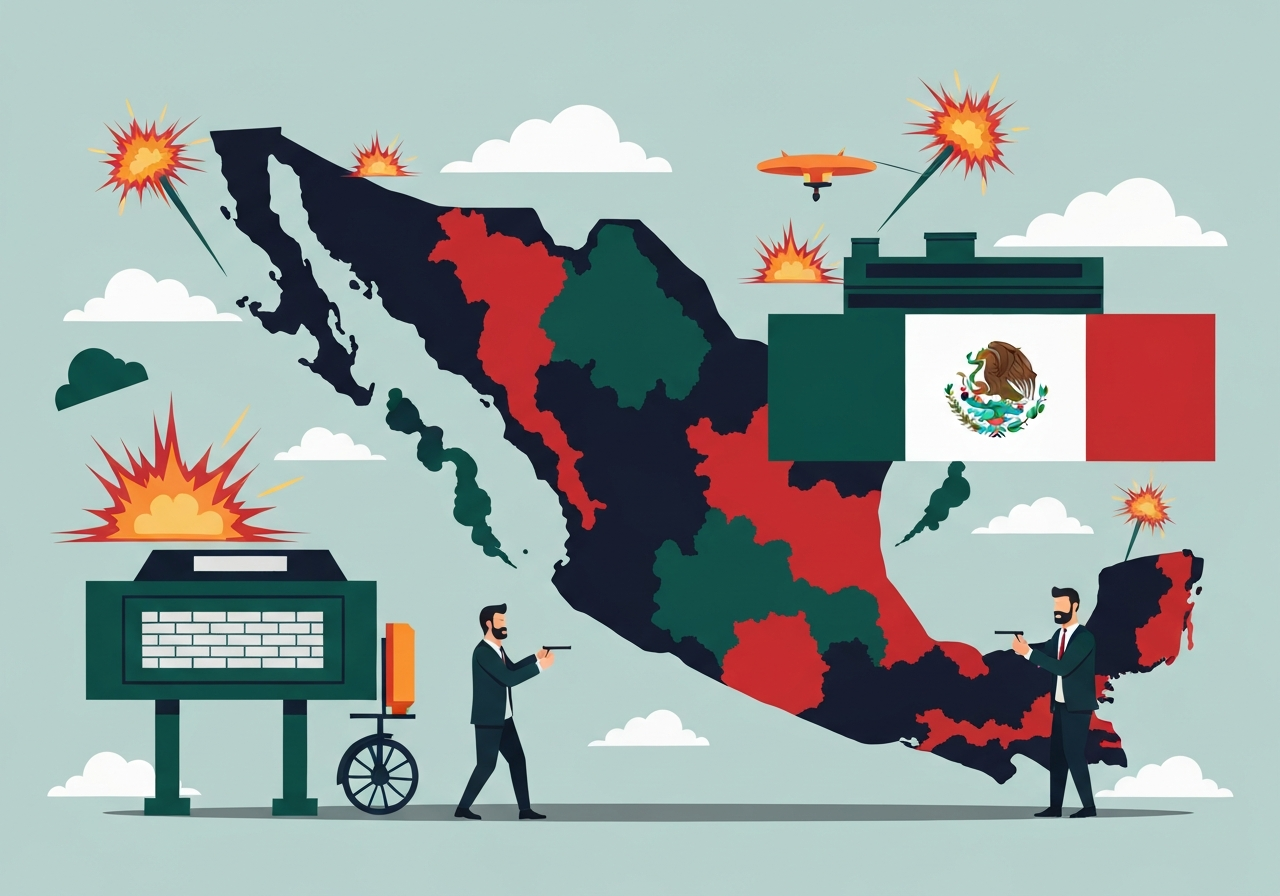
Mexican security forces announced on Feb. 22, 2026 that they killed Nemesio Oseguera Cervantes, known as “El Mencho,” in an operation in Tapalpa, Jalisco, the government said. The strike, which left Mr. Oseguera injured and later dead while being transported to Mexico City for medical attention, immediately triggered a wave of coordinated arson and blockades across multiple states. At least nine other suspected cartel members were reported killed in the operation. The attacks that followed—cars, banks and supermarkets set ablaze—marked one of the broadest eruptions of unrest tied to a cartel leader’s removal in recent years.
Key Takeaways
- Target and date: Nemesio Oseguera Cervantes (“El Mencho”) was located and engaged by Mexican forces in Tapalpa, Jalisco on Feb. 22, 2026.
- Casualties reported: Mexican authorities say Mr. Oseguera was fatally wounded and at least nine other suspected cartel members died during the operation.
- Immediate fallout: Armed groups set fire to vehicles, banks, supermarkets and infrastructure in multiple states, using roadblocks and arson to signal retaliation.
- Cartel profile: El Mencho led the Jalisco New Generation Cartel (CJNG), a group that expanded significantly over the past decade and is widely regarded as one of Mexico’s most powerful criminal organizations.
- Transport and medical response: Officials said Mr. Oseguera was wounded during capture and died while being transported to Mexico City for further medical care.
- Security implications: Analysts warn the removal could prompt short-term spikes in violence, internal power struggles within CJNG, and opportunistic attacks by rival groups.
Background
The Jalisco New Generation Cartel emerged from the western state of Jalisco and has grown into a national and transnational criminal network over the past decade, building revenue streams from drug production and trafficking, extortion, and other illicit businesses. Nemesio Oseguera Cervantes rose to prominence as the cartel’s longtime leader and was long listed among Mexico’s most wanted figures by federal authorities and international partners. Authorities have treated CJNG as a principal security threat given its rapid territorial spread, firepower, and willingness to confront state forces.
Historically, the capture or killing of high-profile cartel leaders in Mexico has produced volatile periods: some operations create short-term declines in specific criminal activities, while others spark violent retribution, fragmentation, or turf wars as subordinate leaders jockey for control. Local communities and state governments often bear the immediate human and economic costs, including threats to businesses, interrupted transport and heightened fear among residents. Federal and state security agencies have increasingly sought to coordinate operations against cartel leadership while balancing the risk of destabilizing violent responses.
Main Event
Mexican security forces located Mr. Oseguera in Tapalpa, a town of about 20,000 in Jalisco, and launched an operation that officials said resulted in his being wounded during the engagement. Government statements reported that the leader was alive when taken into custody but died in transit to Mexico City for medical treatment. Officials also reported that at least nine other suspected cartel operatives were killed in the same operation.
Within hours of the government’s announcement, organized groups set fires to vehicles, businesses and public infrastructure in several states, and blocked roads with burning debris. Authorities described the tactics as coordinated attempts to intimidate, distract and retaliate against security forces. Reports from multiple cities noted damage to banks and supermarkets and temporary interruptions to road and commercial activity as emergency services responded.
Federal security units moved to secure key routes and critical infrastructure while local police mobilized to contain fires and reopen blocked highways. State governments declared heightened alert levels in affected areas and urged civilians to avoid hotspots while investigations and cleanup operations proceeded. The federal government framed the strike as a major blow to CJNG’s leadership, emphasizing that the operation targeted the country’s most wanted cartel figure.
Analysis & Implications
The immediate security picture suggests a classic retaliation pattern: a decapitation of a criminal leader followed by a show of force meant to signal continued operational capacity and deter defections. In the short term, the government faces the twin tasks of maintaining public order and preventing opportunistic violence from rival groups seeking to exploit any CJNG disarray. Public safety and economic activity in affected municipalities are likely to remain fragile until security stabilizes.
Medium-term outcomes are less certain. The CJNG’s organizational structure and the depth of its regional networks will shape whether a single removal produces fragmentation, succession by a consolidated leadership, or the emergence of splinter cells. Each scenario carries different risks: fragmentation can increase local violence as factions fight over territory, while a swift, unified succession could allow the cartel to continue operations with little disruption.
The international dimension is important: CJNG has been implicated in cross-border drug trafficking and violence that affects the United States and other neighbors. U.S. and regional law enforcement cooperation on intelligence and interdiction could intensify if Mexico pursues sustained pressure on CJNG’s financial and logistical networks. Economically, sectors such as retail and transport in affected regions may face immediate losses from riots and longer-term investor caution if instability persists.
Comparison & Data
| Item | Details |
|---|---|
| Date | Feb. 22, 2026 |
| Location | Tapalpa, Jalisco |
| Primary target | Nemesio Oseguera Cervantes (“El Mencho”), CJNG leader |
| Reported fatalities | At least 10 (El Mencho plus nine others) |
| Immediate unrest | Coordinated arson and roadblocks across multiple states |
The table above summarizes the operation and its immediate consequences. While past high-profile operations have produced varied effects—temporary reductions in specific activities but spikes in retaliatory attacks—the scale of this day’s unrest stands out for the coordinated use of arson and blockades across a broad geographic area. Analysts caution that statistical patterns from previous decapitations do not perfectly predict outcomes for CJNG, given the cartel’s unique reach and resources.
Reactions & Quotes
Officials and experts gave measured responses as events unfolded, emphasizing both the operational success and the risks ahead.
“This operation removed a leading criminal figure responsible for violence and extortion across the country,”
Mexican government (official statement)
The government framed the strike as a necessary measure against a major national security threat, while also mobilizing forces to restore order in affected areas.
“We should expect an unpredictable period; this could mean fragmentation or an attempt at rapid consolidation,”
Independent security analyst
Security analysts cautioned that either internal power struggles or a quick replacement could shape the next phase of violence and criminal activity.
“Residents are afraid and businesses have temporarily closed in several cities; the economic fallout is immediate,”
Local civic leader (region affected)
Local officials described widespread closures and a surge in demand for emergency services amid fires and roadblocks.
Unconfirmed
- Whether Mr. Oseguera’s death will permanently weaken CJNG’s operational capacity is uncertain and depends on internal succession dynamics.
- The exact number of states affected by coordinated arson and the full tally of property damage remain under verification by authorities.
- Attribution of all post-operation attacks to CJNG operatives has not been independently confirmed; investigations are ongoing.
Bottom Line
The death of Nemesio Oseguera Cervantes represents a significant tactical victory for Mexican authorities against a high-profile criminal leader, but it has immediately provoked violent retaliation that threatens public safety and local economies. The short-term priority for the government will be reestablishing control, protecting civilians and preventing the violence from spreading or entrenching.
Longer-term outcomes hinge on CJNG’s internal cohesion, the capacity of state institutions to disrupt criminal finances and networks, and regional cooperation on law enforcement. Observers should watch for signs of fragmentation, succession moves within CJNG, and patterns of violence in previously contested territories as indicators of whether the operation produces meaningful, sustained gains in security.
Sources
- The New York Times (news)