
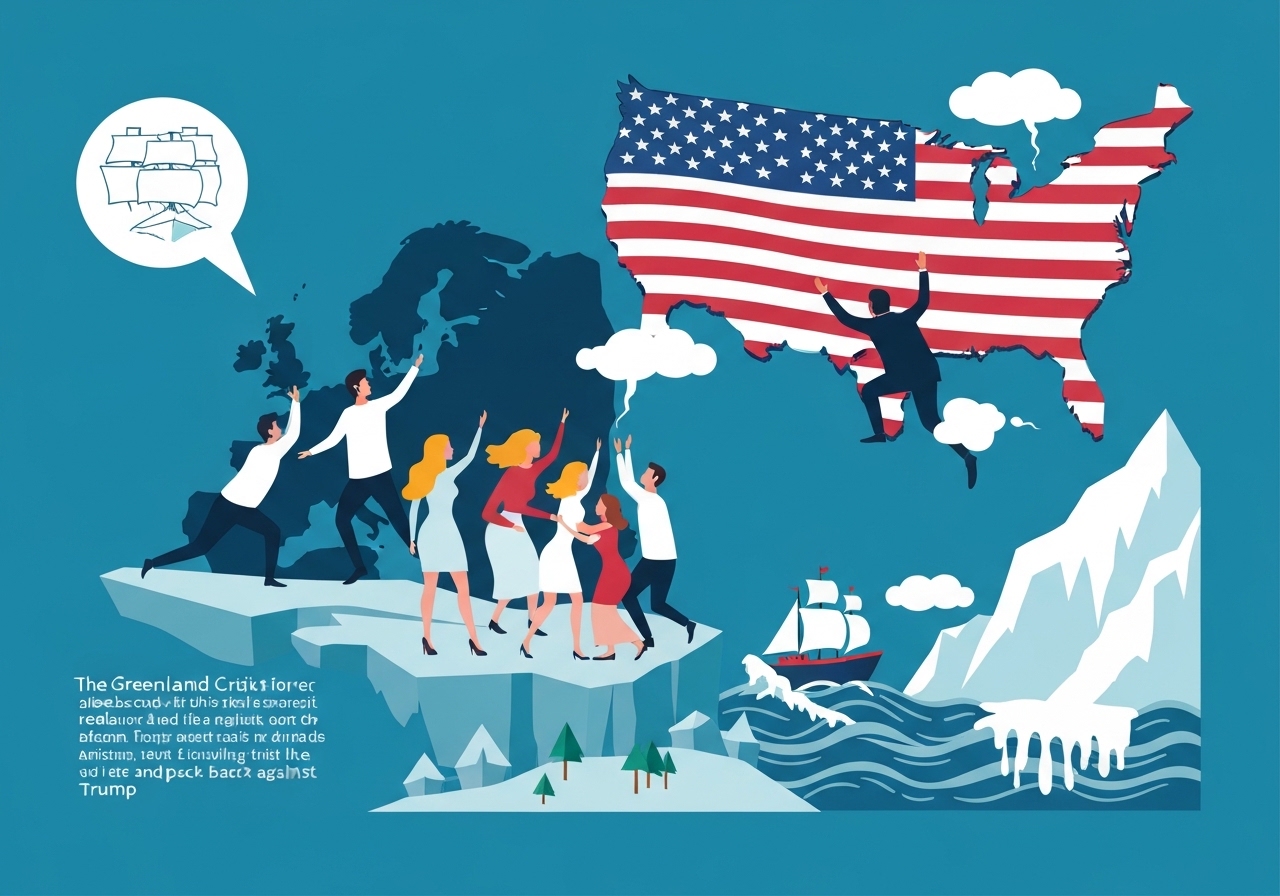
European leaders are confronting a rare transatlantic rupture after President Donald Trump renewed efforts in 2026 to acquire Greenland during talks in Washington DC. Danish and Greenlandic officials said discussions with US envoys, including vice-president JD Vance and secretary of state Marco Rubio, underscored a clash over sovereignty and security that could reshape NATO ties. The episode has exposed a wider dilemma: Europe needs continued American security guarantees, yet many capitals now see a need to resist what they view as overreach. The immediate result is a flurry of European political and military steps aimed at protecting Danish sovereignty over Greenland.
Key takeaways
- President Trump revived interest in Greenland in 2026, meeting US envoys JD Vance and Marco Rubio to press the proposal; Danish officials called the move a violation of red lines.
- Denmark’s foreign minister Lars Løkke Rasmussen publicly rejected the idea, stressing that trading territory or people is unacceptable in 2026.
- European states deployed a limited military contingent to Greenland, with France leading and contributions from Germany, Sweden, Norway, Finland, the Netherlands and the UK.
- Trump has linked the Greenland matter to broader pressure on NATO, including prior demands for members to raise defence spending to 5% of GDP.
- The EU is responding with political and economic measures, including plans to open an office in Nuuk and proposals to double financial assistance to Greenland.
- Some European officials warn that strong pushback is constrained by dependence on US security guarantees and potential economic retaliation.
- Debate continues in Brussels over whether to use the EU ratification timetable for a US trade deal as leverage against Washington.
Background
Greenland, an autonomous territory within the Kingdom of Denmark, has strategic value in the Arctic due to its location and natural resources. Interest in the island intensified after a suggestion first raised with President Trump in 2019 by Ronald Lauder, a longtime acquaintance, resurfaced in 2026 amid wider geopolitical competition with Russia and China. For decades NATO has relied on US military presence across the North Atlantic and Arctic; European capitals now fear that any US attempt to alter sovereignty arrangements would test the alliance’s cohesion.
European governments have long oscillated between accommodation and protest when confronting US unilateralism, from defense-spending rows to contentious operations abroad. That pattern has left many EU and NATO members reluctant to escalate conflicts with Washington despite growing domestic pressure to defend European territories and legal norms. Greenland’s status therefore presents a rare convergence of symbolic and practical stakes: sovereignty, alliance reliability and Arctic security policy intersect in ways that leave little room for a purely technocratic response.
Main event
In mid-January 2026 US envoys held hour-long talks in Washington DC with Danish foreign minister Lars Løkke Rasmussen and Greenlandic foreign minister Vivian Motzfeldt. Diplomats described tense exchanges outside the Eisenhower Executive Office Building after the meetings, and Motzfeldt later said she had been overwhelmed by the intensity of negotiations. Rasmussen made clear publicly that Denmark had ‘red lines’ on any suggestion of selling or ceding territory.
The White House framed its interest in Greenland as rooted in national security, citing the Arctic’s growing strategic salience. President Trump also signalled a personal dimension, telling reporters he viewed ownership of Greenland as ‘psychologically needed for success’, language that domestic and foreign observers said mixed geopolitical rationale with ego. Trump also warned of tariffs against partners who did not ‘go along’ with US aims on the island.
European capitals mobilised a rapid response to undercut Washington’s public arguments about the island’s protection. France dispatched a small contingent to Greenland, followed by troops and assets from Germany, Sweden, Norway, Finland, the Netherlands and the UK, with Danish prime minister Mette Frederiksen calling defence of the island a shared NATO concern. Officials said the deployments were intended to remove any pretext that Greenland lacked adequate security protection and to demonstrate European commitment to Danish sovereignty.
Analysis & implications
The Greenland episode exposes a structural tension in transatlantic relations: Europe relies on American military power for collective defence, yet must preserve sovereignty and international norms when US policy appears unilateral. If left unchecked, efforts to acquire territory from an allied sovereign could erode trust in NATO decisionmaking and set a precedent for transactional diplomacy among allies. European responses that combine symbolic gestures with concrete deployments aim to blunt that risk while avoiding an explicit break with Washington.
Politically, the crisis strengthens voices in the EU and national capitals calling for greater strategic autonomy, particularly on Arctic policy, defence procurement and diplomatic coordination. Yet practical constraints remain: many EU members are wary of risking trade or security cooperation with the United States, and raising the dispute into broader economic arenas could invite retaliatory measures that some European leaders prefer to avoid. The result is a calibrated approach that seeks to defend principles without severing essential ties.
Economically and geostrategically, Greenland’s resources and location mean that any shift in control would have long-term consequences for Arctic governance, resource access and regional security calculations involving Russia and China. The short-term European deployments and diplomatic initiatives are unlikely to be a final fix; they are instead a stopgap to assert sovereignty while policymakers develop longer-term mechanisms for Arctic cooperation and deterrence. How Brussels and NATO institutionalise these measures will determine whether the incident becomes a turning point or a temporary flare-up.
Comparison & data
| Issue | US position | European/Allied response |
|---|---|---|
| NATO defence spending target | US push for 5% of GDP | Most NATO members currently below 5%; 2% remains formal guideline |
| Greenland security | White House cited protection concerns | France led limited deployment; Germany, Sweden, Norway, Finland, Netherlands, UK contributed |
The table highlights areas of disagreement and the asymmetric pressures faced by Europe. While Washington has repeatedly urged higher defence spending, most European NATO members have not met the 5% figure, and many resist treating Greenland as negotiable. The recent multinational deployments aim to shrink the gap between perceived risk and on-the-ground protection to counter one of the stated US rationales.
Reactions & quotes
‘Of course we have our red lines. This is 2026, you trade with people but you don’t trade people,’
Lars Løkke Rasmussen, Danish foreign minister (quote given to Fox News)
Rasmussen framed the issue as a matter of principle about modern sovereignty and human dignity, signalling that Denmark would not treat territory as a commodity despite strong US pressure. His remarks were widely reported and used by other European officials to justify coordinated action.
‘Denmark has been a reliable ally; this felt like an unexpected rebuke,’
Marisol Maddox, senior fellow, Dartmouth Arctic Studies Institute
Analysts emphasised the historical closeness between Denmark and the United States, framing the episode as exceptional because of the absence of any obvious provocation that would explain such a blunt request from Washington.
‘Greenland can count on us, politically, economically and financially,’
Ursula von der Leyen, European Commission president
The European Commission chief outlined steps to deepen ties with Nuuk, including plans to open a representation office and proposals to increase financial support, signalling a non-military pillar to accompany deployments and diplomatic pressure.
Unconfirmed
- Whether the White House has concrete, legally viable plans to pursue formal annexation of Greenland beyond public statements and negotiation attempts remains unconfirmed.
- Reports that specific tariff measures would be used immediately against particular European countries are not independently verified and could be contingent on further White House decisions.
- The extent to which internal US administration actors coordinate a unified Greenland policy versus pursuing individual agendas is not publicly confirmed.
Bottom line
The Greenland dispute in 2026 has forced European capitals to reconcile dependence on US security with the imperative to defend allied sovereignty. Brussels and national governments have responded with a mix of military deployments, diplomatic initiatives and economic pledges designed to remove any pretext for US unilateral action while keeping lines to Washington open.
How Europe institutionalises greater Arctic cooperation and whether NATO can absorb this strain without long-term damage will shape transatlantic relations for years to come. For now, the episode underlines that strategic alliance management requires both partnership and principled pushback when fundamental norms are at stake.
Sources
- The Guardian — journalism
- Fox News — journalism (reporting on Danish statements)
- The New York Times — journalism (coverage of presidential remarks)
- Politico Europe — journalism (reporting on diplomatic reactions)
- European Commission press corner — official communications