
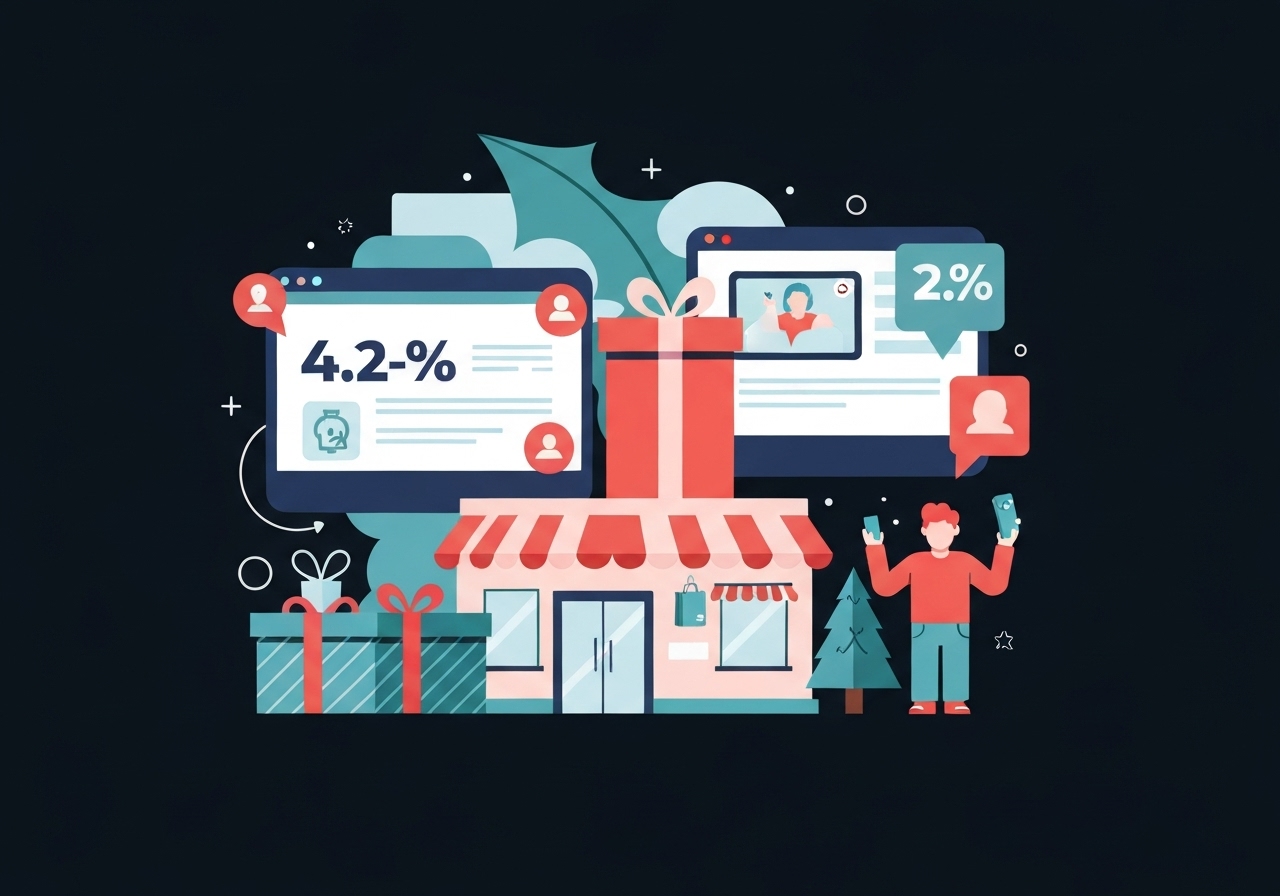
This season U.S. holiday retail payments increased 4.2% year‑over‑year, according to preliminary data from Visa Consulting & Analytics released on Dec. 23, 2025, tracking a seven‑week period beginning Nov. 1. The analysis—based on a subset of Visa network transactions and excluding automotive, gasoline and restaurant spending—shows in‑store payments accounted for 73% of volume while online purchases made up 27%. E‑commerce led growth with a 7.8% rise, and electronics was the top category, up 5.8%. Visa economists noted the headline figures are not adjusted for inflation; inflation‑adjusted, real spending was about 2.2% higher this season.
Key takeaways
- Overall holiday retail payments rose 4.2% YoY in the seven‑week period beginning Nov. 1, per Visa preliminary data.
- E‑commerce grew 7.8% YoY and represented 27% of retail payment volume during the period.
- In‑store payments made up 73% of holiday retail volume, remaining the dominant channel.
- Electronics led category gains with a 5.8% increase; apparel and accessories rose 5.3%.
- General merchandise retailers saw a 3.7% lift, while home improvement spending fell 1% and furniture/home furnishings rose 0.8%.
- Visa estimates real (inflation‑adjusted) spending growth at roughly 2.2% for the season.
- Visa economists point to growing use of artificial intelligence in shoppers’ product search and comparison behavior.
Background
The Visa report arrives amid persistent economic uncertainty for U.S. consumers—softening confidence measures and lingering inflationary pressures have prompted questions about holiday demand. Visa tracked payments across core retail categories but excluded automotive, gasoline and restaurant transactions to focus on merchandise spending patterns. Preliminary figures are unadjusted for inflation, a critical caveat because headline nominal gains can overstate real purchasing volume when prices are rising.
Retailers and economists have watched the holiday window closely since it captures a large share of annual sales for many sectors, and shifts in channel mix (online versus bricks‑and‑mortar) can have outsized effects on logistics, staffing and promotional strategies. The seven‑week Nov. 1 start used by Visa captures early promotions, Black Friday and Cyber Monday activity as well as late‑season buying, providing a broad view of the period most merchants call the holidays.
Main event
Visa’s preliminary dataset shows consumers maintained spending momentum despite softened sentiment in some surveys. The report finds that while most dollars were still spent in physical stores—73% of payments—online growth outpaced in‑store, driving the overall increase. Visa attributes online gains to shoppers seeking convenience and taking advantage of early‑season deals and promotions.
Category detail highlights where dollars flowed. Electronics led with a 5.8% rise, which Visa links to a device refresh cycle amid consumer interest in higher‑performance products tied to the AI era. Apparel and accessories rose 5.3%, and general merchandise retailers, which offer broad assortments and one‑stop experiences, saw a 3.7% gain. Conversely, building materials and garden equipment fell 1%, suggesting consumers deprioritized home projects.
Visa’s principal U.S. economist emphasized that the data are preliminary and not inflation‑adjusted but said a rough inflation adjustment yields about a 2.2% real increase. That gap between nominal and real growth will narrow or widen depending on final Consumer Price Index readings for the period and revisions to price measures.
Analysis & implications
The 4.2% nominal rise signals resilience in consumer demand at a time when many households report caution. If real spending is near the 2.2% estimate, that implies households continued to buy at a pace stronger than many confidence surveys suggested—highlighting a disconnect between sentiment and behavior. For retailers, stronger online growth (7.8%) reinforces the need to balance inventory, fulfillment and promotional investments across channels.
Electronics outperformance matters for several reasons: higher price points lift dollar totals, replacement cycles tied to AI and higher‑performance hardware can accelerate category turnover, and strong electronics sales tend to benefit specialty and big‑box sellers with broad electronics assortments. Apparel gains point to sustained discretionary spending in gift categories, benefiting both specialty brands and department stores.
The home improvement decline (-1%) signals consumers leaned toward gifting and personal tech rather than home projects during the holiday window, a behavior consistent with cyclical substitution when budgets are constrained or when elevated prices make large projects less attractive. For suppliers and installers, this shift could compress an already seasonal revenue stream into months outside the holiday window.
Comparison & data
| Category | YoY change (Visa, preliminary) |
|---|---|
| Overall retail payments | +4.2% |
| E‑commerce | +7.8% |
| In‑store | 73% of volume (share) |
| Electronics | +5.8% |
| Apparel & accessories | +5.3% |
| General merchandise | +3.7% |
| Home improvement | -1.0% |
| Furniture & home furnishings | +0.8% |
The table above summarizes Visa’s reported percentage changes and channel shares for the seven‑week Nov. 1 period. Because these numbers are based on a subset of Visa network data and are not adjusted for inflation, comparisons with other sources (e.g., Census retail sales, CPI‑adjusted measures) may show meaningful differences once official government statistics are released. For strategy teams and investors, the split between nominal and real growth is the key lens for forecasting inventory turns and margin pressures.
Reactions & quotes
Visa economists framed the results as a modest surprise given softer consumer sentiment in some surveys, and highlighted AI’s growing role in how shoppers discover and select products.
“Consumer spending is holding up reasonably well in light of softer consumer confidence and a number of headwinds,”
Michael Brown, principal U.S. economist, Visa
Brown also described the practical influence of AI tools on holiday shopping behavior, noting sizable survey responses indicating adoption for product search and comparison.
“This is the first holiday season where roughly half of surveyed consumers said they would use AI to compare or find products,”
Michael Brown, Visa (paraphrased)
Survey and polling data offered a different angle: the CNBC All‑America Economic Survey found 41% of Americans planned to spend less this holiday season—6 percentage points above last year—suggesting consumers may have shifted budgets across categories even as aggregate payments rose.
Unconfirmed
- The causal degree to which AI adoption directly increased electronics spending is unconfirmed; Visa reports a correlation and survey uptake, not a causal estimate.
- Final real‑growth calculations depend on Consumer Price Index readings for the period; Visa’s ~2.2% inflation‑adjusted estimate may change after official CPI updates.
- The Visa dataset covers a subset of transactions; national totals and category splits could shift when other payment networks and non‑Visa channels are incorporated.
Bottom line
Preliminary Visa data show U.S. holiday retail payments rose 4.2% year‑over‑year, propelled by a strong online performance and outsized electronics gains. The pattern suggests consumers remained willing to spend on gifts and personal tech even as broader sentiment showed caution, reflecting a gap between what people say in surveys and how they behave at checkout.
For retailers, the key takeaways are the continuing importance of e‑commerce capabilities, the outsized role of electronics in driving dollar growth, and the need to monitor inflation adjustments that determine real volume trends. Policymakers and market participants should watch upcoming CPI releases and full government retail reports to confirm how much of the nominal lift translates into real increases in activity.
Sources
- CNBC (news report summarizing Visa preliminary data)
- Visa Consulting & Analytics / Visa (official preliminary retail payments analysis)