
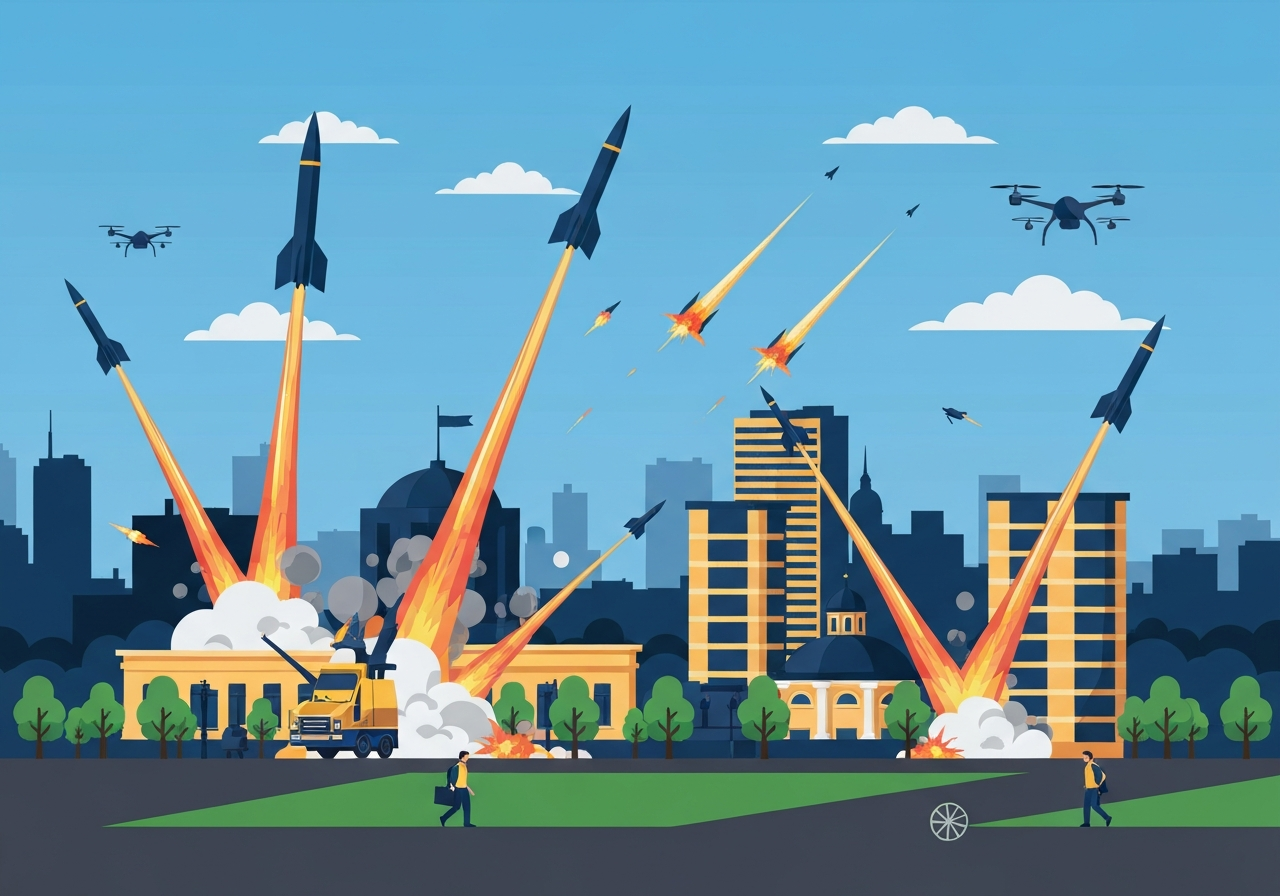
At least 10 people were killed and dozens more wounded when waves of Russian ballistic missiles and unmanned aerial vehicles struck Kyiv on 2 July 2026, hours after President Volodymyr Zelenskyy warned of an imminent “massive” attack. Local officials reported extensive damage across the city, including partial collapse of a multi-storey apartment block and dozens of damaged sites. Kyiv authorities said rescue teams were working to free people trapped in damaged residential buildings while fires and power outages spread. The Russian Defence Ministry said the strikes targeted military and energy infrastructure and several airports.
Key takeaways
- Casualties: Kyiv Mayor Vitali Klitschko reported at least 10 dead; the capital’s military administration gave a separate tally of 56 injured, including two children.
- Damage: Officials said parts of a high-rise apartment building — six floors in one block — partially collapsed after a direct hit and a nine-storey residential building had people trapped.
- Scope: Kyiv reported damage at roughly three dozen locations across central and eastern districts, with fires and power disruptions recorded.
- Weapons used: Ukrainian authorities and journalists reported ballistic missiles and multiple UAV (drone) strikes; air-defence systems were engaged as explosions were heard across the city.
- Timing: The attack occurred hours after President Zelenskyy cut short a visit to Dublin and warned of a planned “massive Russian strike.”
- Russian claim: The Russian Defence Ministry said its long-range, high-precision air-, land- and sea-launched weapons and drones struck military and energy targets and airports in regions including Poltava and Dnipropetrovsk.
- Regional reaction: Poland briefly scrambled fighter jets as a preventive measure; authorities later said there was no airspace violation.
Background
Since Russia’s full-scale invasion in February 2022, Ukrainian cities have repeatedly been targeted by long-range strikes and drone swarms. Kyiv has sustained damage to civilian infrastructure on multiple occasions, and attacks on energy and transport nodes have been a recurring feature of Russia’s campaign. The conflict, now in its fifth year, is widely regarded as Europe’s deadliest since World War II and has produced persistent humanitarian and infrastructure challenges across Ukraine.
Russian forces have periodically launched concentrated waves of missiles and drones intended to degrade Ukraine’s military capacity and strike symbolic or strategic targets. Ukraine and its Western partners have repeatedly warned of escalating long-range strikes, while Moscow frames many operations as retaliation for attacks inside Russia or against military targets. Civil defence systems in Kyiv and other cities have become a daily reality for residents, who routinely shelter in metro stations and basements during alerts.
Main event
The strikes began on the morning of 2 July 2026 with multiple loud explosions reported across central and eastern districts of Kyiv. Journalists on the ground heard more than a dozen blasts while air-raid sirens sounded and air-defence units tracked incoming ballistic missiles. Local emergency services described rescue operations at a nine-storey residential building where people were trapped and at an apartment block that partially collapsed after a direct hit.
Mayor Vitali Klitschko used Telegram to report casualties and widespread damage, citing both fatalities and dozens wounded. Tymur Tkachenko, head of Kyiv’s military administration, gave the figure of 56 injured, including two children, and confirmed damage at roughly three dozen locations. Social media and unofficial Telegram channels showed images and video of residents carrying bedding and essentials into underground stations where people sought shelter.
The Russian Defence Ministry issued a statement saying its forces had conducted a “massive attack” using long-range precision weapons and drones, and claimed strikes on military and energy infrastructure as well as military airfields in several regions. Ukrainian officials denied that strikes were limited to military targets and highlighted civilian casualties and residential damage. Outside Kyiv, Polish authorities briefly scrambled jets; they later reported no violation of Polish airspace.
Analysis & implications
The attack underscores the continued reach of Russia’s long-range strike capabilities and the difficulty Ukraine faces in defending critical infrastructure and densely populated areas. Ballistic missiles and massed drone attacks present different detection and interception challenges: ballistic threats arrive at high velocity and require long-range missile defence, while drone swarms can saturate short-range air defences. Kyiv’s mix of layered air defences and civil shelters reduces—but does not eliminate—civilian harm.
Targeting energy facilities and airports can have outsized effects beyond immediate casualties by disrupting power, heating and logistics, particularly during summer-to-autumn transitions when infrastructure repair is critical. If Russian claims of hitting military and energy nodes are confirmed, the strikes may aim to degrade Ukraine’s sustainment and mobility ahead of possible future operations. For Ukraine’s international partners, repeated strikes on civilian areas will intensify calls for more air-defence deliveries and longer-range capabilities.
Diplomatically, the timing—hours after President Zelenskyy explicitly warned of a looming large-scale strike—adds pressure on Western capitals to weigh further security assistance and diplomatic measures. NATO members bordering Ukraine remain watchful for spillover effects; Poland’s brief jet scramble illustrated regional nervousness even when no airspace breach was recorded. Legally, these incidents will likely be scrutinized by investigators for whether strikes complied with international humanitarian law, particularly where civilian residential blocks were hit.
Comparison & data
| Item | Reported figure |
|---|---|
| Deaths | At least 10 |
| Injured | 56 (official Kyiv military administration) |
| Damaged locations | About three dozen sites in Kyiv |
| Major structural damage | Partial collapse of multiple floors in an apartment block |
| Date | 2 July 2026 |
The table above consolidates official figures reported by Kyiv authorities and on-scene media. Casualty and damage tallies in fast-moving attacks often change as rescue teams complete searches and hospitals update lists; past large-scale strikes in Ukrainian cities have seen numbers revised upward in the days after impact. Monitoring official updates from municipal and national emergency services is essential to track the evolving human and material toll.
Reactions & quotes
Local officials and international observers reacted quickly, balancing operational updates with appeals for civilian caution.
“Kyiv is under attack from ballistic missiles and UAVs,”
Vitali Klitschko, Kyiv Mayor
Klitschko’s message was posted on Telegram amid reports of trapped residents and collapsing residential structures; it served both to inform and to warn citizens to seek shelter.
“We have information about another massive Russian strike… immediately after this conversation, I am returning to Ukraine,”
Volodymyr Zelenskyy, President of Ukraine
Zelenskyy cut short a state visit to Ireland and urged Ukrainians to heed air-raid alerts, framing the strikes as part of a sustained and escalatory campaign against Ukraine.
“A massive attack was carried out on Kyiv and other locations using long-range, high-precision weapons and drones,”
Russian Defence Ministry (Telegram statement)
Moscow described the operation as retaliation for alleged Ukrainian strikes on Russian infrastructure; independent verification of specific target effects remains pending.
Unconfirmed
- Independent verification of Russia’s claim that military and energy facilities and specific airports were struck remains pending; open-source confirmation is limited at this stage.
- The full civilian casualty count may rise as search-and-rescue operations continue and hospitals update records.
- Attribution of intent—whether specific strikes were aimed primarily at military targets or had broader disruptive aims against civilian infrastructure—requires further on-the-ground evidence.
Bottom line
The 2 July strikes on Kyiv highlight the persistent vulnerability of Ukraine’s cities to long-range and multi-domain attacks, even as the country’s air-defence and civil-protection measures mitigate some impacts. Immediate priorities are search-and-rescue, medical care for the wounded and rapid repair of critical infrastructure to prevent cascading humanitarian effects.
Looking ahead, the attack increases pressure on Ukraine’s partners to accelerate deliveries of air-defence systems and complementary capabilities, and it intensifies scrutiny of Russian targeting practices. Observers should watch official casualty updates, independent verification of claimed target damage, and any changes in NATO posture in neighbouring states as authorities assess risk of spillover or further escalation.
Sources
- Al Jazeera — international news outlet reporting on the attack (primary contemporaneous report)