
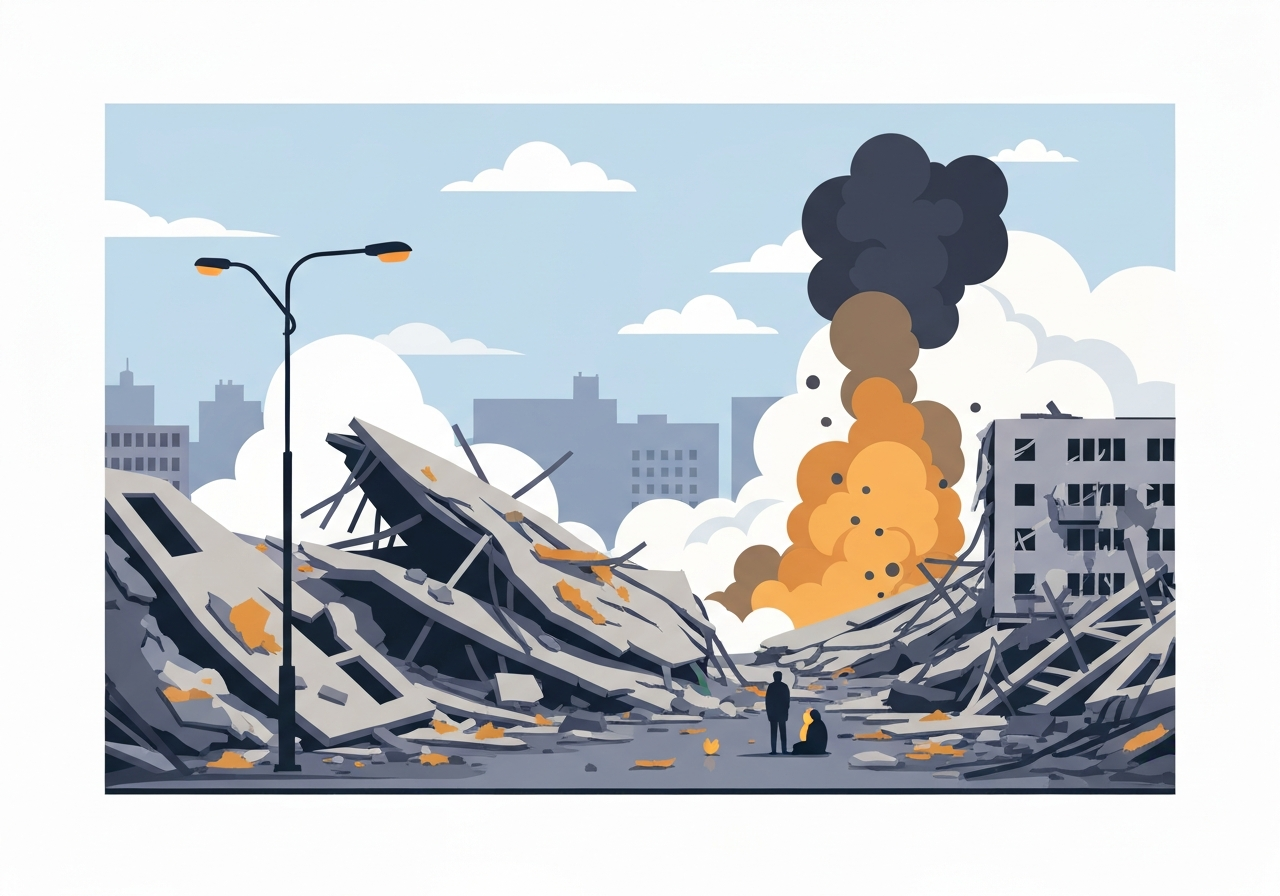
On July 1, 2026, overnight missile, cruise missile and drone strikes against Ukraine’s capital killed at least 17 people and injured scores as explosions shook Kyiv for hours. President Volodymyr Zelenskyy had warned of a possible “massive strike” and cut short a visit to Dublin before the attacks began. Local authorities reported damage across roughly 30 locations, with residential buildings, a hotel and critical infrastructure hit. Emergency teams deployed nearly 500 personnel and about 100 specialized vehicles, including a helicopter, to conduct rescues and extinguish fires.
Key Takeaways
- At least 17 people were killed in Kyiv in the overnight attack on July 1, 2026, according to Ukraine’s Emergency Service.
- Kyiv Mayor Vitali Klitschko reported at least 90 people injured; rescue operations and searches were ongoing into July 2.
- Officials recorded damage in about 30 locations across multiple districts; Interior Minister Ihor Klymenko said 20 residential buildings were damaged.
- Rescue resources mobilized included nearly 500 personnel and roughly 100 specialized vehicles, plus at least one helicopter, per the Emergency Service.
- Districts reporting major impacts included Shevchenkivskyi, Desnianskyi, Holosiivskyi, Darnytskyi, Sviatoshynskyi, Pecherskyi, Solomianskyi, Obolonskyi and Podilskyi.
- Foreign Minister Andrii Sybiha urged allies to accelerate deliveries of air‑defense systems and missiles after what he called a “night of horror.”
- Authorities warned residents to remain in shelters as aftershocks and further strikes remained possible.
Background
Russian strikes on Kyiv have increased in frequency and scale in recent weeks, in parallel with Ukraine’s intensified long‑range drone and missile operations targeting Russian military and energy infrastructure. Those Ukrainian attacks have, Ukraine says, degraded some supply and fuel lines inside Russia; Moscow has repeatedly cited such strikes when justifying its own strikes on Ukrainian cities. International partners have provided air‑defense systems in varying numbers and capabilities, but Kyiv and its diplomats say the volume and sophistication of recent raids have outpaced current defenses.
The July 1 attack occurred as Zelenskyy was traveling to Dublin for the start of Ireland’s six‑month EU presidency; he cut short that trip after alerts of an imminent large‑scale strike. Ukraine’s leadership has used diplomatic channels since then to press allies for expedited air‑defense and interceptor missile deliveries. Domestic officials—from the Kyiv City Military Administration to the national Emergency Service—coordinated evacuation orders, rescue deployments and public alerts across municipal and regional lines.
Main Event
Shortly before midnight on July 1 local time, Kyiv experienced a sequence of explosions as a mix of ballistic missiles, cruise missiles and attack drones struck across the city. The Emergency Service and municipal officials reported fires, building collapses and heavy damage to residential blocks; teams were dispatched to more than 30 impacted sites. In the Shevchenkivskyi district a paramedic was described as in extremely critical condition after a strike damaged a hotel and two five‑story residential buildings.
In Desnianskyi district rescuers responded to a partially destroyed apartment block and reports of people trapped in a damaged nine‑story building. In Darnytskyi, one nine‑story building lost six upper levels after a strike and another five‑story residential block was badly damaged. Fire crews worked on a 16‑story rooftop blaze in Holosiivskyi and on fires in private residences in Sviatoshynskyi, with debris reported to be trapping inhabitants in at least one house.
Kyiv City Military Administration head Tymur Tkachenko said damage was also recorded in Pecherskyi, Solomianskyi, Obolonskyi and Podilskyi districts, and the regional governor, Mykola Kalashnyk, reported impacts across five surrounding districts with three people injured in Bucha. Teams used heavy equipment, cutting tools and aerial assets to search for survivors amid unstable structures; officials cautioned that casualty figures could rise as crews access hard‑hit areas.
Analysis & Implications
The attack underscores persistent gaps in Ukraine’s layered air‑defense posture: a high volume of mixed aerial threats—ballistic missiles, cruise missiles and kamikaze drones—stresses detection, tracking and interception chains. Kyiv’s call for expedited systems reflects both immediate humanitarian urgency and a strategic calculation: sustained strikes that damage housing and civic infrastructure aim to erode civilian morale and complicate governance in the capital. Western partners must weigh speed, capability and sustainability when deciding what and how much to deliver.
Politically, Moscow’s strikes during a period of heightened Ukrainian long‑range activity risk further escalation but also harden Kyiv’s diplomatic arguments for more robust defenses. Foreign Minister Andrii Sybiha’s appeal to allies frames the attack as evidence that supply timelines must accelerate; doing so could change operational calculations on the battlefield by reducing the window in which Russian strikes inflict major civilian harm. Conversely, an influx of long‑range strike systems to Ukraine could prompt additional Russian targeting of more strategic infrastructure.
Economically and socially, repeated damage to residential buildings and utilities will heighten humanitarian needs—temporary shelter, repairs, and psychological services—while complicating reconstruction budgets already strained by prolonged conflict. If strikes continue to hit transport and power nodes, the city could face disruptions that reverberate through supply chains and public services, increasing pressure on municipal and central authorities to secure immediate relief supplies and longer‑term resilience investments.
Comparison & Data
| Metric | Reported figure |
|---|---|
| Deaths | 17 |
| Injured | 90+ |
| Impacted locations | ~30 |
| Residential buildings damaged | 20 (Interior Ministry) |
| Rescue personnel deployed | ~500 |
| Specialized vehicles | ~100 (incl. helicopter) |
The table compiles officials’ near‑term tallies reported by Kyiv municipal authorities and national emergency services on July 1–2, 2026. These figures align with on‑the‑ground descriptions of multiple multi‑story residential blocks damaged or partially collapsed and clustered fires in central and outlying districts. Compared with similar citywide strikes earlier in 2026, the concentration across districts and the mixed weapon types indicate both tactical diversification by attackers and continuing pressure on Kyiv’s civil defense capacity.
Reactions & Quotes
Ukraine’s foreign minister framed the strike as a test for allied resolve and public safety systems, urging faster deliveries of interceptors and air‑defense batteries.
“This was a night of horror for Kyiv. Allies must not delay on air defense and missile supplies.”
Andrii Sybiha, Foreign Minister of Ukraine
President Zelenskyy had issued a public alert before the attacks, warning residents of an anticipated large strike and returning immediately from an international visit once the alert escalated.
“A massive strike is possible—take shelter now.”
Volodymyr Zelenskyy, President of Ukraine
Mayor Vitali Klitschko repeated shelter orders and provided local damage updates, noting rescue crews were working to reach trapped people and that several residential structures were heavily damaged.
“Remain in shelters while our teams work—rescue operations continue across the city.”
Vitali Klitschko, Mayor of Kyiv
Unconfirmed
- Precise final casualty totals may rise: officials warned rescue operations were ongoing and figures remained provisional.
- Attribution of every specific munition to particular Russian units or launch sites has not been publicly confirmed.
- Details on whether particular strikes targeted military versus civilian infrastructure in each damaged building remain under investigation.
Bottom Line
The July 1–2 attacks on Kyiv left significant human and material damage, highlighting both the human cost of a conflict that continues into its successive year and tangible shortfalls in current defensive coverage. Kyiv’s officials and diplomats are using the event to press allies for faster and more capable air‑defense deliveries, framing the need as both humanitarian and strategic.
For observers, the key developments to watch are (1) whether allied states speed up shipments of interceptors and batteries, (2) how Kyiv prioritizes protective measures for civilians and critical infrastructure, and (3) whether Moscow’s campaign of strikes shifts in intensity or targeting as Ukraine’s long‑range capabilities evolve. Those dynamics will shape the city’s immediate recovery needs and the broader course of military and diplomatic responses.