
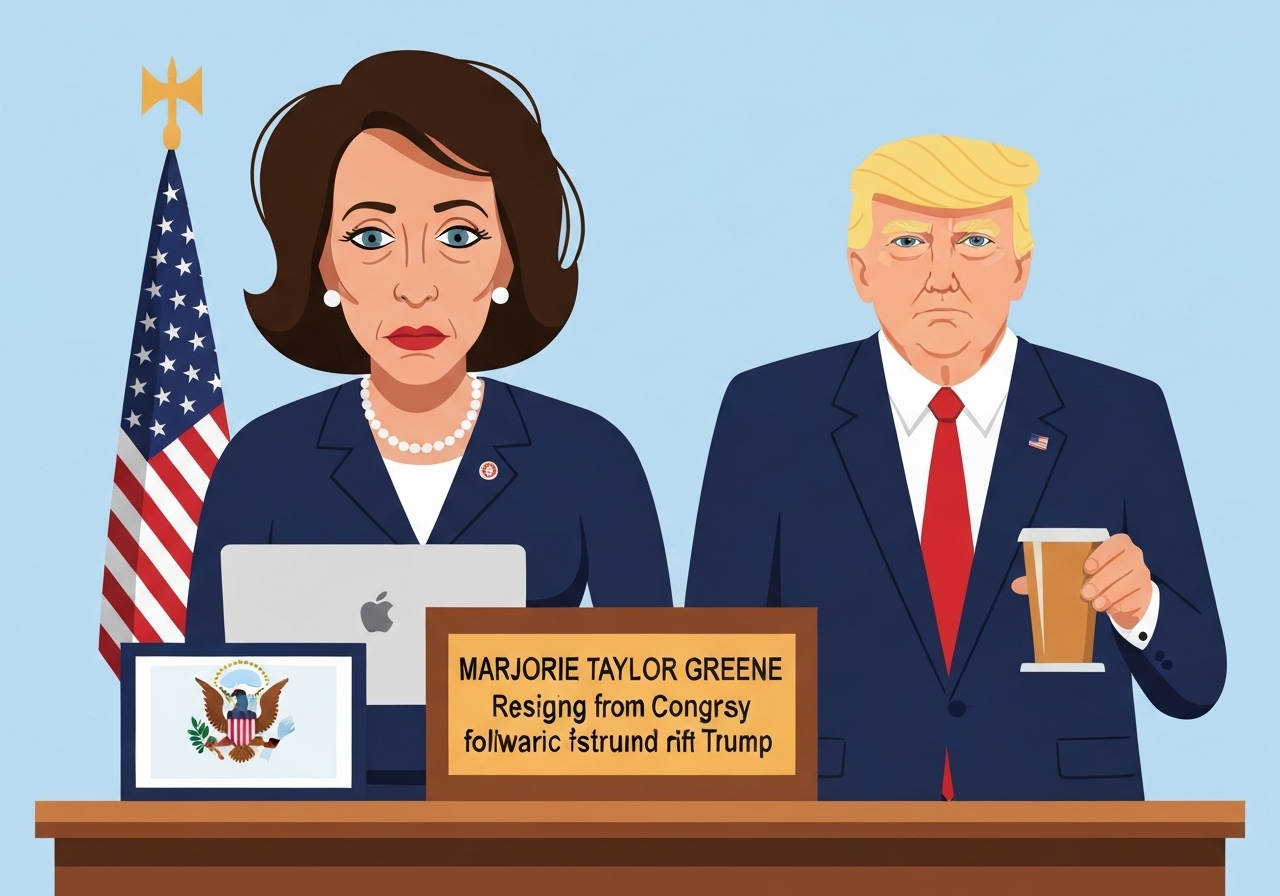
Lead: Representative Marjorie Taylor Greene, a Republican from Georgia first elected in 2020, announced in late November 2025 that she will resign from the U.S. House in January. The announcement followed a highly public split with former President Donald Trump after she pressed for the Justice Department to release documents related to Jeffrey Epstein. Ms. Greene made the declaration in a video and a lengthy social-media post filmed at her Georgia home, and Mr. Trump called her departure “great news for the country” in a phone interview with an ABC reporter. Her early exit is an uncommon midterm resignation not tied to illness or criminal conviction.
Key Takeaways
- Timing: Ms. Greene announced the resignation publicly on Nov. 21–22, 2025 and said she would leave in January (following the announcement period).
- Political context: Elected in 2020, Greene was long aligned with Mr. Trump but has recently broken with him on several issues, culminating in his withdrawal of support.
- Epstein files: Greene helped press the Justice Department to release records related to Jeffrey Epstein; that move intensified her rift with Trump and some party allies.
- Public statement: In her post she wrote that “loyalty should be a two-way street,” framing her exit as connected to broader complaints about party leadership and representation.
- Reaction from Trump: In a phone interview with ABC News, Mr. Trump described her decision as “great news for the country,” signaling his endorsement of her departure.
- Procedural note: Midterm resignations by sitting House members are rare and will trigger seat-vacancy procedures under Georgia and federal practice.
- Electoral implication: A special election or an appointment process (depending on state rules) will determine who fills her seat; the timing will affect House balance in a narrowly divided chamber.
Background
Marjorie Taylor Greene first won election to the House in 2020 as part of a Republican wave that brought a cohort of staunchly pro-Trump candidates to Washington. Over her tenure she cultivated a combative, high-profile image and frequently defended the former president’s agenda, building a national profile among conservative activists and donors. That alignment with Mr. Trump became a defining feature of her brand in Congress, and she leveraged it to both raise funds and secure a vocal base of support in her district.
Across 2024 and 2025, however, Ms. Greene’s relationship with Mr. Trump showed visible strains. The immediate break precipitating her resignation centered on her cooperation with efforts to secure release of Justice Department records linked to Jeffrey Epstein, a convicted sex offender whose network and legal files have been the subject of extensive public scrutiny. Her role in pushing for those disclosures angered key figures in the pro-Trump coalition and led to a public withdrawal of support from Mr. Trump, a significant setback for a member whose profile depended heavily on that alliance.
Main Event
On Friday night in late November 2025, Ms. Greene posted a video from her Georgia home — a setting she used repeatedly in prior messages — in which she announced her intention to resign in January. The video, accompanied by a longer written post, framed her decision as a refusal to be governed by what she described as a narrow party machine. She emphasized representative duties and claimed that being “cast aside” by national party leaders reflected a broader displacement of ordinary Americans.
Her announcement followed days of public friction with Mr. Trump, who had publicly labeled her a “traitor” after she moved to compel the Justice Department to turn over documents tied to Jeffrey Epstein. The clash was unusual because it involved a sitting Congress member actively challenging a dominant former president whose endorsement has been politically consequential for many Republicans. Within hours of her statement, Mr. Trump told an ABC News reporter that her planned resignation was “great news for the country,” underlining the personal and political rupture between them.
Observers noted the visible domestic backdrop of the video — a Christmas tree behind Ms. Greene — and the video’s tone of grievance toward party elites. She framed her resignation as a principled choice tied to conscience and constituency service rather than a tactical retreat. Yet the timing and the high-profile public fall-out with Mr. Trump make it likely to reverberate through Republican politics and the composition of House committees on which she has served.
Analysis & Implications
Politically, the resignation removes a polarizing figure from the House floor and could recalibrate dynamics within the Republican Conference. Greene’s departure may reduce some of the most confrontational rhetoric in the chamber, but it also creates an opening for a successor who might run to her right or to her center depending on the special election dynamics and primary field. In a closely divided House, even a single seat change can affect committee assignments and legislative margins on narrow votes.
The rupture highlights the continued influence of Mr. Trump over Republican politics; his public disavowal of a former ally demonstrates that loyalty to him remains a decisive factor for many voters and officeholders. At the same time, Greene’s move to force the release of Epstein-related materials indicates growing pressure from some quarters — including lawmakers and media actors — for greater transparency around high-profile criminal investigations, even when that pressure conflicts with party unity.
From a governance perspective, the resignation raises questions about institutional stability and representation for Greene’s district. Constituents will temporarily lack full representation until a successor is chosen, and committee seats she leaves vacant may be redistributed, affecting oversight and legislative momentum. Strategically, party leaders in Georgia will have to weigh the short-term benefit of recruiting an electable candidate against the long-term ideological signals sent by endorsing or distancing themselves from Greene’s brand of politics.
Comparison & Data
| Year | Notable Midterm House Resignation | Context |
|---|---|---|
| 2025 | Marjorie Taylor Greene | Resignation after break with former President and dispute over DOJ documents |
| 2021 | Representative (example) | Resigned for personal/health reasons (illustrative) |
The pattern of midterm resignations is sparse: members typically leave due to health, appointment to other posts, or scandal. Greene’s announced departure, framed as political and principled, is therefore atypical. The table above is intended to show that the 2025 instance differs in motive from the more common resignation causes in recent cycles.
Reactions & Quotes
“Loyalty should be a two-way street, and we should be able to vote our conscience and represent our district’s interest.”
Marjorie Taylor Greene (social post/video)
Ms. Greene used that line in her written post accompanying the video, presenting her exit as a matter of principle rather than purely political calculation.
“This is great news for the country.”
Donald J. Trump (phone interview with ABC News)
Mr. Trump’s remark, made during a phone interview with an ABC reporter, signaled that the split was definitive and that he preferred her departure to continued dissension within GOP ranks.
Unconfirmed
- Whether Ms. Greene’s resignation was negotiated behind the scenes with national party figures or carried out unilaterally by her remains unclear.
- The precise schedule for any special election in her district had not been announced at the time of her statement.
Bottom Line
Marjorie Taylor Greene’s announced January departure caps a rapid unravelling of a once-solid alliance with former President Trump and underscores the fragility of personalistic political coalitions. Her exit reduces the immediate visibility of one of the House’s most combative lawmakers, but it also opens a contested vacancy that will test local and national Republican organizing ahead of forthcoming contests.
For constituents and political observers, the near-term story will be the mechanics and timing of the vacancy and the identity of any successor; for the broader GOP, the episode is a signal about the limits of dissent from the dominant party figure and the consequences of high-profile pressure campaigns over sensitive investigatory materials.
Sources
- The New York Times — Media reporting and chronology of the announcement (press).
- ABC News — Media outlet referenced for the phone interview with former President Trump (press).