
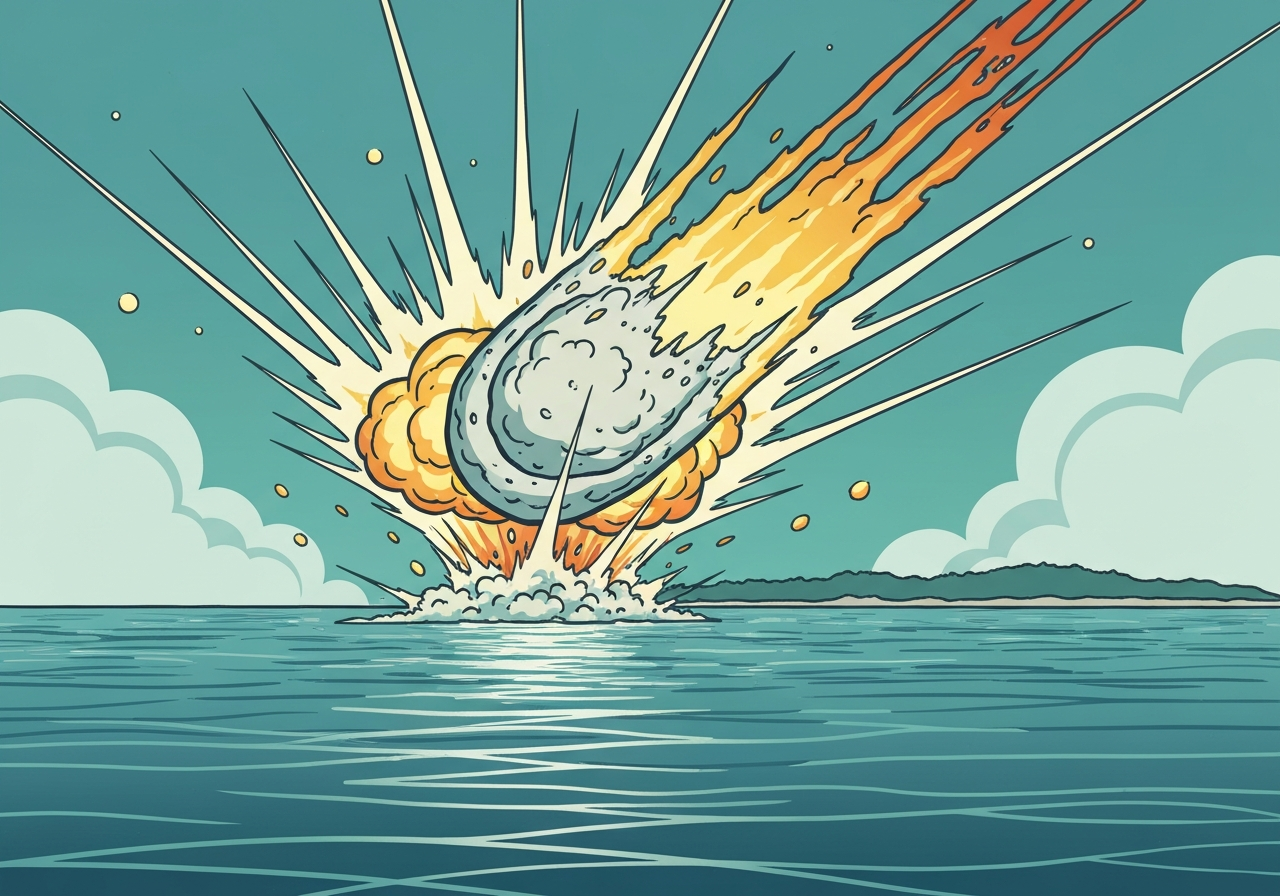
On Saturday afternoon around 2:11 p.m. Eastern Time, a meteor exploded over the waters off Massachusetts, producing a loud boom heard across the region and a bright daytime fireball seen by dozens. Preliminary reports to the American Meteor Society and satellite data from NOAA helped reconstruct the event; NASA estimated the breakup released energy equivalent to about 300 tons of TNT. Officials say the meteor fragmented at roughly 40 miles altitude over northeast Massachusetts and southeast New Hampshire, and pieces fell into Cape Cod Bay where the water depth at the fall site is about 34 meters. The blast rattled windows, startled animals and prompted calls to local newsrooms from Boston to Ipswich and as far as Johnston, Rhode Island.
Key Takeaways
- The explosion was heard at approximately 2:11 p.m. ET on Saturday and was accompanied by a visible fireball reported across the Northeast.
- NASA estimates the energy released at breakup was about 300 tons of TNT and places fragmentation at ~40 miles altitude over NE Massachusetts/SE New Hampshire.
- NOAA satellite lightning data showed a signature consistent with a meteor and suggests atmospheric entry over the South Shore near Boston.
- NASA reported a daytime bolide and located the fall in the middle of Cape Cod Bay; water depth at the site is 34 meters.
- Dozens of eyewitness reports submitted to the American Meteor Society helped triangulate the path; sightings spanned multiple states around 2 p.m.
- Experts note most meteors disintegrate harmlessly; larger bolides can generate audible sonic booms tens of miles away.
- Related 2026 events: a March bolide over Ohio created a sonic boom across multiple states; a separate March event in Texas scattered meteorites around Houston.
Background
Meteors routinely strike Earth’s atmosphere; most are tiny and vaporize high above ground. When larger fragments survive deeper descent, they can produce bright fireballs and generate shock waves similar to a supersonic aircraft. Agencies that monitor atmospheric and near-Earth events—NOAA, NASA, the U.S. Geological Survey and citizen-science networks such as the American Meteor Society—combine eyewitness reports, infrasound, satellite and lightning-detection data to reconstruct entry paths.
Regional search and recovery are complicated when falls occur over water. Oceans and bays cover most of Earth, so many meteorites land in water or remote areas where recovery is unlikely. Still, eyewitness video, timing and multi-angle reports provide scientists with estimates of speed, angle of entry and luminous duration—data that help classify the object and its possible origin in the solar system.
Main Event
Shortly after reports began arriving at local newsrooms, NOAA satellite lightning-detection products displayed a high-energy signature near the South Shore of Boston at the same time eyewitnesses described the boom. Local meteorologists and citizen observers captured video and audio that showed a bright fireball and an abrupt, powerful sound wave that propagated across the region. The American Meteor Society logged dozens of independent reports from witnesses across the Northeast around 2 p.m., enabling triangulation of the trajectory.
NASA issued a statement saying the meteor fragmented at an altitude near 40 miles over northeast Massachusetts and southeast New Hampshire, and estimated the released energy was equivalent to about 300 tons of TNT—sufficient to account for the loud shock. Later, NASA identified the fall area in the middle of Cape Cod Bay; the agency described the water depth at the site as 34 meters and used the informal term “fishy squisher” to note a water impact.
On the ground, residents reported rattled windows and tremors in houses; some calls to local stations came from towns including Boston, Ipswich and as far as Johnston, Rhode Island. Emergency-management offices reported no injuries or structural damage tied to the event. Scientists emphasized that while the event was dramatic, there is no evidence of any broader impact threat to populated areas.
Analysis & Implications
The estimated 300-ton TNT-equivalent energy release places this bolide among the stronger daytime fireballs observed in recent years, though still far below catastrophic asteroid-impact levels. The altitude of fragmentation—around 40 miles—meant most kinetic energy was dissipated high in the atmosphere, which limited ground damage but allowed a pronounced sonic boom to reach the surface across tens of miles. For atmospheric scientists, combined satellite and eyewitness data sharpen models of how energy is deposited during breakup and how shock waves propagate.
For recovery teams, the fall into 34-meter-deep water in Cape Cod Bay significantly reduces the chance of retrieving intact meteorites. Even when fragments land in shallow water, currents and bottom conditions complicate searches; in deeper or murkier waters the probability of successful recovery drops sharply. Nevertheless, photographic and video records are valuable: brightness, duration and track angle yield good constraints on mass, speed and possible parent body.
Operationally, the event underscores the value of integrating civilian reports with federal remote-sensing products. NOAA lightning and satellite products, NASA analyses and AMS witness logs together deliver a faster, more geographically detailed picture than any single source. That hybrid monitoring approach helps emergency managers distinguish meteor-generated sonic booms from earthquakes or man-made blasts, improving public communication during similar future events.
Comparison & Data
| Event | Date (2026) | Estimated energy | Location / Outcome |
|---|---|---|---|
| Massachusetts bolide | Saturday (~2:11 p.m. ET) | ~300 tons TNT | Fragmentation at ~40 miles; fall in middle of Cape Cod Bay (34 m depth) |
| Ohio bolide | March (2026) | Not publicly estimated | Daytime explosion and sonic boom heard across multiple states |
| Texas fireball | March (2026) | Not publicly estimated | Shock wave; meteorites scattered around Houston, one fragment reportedly broke a roof |
The table places the Massachusetts event in context with two earlier 2026 fireballs. Unlike the Ohio and Texas events—where public energy estimates were not broadly published—the NASA estimate for the Cape Cod Bay bolide gives scientists a more precise energy benchmark to test atmospheric-fragmentation models. Even when numeric energy estimates are absent, reports of sonic booms and recovered meteorites provide complementary constraints for researchers.
Reactions & Quotes
Officials and experts gave measured, explanatory statements as the event unfolded.
The meteor appears to have fragmented at an altitude of 40 miles over northeast MA and southeast NH. The energy released at breakup is estimated to be equivalent to about 300 tons of TNT, which accounts for the loud noise.
NASA (official statement)
NASA’s short release framed the event as a daytime bolide with a water fall site in Cape Cod Bay and provided the energy and altitude figures that explain the audible boom.
What you hear is the air compression of it moving really fast, creating those pressure waves, and occasionally sometimes you’re also hearing the stone itself break apart from the forces that it’s going through.
Shauna Edson, Smithsonian National Air and Space Museum (astronomy educator)
Edson’s explanation to local media clarified why meteors sometimes generate loud booms similar to supersonic aircraft, highlighting air compression and fragmentation as the physical cause.
Unlike earthquakes which occur at a discrete location in the earth, sonic boom events occur along a linear path in the atmosphere.
U.S. Geological Survey (technical guidance)
The USGS emphasis helps distinguish seismic events from atmospheric shock waves, a crucial distinction for emergency response agencies assessing public reports of ground shaking and explosive sounds.
Unconfirmed
- Exact GPS coordinates of individual meteorite fragments in Cape Cod Bay are not publicly released and recovery teams have not reported recovered pieces.
- Detailed mass and pre-entry speed estimates for the object have not been published beyond NASA’s energy-equivalent figure; the object’s parent body (asteroid family) remains undetermined.
- The complete, peer-reviewed analysis integrating all eyewitness, satellite and infrasound data has not yet been released.
Bottom Line
The Massachusetts bolide was a high-energy atmospheric breakup whose sonic boom and fireball were widely observed and recorded; NASA’s 300-ton TNT estimate and a fragmentation altitude near 40 miles explain the intense but non-destructive ground effects. Because the fall occurred in Cape Cod Bay at about 34 meters depth, recovery of fragments is unlikely, but the event still yields valuable observational data for atmospheric-entry science.
For the public, the incident is a reminder that most meteors pose no risk to people or infrastructure, even when they produce dramatic sights and sounds. Agencies and networks that combine eyewitness logs, satellite products and scientific analysis will continue to refine our understanding of such events and improve communication when they occur.
Sources
- CBS Boston — Local news report and eyewitness aggregation (local/press)
- NASA — Official agency statements and bolide analysis (federal agency)
- NOAA — Satellite and lightning-detection data (federal agency)
- American Meteor Society — Citizen-science sighting reports (scientific/citizen network)
- U.S. Geological Survey — Guidance on atmospheric sonic events vs. seismic events (federal agency)
- Smithsonian National Air and Space Museum — Expert commentary on meteors and sonic booms (museum/educational)