
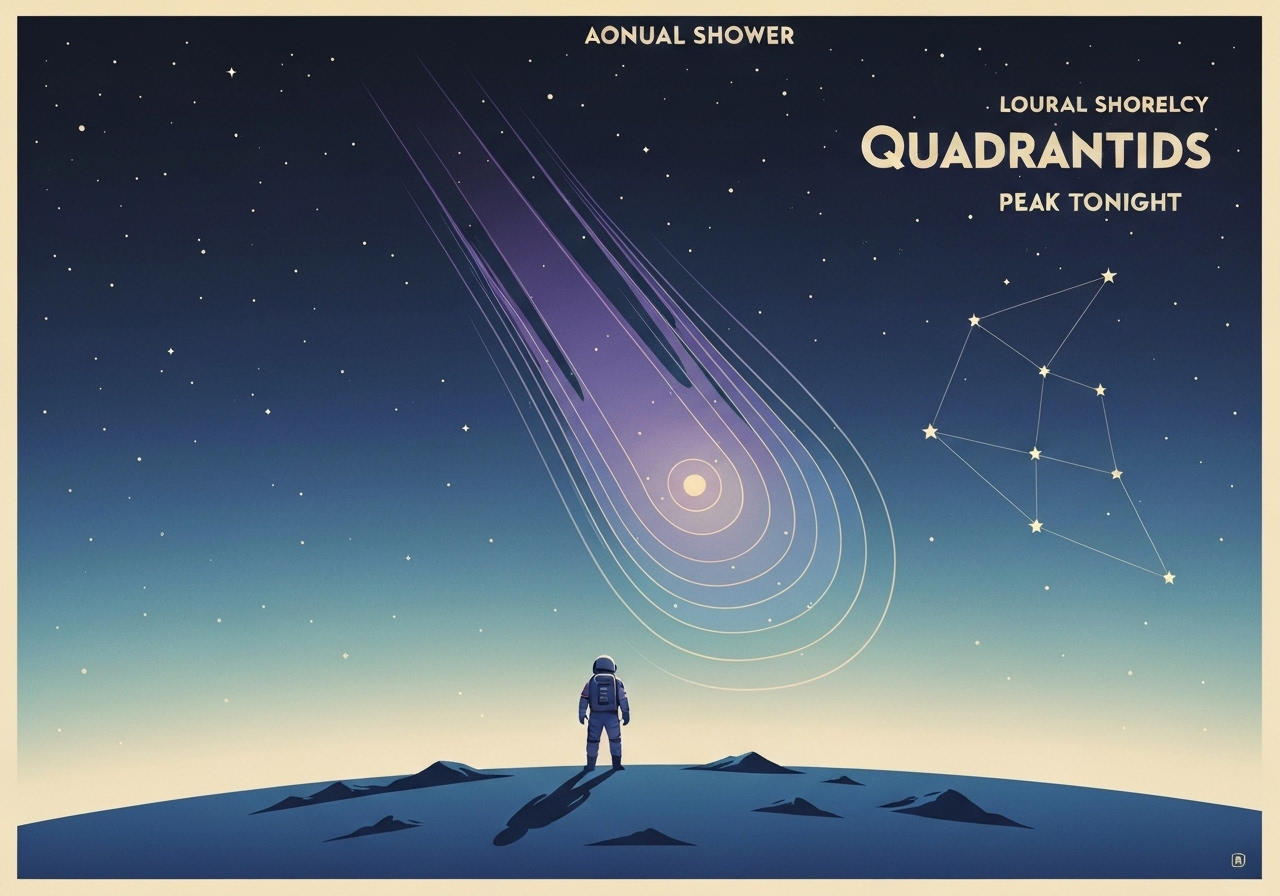
Tonight’s pre-dawn sky brings the first major meteor display of 2026 as the Quadrantid shower reaches its brief peak before dawn on Jan. 4, 2026. Observers across the Northern Hemisphere — especially locations north of 51° latitude — can expect the radiant to climb from the northern horizon into the late pre-dawn sky, but visibility will be hampered by a bright full “Wolf Moon.” Because the Quadrantids produce a short, intense peak lasting roughly six hours, only the brightest meteors and occasional fireballs are likely to stand out against moonlight. Casual skywatchers and photographers should still be able to catch striking streaks if they plan for moonlight and aim for dark, open horizons.
Key Takeaways
- The Quadrantid meteor shower is active from Dec. 26, 2025, through Jan. 16, 2026, with a narrow peak centered in the hours before dawn on .
- The shower’s brief peak — roughly six hours — results from Earth crossing a thin debris stream left by asteroid 2003 EH1, yielding intense but short-lived rates.
- Radiant location: near the handle of the Big Dipper in the constellation Ursa Major; best viewing is north of 51° latitude where the radiant stays high.
- Moon phase: a full “Wolf Moon” on the peak night will brighten the sky and significantly reduce visibility of faint meteors.
- Only the brightest Quadrantids and occasional fireballs are likely to be visible to the naked eye under full-moon conditions.
- Photographers should use wide-field, long-exposure techniques and shield their lenses from direct moon glare to maximize capture chances.
Background
Meteors are produced when small particles from comets or asteroids hit Earth’s atmosphere and burn up from friction. The Quadrantid shower is linked to the object 2003 EH1, which is generally classified as a near-Earth asteroid but is believed to be the remnant of a cometary body; the debris left along its orbit causes the annual display. Unlike broad showers that deliver steady rates over many hours, the Quadrantids are notable for their compact and intense peak, which can produce a high apparent hourly rate for only a short window.
The shower’s name comes from Quadrans Muralis, a constellation coined by Jérôme Lalande in 1795 and located near the Big Dipper’s handle. Quadrans Muralis did not survive the 20th-century standardization of constellations by the International Astronomical Union, but the historical name persists in labelling the meteor shower. Because the radiant lies in Ursa Major, a circumpolar constellation for many northern observers, parts of the Northern Hemisphere can see the radiant above the horizon for most or all of the night.
Main Event
The Quadrantids’ peak occurs in the narrow interval before local dawn on Jan. 4, so the best watching window is the hours just before sunrise. The radiant will be low on the northern horizon after sunset and climb higher as the night progresses, reaching its most favorable altitude in the pre-dawn hours. Observers should lie back with an unobstructed view of the sky rather than stare directly at the radiant; meteors seen a few tens of degrees away from the radiant tend to show longer, more photogenic trails.
Moonlight from the full Wolf Moon will raise sky brightness across the visible sky, washing out many fainter meteors and reducing overall naked-eye counts. Under these conditions, bright fireballs — meteors that outshine Venus or the Moon — remain the most likely spectacle. For photographers, shielding the camera from direct moonlight, using low ISO with long exposures for star fields, and employing continuous image capture increase the odds of recording a useful meteor frame.
Expect local rates to vary widely. In perfect, dark-sky conditions the Quadrantids can produce dozens to over a hundred meteors per hour at peak, but with a full Moon visible those numbers can drop to a handful of bright events per hour over many locations. Northern-latitude observers will generally have a visibility advantage because the radiant spends more time high above the horizon.
Analysis & Implications
From a scientific perspective, the Quadrantids are valuable because their short, sharp peak allows researchers to pinpoint the structure of a narrow debris stream. Monitoring optics and radar during the peak can help map particle size distributions and velocity, improving models of how parent bodies like 2003 EH1 evolve. However, moonlit conditions complicate optical surveys by raising the sky background and reducing contrast for faint meteors; radar and all-sky camera networks can partially compensate by detecting ionization and brighter events independent of visual conditions.
For the public, the full Wolf Moon turns an otherwise promising display into one that favors bright meteors and fireballs. That changes the experience: rather than a steady sprinkling of faint streaks, watchers should be prepared to spot occasional dramatic flashes. Amateur and professional photographers face trade-offs: moonlit landscapes can make for attractive foregrounds in meteor images, but they also require exposure adjustments and careful composition to avoid washed-out skies.
Regionally, skywatchers in northern Europe, Canada, Alaska and similar latitudes have the best geometric advantage because the radiant climbs higher and remains above the horizon longer. Observers in mid- to low-northern latitudes can still see meteors, but rates will be lower and many events obscured by moonlight. Since the Quadrantids come from debris associated with an asteroid-like body, they tend to produce relatively fast meteors; the occasional slow, bright fireball is of interest to meteorite recovery efforts, although actual recoveries are rare.
Comparison & Data
| Shower | Active | Typical Peak ZHR | Peak Duration | Parent Body |
|---|---|---|---|---|
| Quadrantids | Dec 26 – Jan 16 | ~100–120 | ~6 hours | 2003 EH1 (asteroid/dead comet) |
| Geminids | Dec 4 – Dec 17 | ~120 | ~24+ hours | 3200 Phaethon (asteroid) |
| Perseids | Jul 17 – Aug 24 | ~100 | several days | 109P/Swift–Tuttle (comet) |
The table highlights why the Quadrantids feel different from other major showers: a comparable theoretical zenithal hourly rate (ZHR) but a far narrower peak. That compressed timing concentrates activity but also increases sensitivity to precise timing and local observing conditions. With the full Moon present, effective visual rates will be much lower than the theoretical ZHR unless an observer is fortunate enough to witness a bright fireball.
Reactions & Quotes
“The Quadrantids deliver a sharp, short-lived peak each early January — timing is everything for catching their brightest members.”
EarthSky (astronomy outreach)
“Radiant placement near the Big Dipper and the shower’s short duration make pre-dawn observations essential; moonlight will suppress the fainter meteors.”
NASA (space agency)
“If you photograph a Quadrantid, send your best frames to our readers — moonlit fireballs make striking images and help document the event.”
Space.com (news outlet)
Unconfirmed
- Exact visible meteor counts on Jan. 4, 2026: predicted hourly rates are model-based; actual naked-eye counts will vary by local sky brightness and cloud cover.
- Whether 2003 EH1 is a true extinct comet or an asteroid fragment remains debated in research literature; details of its recent fragmentation history are not fully settled.
- Predictions that a specific region will see fireballs are inherently uncertain; fireball occurrences are sporadic and localized.
Bottom Line
The Quadrantid meteor shower offers one of the year’s most intense but brief displays, peaking in the narrow pre-dawn window on Jan. 4, 2026. A full Wolf Moon will dim most faint meteors, so tonight’s spectacle will favor bright fireballs for most observers. Planning matters: choose a dark, northern-facing site, allow eyes to adapt, and use wide-field, continuous imaging if you want to capture rare bright streaks.
For researchers, the event remains an opportunity to study a compact debris stream despite moonlight challenges; for the public, the best strategy is patience and preparation — even a few bright meteors against a moonlit landscape can make a memorable start to the new year.